


Targeting hypoxic cells through the DNA damage response
- PMID: 20876254
- PMCID: PMC3000384
- DOI: 10.1158/1078-0432.CCR-10-0286
Targeting hypoxic cells through the DNA damage response
Abstract
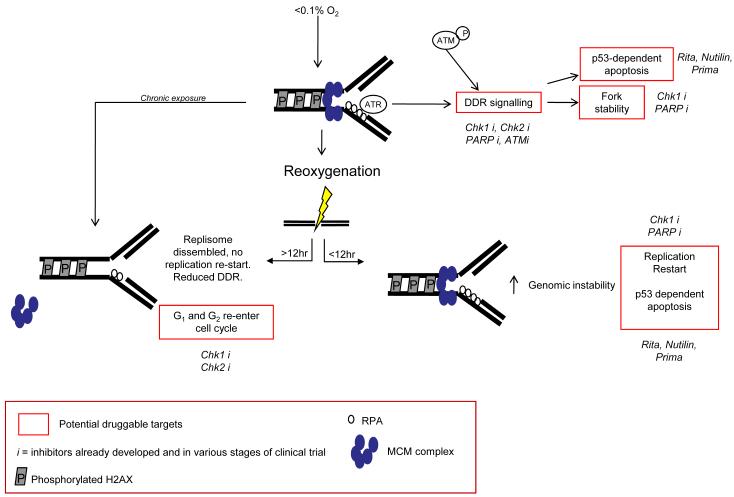
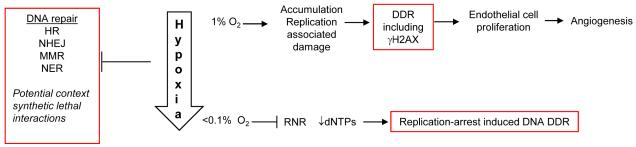
Exposure to hypoxia-induced replication arrest initiates a DNA damage response that includes both ATR- and ATM-mediated signaling. DNA fiber analysis was used to show that these conditions lead to a replication arrest during both the initiation and elongation phases, and that this correlated with decreased levels of nucleotides. The DNA damage response induced by hypoxia is distinct from the classical pathways induced by damaging agents, primarily due to the lack of detectable DNA damage, but also due to the coincident repression of DNA repair in hypoxic conditions. The principle aims of the hypoxia-induced DNA damage response seem to be the induction of p53-dependent apoptosis or the preservation of replication fork integrity. The latter is of particular importance should reoxygenation occur. Tumor reoxygenation occurs as a result of spontaneous changes in blood flow and also therapy. Cells experiencing hypoxia and/or reoxygenation are, therefore, sensitive to loss or inhibition of components of the DNA damage response, including Chk1, ATM, ATR, and poly(ADP-ribose) polymerase (PARP). In addition, restoration of hypoxia-induced p53-mediated signaling may well be effective in the targeting of hypoxic cells. The DNA damage response is also induced in endothelial cells at moderate levels of hypoxia, which do not induce replication arrest. In this situation, phosphorylation of H2AX has been shown to be required for proliferation and angiogenesis and is, therefore, an attractive potential therapeutic target.
©2010 AACR.
Figures
References
-
- Hockel M, Schlenger K, Mitze M, Schaffer U, Vaupel P. Hypoxia and Radiation Response in Human Tumors. Semin Radiat Oncol. 1996;6:3–9. - PubMed
-
- Brown JM, Giaccia AJ. The unique physiology of solid tumors: opportunities (and problems) for cancer therapy. Cancer Res. 1998;58:1408–16. - PubMed
-
- Hockel M, Schlenger K, Aral B, Mitze M, Schaffer U, Vaupel P. Association between tumor hypoxia and malignant progression in advanced cancer of the uterine cervix. Cancer Res. 1996;56:4509–15. - PubMed
-
- Brizel DM, Scully SP, Harrelson JM, et al. Tumor oxygenation predicts for the likelihood of distant metastases in human soft tissue sarcoma. Cancer Res. 1996;56:941–3. - PubMed
-
- Erler JT, Bennewith KL, Nicolau M, et al. Lysyl oxidase is essential for hypoxia-induced metastasis. Nature. 2006;440:1222–6. - PubMed
Publication types
MeSH terms
Substances
Grants and funding
LinkOut - more resources
Full Text Sources
Research Materials
Miscellaneous
