. 2010 Oct 1;70(19):7411-20.
doi: 10.1158/0008-5472.CAN-10-1438. Epub 2010 Sep 28.

Activation-induced cytidine deaminase accelerates clonal evolution in BCR-ABL1-driven B-cell lineage acute lymphoblastic leukemia

Affiliations

Activation-induced cytidine deaminase accelerates clonal evolution in BCR-ABL1-driven B-cell lineage acute lymphoblastic leukemia

Tanja Andrea Gruber et al. Cancer Res. .

Abstract

Activation-induced cytidine deaminase (AID) is required for somatic hypermutation and immunoglobulin (Ig) class switch recombination in germinal center (GC) B cells. Occasionally, AID can target non-Ig genes and thereby promote GC B-cell lymphomagenesis. We recently showed that the oncogenic BCR-ABL1 kinase induces aberrant expression of AID in pre-B acute lymphoblastic leukemia (ALL) and lymphoid chronic myelogenous leukemia blast crisis. To elucidate the biological significance of aberrant AID expression, we studied loss of AID function in a murine model of BCR-ABL1 ALL. Mice transplanted with BCR-ABL1-transduced AID(-/-) bone marrow had prolonged survival compared with mice transplanted with leukemia cells generated from AID(+/+) bone marrow. Consistent with a causative role of AID in genetic instability, AID(-/-) leukemia had a lower frequency of amplifications and deletions and a lower frequency of mutations in non-Ig genes, including Pax5 and Rhoh compared with AID(+/+) leukemias. AID(-/-) and AID(+/+) ALL cells showed a markedly distinct gene expression pattern, and AID(-/-) ALL cells failed to downregulate a number of tumor-suppressor genes including Rhoh, Cdkn1a (p21), and Blnk (SLP65). We conclude that AID accelerates clonal evolution in BCR-ABL1 ALL by enhancing genetic instability and aberrant somatic hypermutation, and by negative regulation of tumor-suppressor genes.


Figures

Figure 1
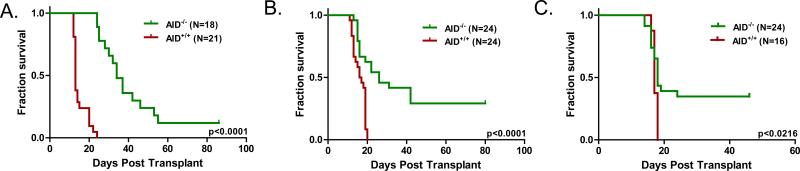
Figure 1. AID-deficiency in acute lymphoblastic leukemia confers prolonged survival in primary and secondary transplants
A. AID+/+ or AID-/- bone marrow was transduced with the BCR-ABL1 oncogene in vitro. Following transduction, 106 cells were injected into lethally irradiated Balb/c wild type recipients (curve compiled from 2 experiments). B. Kaplan-Meier overall survival of secondary transplantation. Leukemia cells from the spleen and peripheral blood of diseased mice sacrificed in primary transplant experiments were harvested, CD19 purified, and grown in vitro for one week. Following expansion, 104 cells from 6 different AID+/+ mice and 10 different AID-/- mice (~two recipient mice per clone) were injected into lethally irradiated Balb/c wild type recipients (curve compiled from 4 experiments). C. Kaplan-Meier overall survival of tertiary transplantation. 104 cells leukemia cells from secondary transplants were were injected into lethally irradiated Balb/c wild type recipients (curve compiled from 2 experiments). Statistical analysis of the serial transplantation experiments is presented in Table 1.
Figure 2
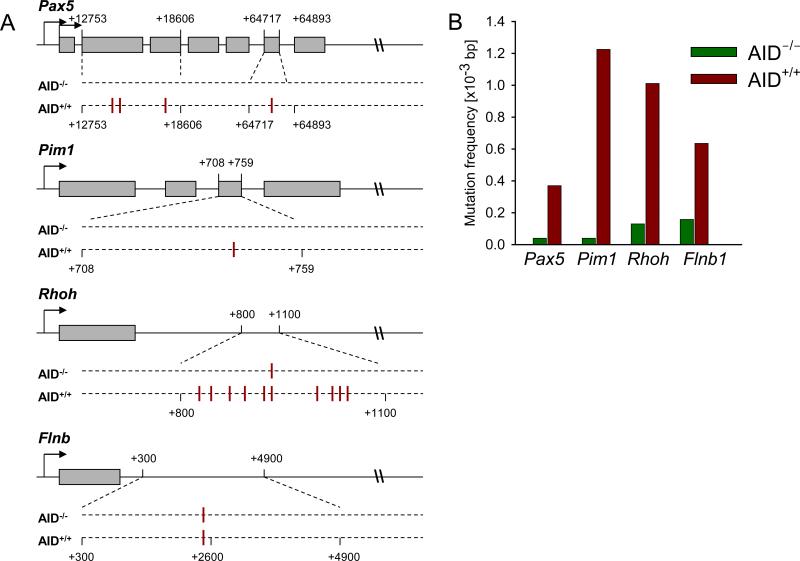
Figure 2. Mutation analysis of Rhoh, Pax5, Pim1, and Flnb
In (A), genomic loci are shown with exon (boxes) and introns (lines), and are not drawn to scale. Location of mutations in both cohorts of mice are shown below loci with their positions. In AID+/+ leukemia, 4 clones had 4 separate mutations in the Pax5 gene, 2 clones had the same mutation in the Pim1 gene, and 8 clones had 10 different mutations in the Rhoh gene (2 clones had 2 mutations each, all of which were unique. In (B), The overall mutation frequencies [mutations/1,000 sequenced basepairs] are indicated for AID+/+ (red bars) and AID-/- (green bars) leukemia cells for Pax5, Pim1, Rhoh and Flnb genes.
Figure 3
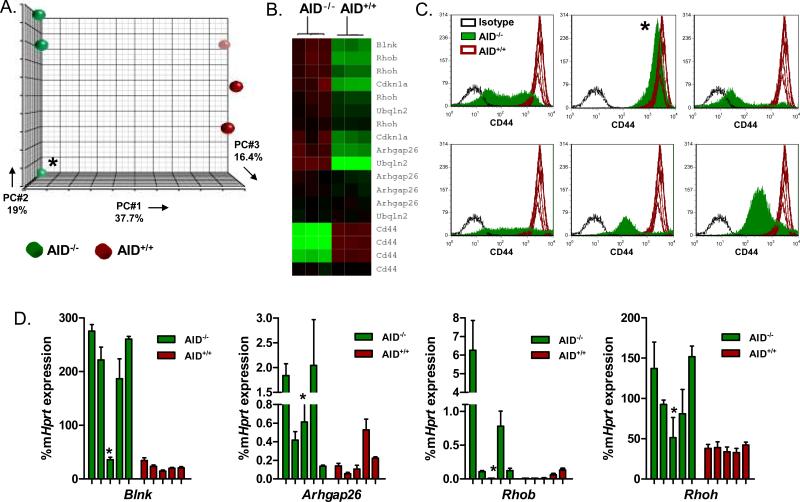
Figure 3. Differential gene expression patterns in AID-/- and AID+/+ leukemia
A. Principle component analysis. RNA was extracted from leukemia cells harvested from 6 mice; 3 mice with AID-/- leukemia and 3 mice with AID+/+ leukemia. The AID-/- outlier is designated by an asterisk in subsequent figures. Samples were hybridized to Affymetrix mouse genome 430A 2.0 arrays. 2,365 genes were found to be significantly differentially expressed (FDR 0.05, p<0.0026). B. Heatmap of genes chosen for validation by quantitative RT-PCR. C. CD44 expression in AID+/+ and AID-/- leukemia. 7 different AID+/+ samples comprise the wild type leukemia histogram (red lines). Shown are 6 different AID-/- leukemia samples in comparison (solid green overlay) and their isotype controls (dashed black line). D. Quantitative real-time RT-PCR of select differentially expressed genes. Data is shown as a percentage of murine Hprt gene expression. For each gene, 5 AID-/- samples and 5 AID+/+ samples from different mice were analyzed.
Figure 4
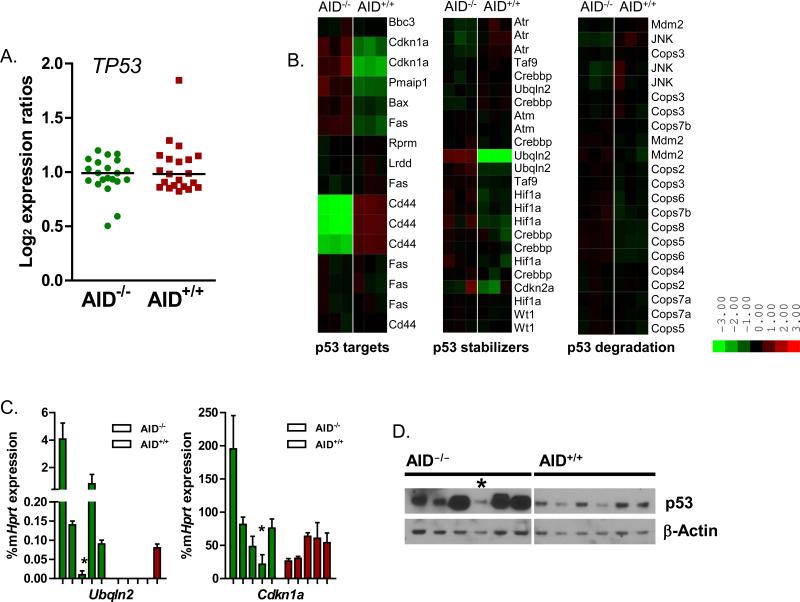
Figure 4. AID-/- leukemia cells fail to downregulate p53
A. Shown is the log2 expression ratio for the seven different p53 probe sets in the mouse genome 430 2.0 array for each of the AID+/+ samples (N=3) and AID-/- samples (N=3). B. Heat map of downstream p53 targets, molecules involved in the p53 stabilization and p53 degradation. C. Confirmatory quantitative RT-PCR of Ubqln2 and Cdkn1a mRNA levels in AID-/- mice (percentage of Hprt mRNA levels). For each gene, 5 AID-/- samples and 5 AID+/+ samples from different mice were analyzed. D. Western blot analysis of p53 protein levels. Protein from 6 AID-/- leukemia samples and 6 AID+/+ leukemia samples was extracted and evaluated for p53 expression. The AID-/- outlier by PCA component analysis is designated by an asterisk.
Figure 5
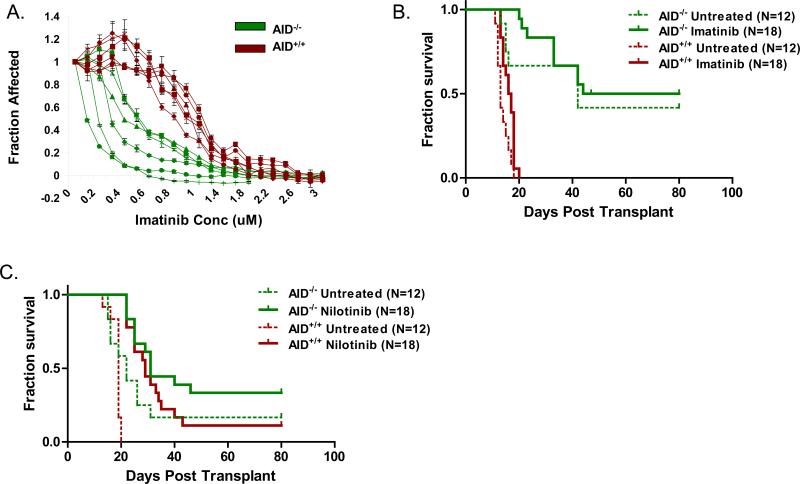
Figure 5. Sensitivity of AID-/- leukemia to tyrosine kinase inhibition
A. Leukemia cells were harvested from diseased mice and expanded in vitro. Subsequently cells were plated and treated with increasing concentrations with Imatinib as indicated. After 72 hours of incubation, proliferation was measured using a standard MTT assay. Data is compiled from two separate experiments, each experiment with three different AID-/- (green) and AID+/+ (red) clones. Each line represents an individual clone. B. Secondary transplant recipients were treated with Imatinib beginning 4 days post transplant until 30 days post transplant (data compiled from 2 experiments). C. Secondary transplant recipients were treated with Nilotinib beginning 4 days post transplant until 60 days post transplant as described in Materials and Methods (data compiled from 2 experiments).

References

    1. Muramatsu M, Kinoshita K, Fagarasan S, Yamada S, Shinkai Y, Honjo T. Class switch recombination and hypermutation require activation-induced cytidine deaminase (AID), a potential RNA editing enzyme. Cell. 2000;102:553–563. - PubMed
    1. Revy P, Muto T, Levy Y, et al. Activation-induced cytidine deaminase (AID) deficiency causes the autosomal recessive form of the Hyper-IgM syndrome (HIGM2). Cell. 2000;102:565–575. - PubMed
    1. Ramiro A, San-Martin BR, McBride K, et al. The role of activation-induced deaminase in antibody diversification and chromosome translocations. Adv. Immunol. 2007;94:75–107. - PubMed
    1. Liu M, Duke JL, Richter DJ, et al. Two levels of protection for the B cell genome during somatic hypermutation. Nature. 2008;451:841–845. - PubMed
    1. Pasqualucci L, Neumeister P, Goossens T, et al. Hypermutation of multiple proto-oncogenes in B-cell diffuse large-cell lymphomas. Nature. 2001;412:341–346. - PubMed

Publication types

MeSH terms

Substances