. 2010 Sep;22(9):3118-29.
doi: 10.1105/tpc.110.078493. Epub 2010 Sep 28.

Epigenetic regulation of repetitive elements is attenuated by prolonged heat stress in Arabidopsis

Affiliations

Epigenetic regulation of repetitive elements is attenuated by prolonged heat stress in Arabidopsis

Ales Pecinka et al. Plant Cell. 2010 Sep.

Abstract

Epigenetic factors determine responses to internal and external stimuli in eukaryotic organisms. Whether and how environmental conditions feed back to the epigenetic landscape is more a matter of suggestion than of substantiation. Plants are suitable organisms with which to address this question due to their sessile lifestyle and diversification of epigenetic regulators. We show that several repetitive elements of Arabidopsis thaliana that are under epigenetic regulation by transcriptional gene silencing at ambient temperatures and upon short term heat exposure become activated by prolonged heat stress. Activation can occur without loss of DNA methylation and with only minor changes to histone modifications but is accompanied by loss of nucleosomes and by heterochromatin decondensation. Whereas decondensation persists, nucleosome loading and transcriptional silencing are restored upon recovery from heat stress but are delayed in mutants with impaired chromatin assembly functions. The results provide evidence that environmental conditions can override epigenetic regulation, at least transiently, which might open a window for more permanent epigenetic changes.


Figures
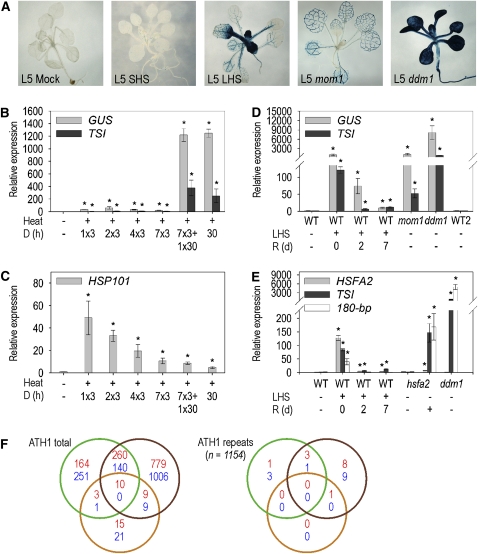
Figure 1.
Figure 1.
Long Heat Stress Transiently Abolishes TGS. (A) GUS-stained L5 plantlets after mock, short (SHS) and long (LHS) heat stress, and nontreated after crossing to mom1 and ddm1 mutants. (B) to (E) qRT-PCR for RNA of TGS targets (GUS and TSI) and heat stress marker genes (HSP101 and HSFA2) in the wild type (WT = Col-0; WT2 = Col-0/Zh) and mutants (mom1, ddm1, and hsfa2; see text for description) after heat stress (D = frequency of application × duration in hours and R = recovery time in days), LHS = 30 h. Error bars indicate sd of triplicate measurement. Statistically significant differences between mock-treated wild types and stressed (or mutant) samples are indicated by asterisks (t test, P < 0.05). (F) Differential gene expression (log fold changes of ≥2 [red] and ≤−2 [blue]) between mock and SHS (SHS R0, green circle) and mock versus LHS without (LHS R0, brown circle) or with (LHS R2, orange circle) recovery. ATH1 total, all probe sets; ATH1 repeats, probe sets representing repetitive elements (Slotkin et al., 2009).
Figure 2.
Figure 2.
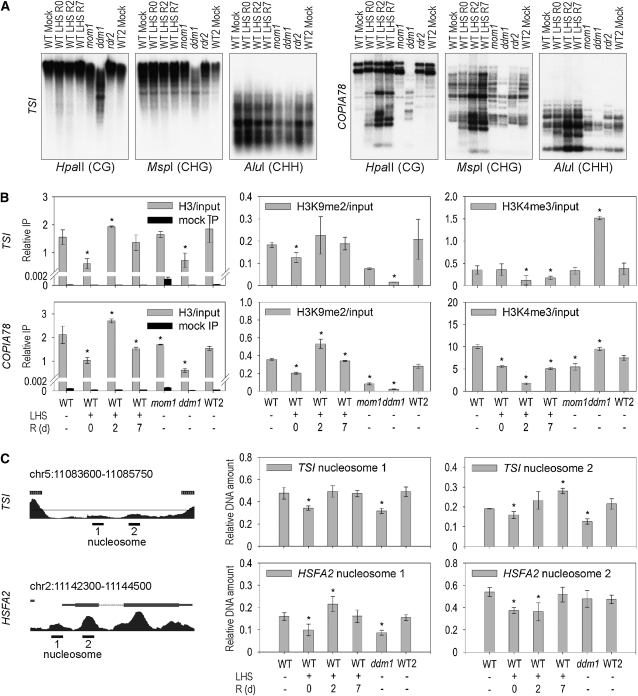
Chromatin Analysis after LHS. (A) Methylation analysis of TSI and COPIA78 by DNA gel blotting of LHS samples without (LHS R0) or with recovery for 2 or 7 d (LHS R2 and LHS R7). (B) Histone H3 occupancy and modifications (H3K9me2 and H3K4me3), relative to input, were assessed by ChIP and qPCR. (C) Nucleosome occupancy analysis by MNase I sensitivity assay at a representative TSI locus and at HSFA2. The positions of the PCR-amplified regions with respect to nucleosomes are indicated (left). (B) and (C) Error bars indicate sd of triplicate measurement. R, recovery time in days. Statistically significant differences between mock-treated wild types and stressed (or mutant) samples are indicated by asterisks (t test, P < 0.05).
Figure 3.
Figure 3.
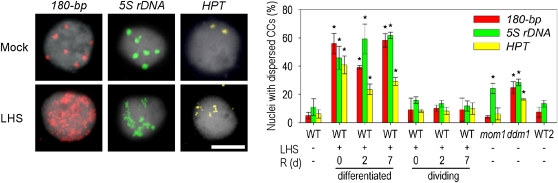
LHS Leads to Loss of Heterochromatin Compaction. Heterochromatin condensation was analyzed by FISH with 180-bp (red, left), 5S rDNA (green, middle), and HPT (yellow, right) probes in nuclei (n = 240/experimental point) of mock- and LHS-treated plants and mutant controls. Bar = 5 μm. Error bars indicate sd of triplicate measurement. R, recovery time in days. Statistically significant differences between mock-treated wild types and stressed (or mutant) samples are indicated by asterisks (t test, P < 0.05).
Figure 4.
Figure 4.
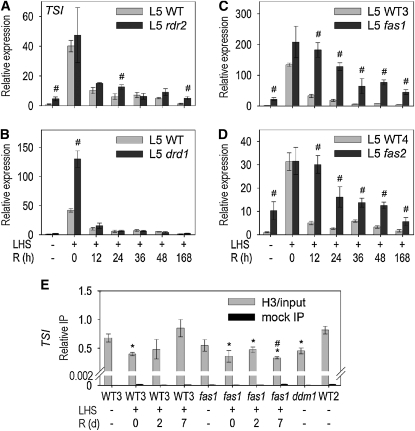
Involvement of CAF-1 in Resilencing. (A) to (D) Kinetics of TSI expression after LHS quantified by qRT-PCR during recovery (R = recovery time in hours) in the wild type, RdDM, and CAF-1 mutants (see text for description). WT = Col-0, WT3 = Enk/Col-0, and WT4 = Ler/Col-0. (E) Histone H3 occupancy (relative to input) was assessed by ChIP and qPCR. R = recovery time in days. (A) to (E) Error bars indicate sd of triplicate measurement. (A) to (D) Statistically significant differences between wild-type and mutant samples at the same time points are indicated by # (t test, P < 0.05). (E) Statistically significant differences between mock-treated and heat-stressed plants (wild type or mutants, respectively) are indicated by asterisks (t test, P < 0.05).
Figure 5.
Figure 5.
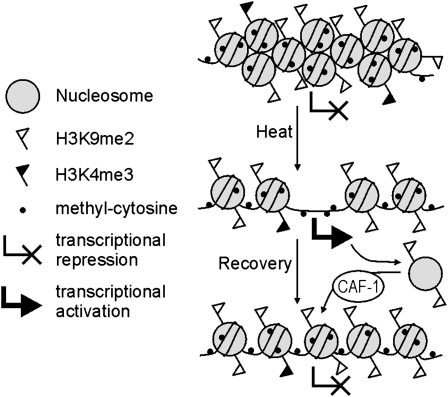
Model of Heat Stress–Induced Epigenetic Changes. Transcriptionally inactive repeats reside in compact, heavily DNA-methylated heterochromatin with substantial H3K9 dimethylation and low levels of H3K4 trimethylation (top); after LHS, nucleosomes are partially removed rather than their modifications being altered, while heterochromatin becomes decondensed and transcriptionally active (middle). During recovery, nucleosomes are reloaded (partially via CAF-1 activity) and dimethylated at H3K9, but without reconstituting compact heterochromatin (bottom).

References

    1. Adamo A., Pinney J.W., Kunova A., Westhead D.R., Meyer P. (2008). Heat stress enhances the accumulation of polyadenylated mitochondrial transcripts in Arabidopsis thaliana. PLoS ONE 3: e2889. - PMC - PubMed
    1. Amedeo P., Habu Y., Afsar K., Mittelsten Scheid O., Paszkowski J. (2000). Disruption of the plant gene MOM releases transcriptional silencing of methylated genes. Nature 405: 203–206 - PubMed
    1. Bilang R., Iida S., Peterhans A., Potrykus I., Paszkowski J. (1991). The 3′-terminal region of the hygromycin-B-resistance gene is important for its activity in Escherichia coli and Nicotiana tabacum. Gene 100: 247–250 - PubMed
    1. Binelli G., Mascarenhas J. (1990). Arabidopsis: Sensitivity of growth to high temperature. Dev. Genet. 11: 294–298
    1. Chan S.W., Henderson I.R., Jacobsen S.E. (2005). Gardening the genome: DNA methylation in Arabidopsis thaliana. Nat. Rev. Genet. 6: 351–360 - PubMed

Publication types

Associated data