


Angiotensin II-regulated transcription regulatory genes in adrenal steroidogenesis
- PMID: 20876845
- PMCID: PMC3008366
- DOI: 10.1152/physiolgenomics.00098.2010
Angiotensin II-regulated transcription regulatory genes in adrenal steroidogenesis
Abstract
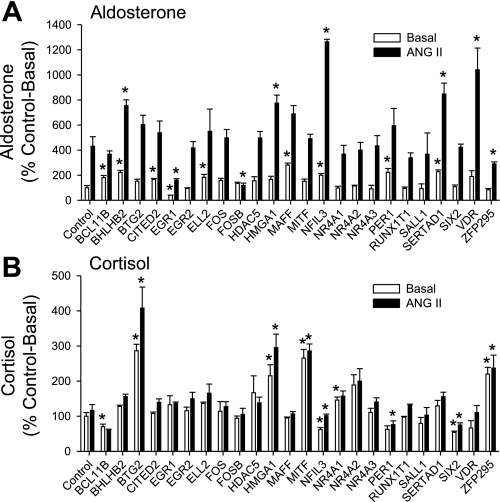
Transcription regulatory genes are crucial modulators of cell physiology and metabolism whose intracellular levels are tightly controlled in response to extracellular stimuli. We previously reported a set of 29 transcription regulatory genes modulated by angiotensin II in H295R human adrenocortical cells and their roles in regulating the expression of the last and unique enzymes of the glucocorticoid and mineralocorticoid biosynthetic pathways, 11β-hydroxylase and aldosterone synthase, respectively, using gene expression reporter assays. To study the effect of this set of transcription regulatory genes on adrenal steroidogenesis, H295R cells were transfected by high-efficiency nucleofection and aldosterone and cortisol were measured in cell culture supernatants under basal and angiotensin II-stimulated conditions. BCL11B, BHLHB2, CITED2, ELL2, HMGA1, MAFF, NFIL3, PER1, SERTAD1, and VDR significantly stimulated aldosterone secretion, while EGR1, FOSB, and ZFP295 decreased aldosterone secretion. BTG2, HMGA1, MITF, NR4A1, and ZFP295 significantly increased cortisol secretion, while BCL11B, NFIL3, PER1, and SIX2 decreased cortisol secretion. We also report the effect of some of these regulators on the expression of endogenous aldosterone synthase and 11β-hydroxylase under basal and angiotensin II-stimulated conditions. In summary, this study reports for the first time the effects of a set of angiotensin II-modulated transcription regulatory genes on aldosterone and cortisol secretion and the expression levels of the last and unique enzymes of the mineralocorticoid and glucocorticoid biosynthetic pathways. Abnormal regulation of mineralocorticoid or glucocorticoid secretion is involved in several pathophysiological conditions. These transcription regulatory genes may be involved in adrenal steroidogenesis pathologies; thus they merit additional study as potential candidates for therapeutic intervention.
Figures


References
-
- Ashburner M, Ball CA, Blake JA, Botstein D, Butler H, Cherry JM, Davis AP, Dolinski K, Dwight SS, Eppig JT, Harris MA, Hill DP, Issel-Tarver L, Kasarskis A, Lewis S, Matese JC, Richardson JE, Ringwald M, Rubin GM, Sherlock G. Gene Ontology: tool for the unification of biology. The Gene Ontology Consortium. Nat Genet 25: 25–29, 2000 - PMC - PubMed
-
- Bamforth SD, Braganca J, Eloranta JJ, Murdoch JN, Marques FI, Kranc KR, Farza H, Henderson DJ, Hurst HC, Bhattacharya S. Cardiac malformations, adrenal agenesis, neural crest defects and exencephaly in mice lacking Cited2, a new Tfap2 co-activator. Nat Genet 29: 469–474, 2001 - PubMed
-
- Bassett MH, Suzuki T, Sasano H, De Vries CJ, Jimenez PT, Carr BR, Rainey WE. The orphan nuclear receptor NGFIB regulates transcription of 3beta-hydroxysteroid dehydrogenase. Implications for the control of adrenal functional zonation. J Biol Chem 279: 37622–37630, 2004 - PubMed
-
- Bassett MH, Suzuki T, Sasano H, White PC, Rainey WE. The orphan nuclear receptors NURR1 and NGFIB regulate adrenal aldosterone production. Mol Endocrinol 18: 279–290, 2004 - PubMed
Publication types
MeSH terms
Substances
Grants and funding
LinkOut - more resources
Full Text Sources
Miscellaneous
