


Genetic composition of laboratory stocks of the self-fertilizing fish Kryptolebias marmoratus: a valuable resource for experimental research
- PMID: 20877576
- PMCID: PMC2943930
- DOI: 10.1371/journal.pone.0012863
Genetic composition of laboratory stocks of the self-fertilizing fish Kryptolebias marmoratus: a valuable resource for experimental research
Abstract
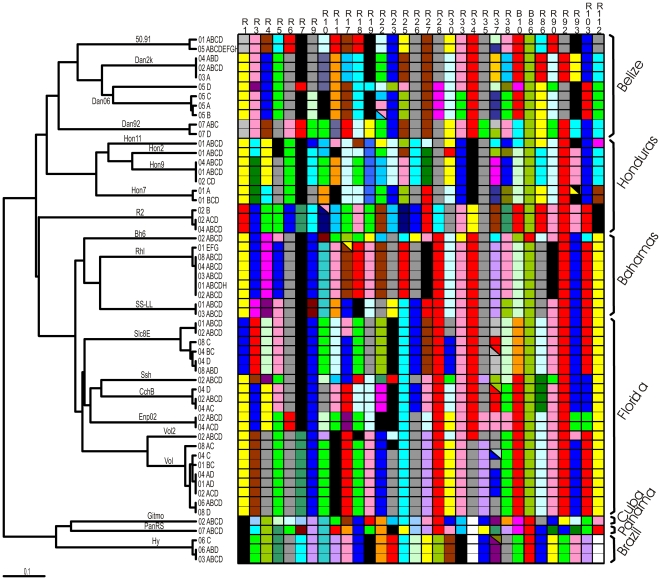
The hermaphroditic Mangrove Killifish, Kryptolebias marmoratus, is the world's only vertebrate that routinely self-fertilizes. As such, highly inbred and presumably isogenic "clonal" lineages of this androdioecious species have long been maintained in several laboratories and used in a wide variety of experiments that require genetically uniform vertebrate specimens. Here we conduct a genetic inventory of essentially all laboratory stocks of the Mangrove Killifish held worldwide. At 32 microsatellite loci, these stocks proved to show extensive interline differentiation as well as some intraline variation, much of which can be attributed to post-origin de novo mutations and/or to the segregation of polymorphisms from wild progenitors. Our genetic findings also document that many of the surveyed laboratory strains are not what they have been labeled, apparently due to the rather frequent mishandling or unintended mixing of various laboratory stocks over the years. Our genetic inventory should help to clarify much of this confusion about the clonal identities and genetic relationships of laboratory lines, and thereby help to rejuvenate interest in K. marmoratus as a reliable vertebrate model for experimental research that requires or can capitalize upon "clonal" replicate specimens.
Conflict of interest statement
Figures
References
-
- Dave G. Replicability, repeatability, and reproducibility of embryo-larval toxicity tests with fish. In: Soares AMVM, Calow P, editors. Progress in standardization of aquatic toxicity tests. Boca Raton, Florida: Lewis Publishers; 1993. pp. 129–157.
-
- Silver LM. New York: Oxford University Press; 1995. Mouse genetics: concepts and applications.
-
- Beck JA, Lloyd S, Hafezpatast M, Lennon-Pierce M, Eppig JT, et al. Genealogies of mouse inbred strains. Nature Genet. 2000;24:23–25. - PubMed
-
- Darvasi A. Experimental strategies for the genetic dissection of complex traits in animal models. Nature Genet. 1998;18:19–24. - PubMed
-
- Bongers ABJ, Sukkel M, Gort G, Komen J, Richter CJJ. Development and use of genetically uniform strains of common carp in experimental animal research. Lab Anim. 1998;32:349–363. - PubMed
Publication types
MeSH terms
Grants and funding
LinkOut - more resources
Full Text Sources
Research Materials
