


Chagas cardiomyopathy: the potential of diastolic dysfunction and brain natriuretic peptide in the early identification of cardiac damage
- PMID: 20877635
- PMCID: PMC2943653
- DOI: 10.1371/journal.pntd.0000826
Chagas cardiomyopathy: the potential of diastolic dysfunction and brain natriuretic peptide in the early identification of cardiac damage
Abstract
Introduction: Chagas disease remains a major cause of mortality in several countries of Latin America and has become a potential public health problem in non-endemic countries as a result of migration flows. Cardiac involvement represents the main cause of mortality, but its diagnosis is still based on nonspecific criteria with poor sensitivity. Early identification of patients with cardiac involvement is desirable, since early treatment may improve prognosis. This study aimed to assess the role of diastolic dysfunction, abnormal myocardial strain and elevated brain natriuretic peptide (BNP) in the early identification of cardiac involvement in Chagas disease.
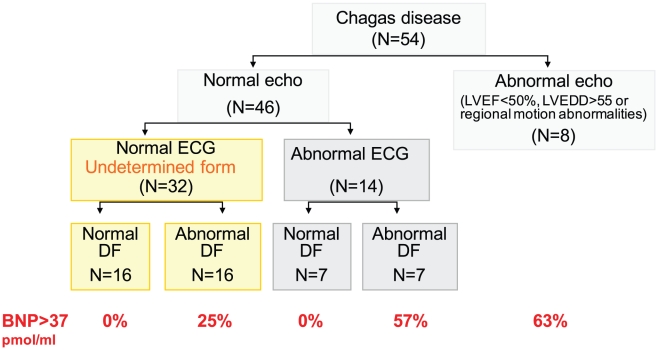
Methodology/principal findings: Fifty-four patients divided into 3 groups--group 1 (undetermined form: positive serology without ECG or 2D-echocardiographic abnormalities; N = 32), group 2 (typical ECG abnormalities of Chagas disease but normal 2D-echocardiography; N = 14), and group 3 (regional wall motion abnormalities, left ventricular [LV] end-diastolic diameter >55 mm or LV ejection fraction <50% on echocardiography; N = 8)--and 44 control subjects were studied. Patients with significant non-cardiac diseases, other heart diseases and previous treatment with benznidazol were excluded. The median age was 37 (20-58) years; 40% were men. BNP levels, longitudinal and radial myocardial strain and LV diastolic dysfunction increased progressively from group 1 to 3 (p for trend <0.01). Abnormal BNP levels (>37 pg/ml) were noted in 0%, 13%, 29% and 63% in controls and groups 1 to 3, respectively. Half of patients in the undetermined form had impaired relaxation patterns, whereas half of patients with ECG abnormalities suggestive of Chagas cardiomyopathy had normal diastolic function. In group 1, BNP levels were statistically higher in patients with diastolic dysfunction as compared to those with normal diastolic function (27 ± 26 vs. 11 ± 8 pg/ml, p = 0.03).
Conclusion/significance: In conclusion, the combination of diastolic function and BNP measurement adds important information that could help to better stratify patients with Chagas disease.
Conflict of interest statement
The authors have declared that no competing interests exist.
Figures
References
-
- Jannin J, Villa L. An overview of Chagas disease treatment. Mem Inst Oswaldo Cruz. 2007;102(Suppl 1):95–97. - PubMed
-
- Schmunis GA. Epidemiology of Chagas disease in non-endemic countries: the role of international migration. Mem Inst Oswaldo Cruz. 2007;102(Suppl 1):75–85. - PubMed
-
- Schmunis GA, Yadon ZE. Chagas disease: A Latin American health problem becoming a world health problem. Acta Trop. 2009 In press. - PubMed
-
- Munoz J, Gomez i Prat J, Gallego M, Gimeno F, Trevino B, et al. Clinical profile of Trypanosoma cruzi infection in a non-endemic setting: immigration and Chagas disease in Barcelona (Spain). Acta Trop. 2009;111:51–55. - PubMed
-
- Hotez PJ, Molyneux DH, Fenwick A, Kumaresan J, Sachs SE, et al. Control of neglected tropical diseases. N Engl J Med. 2007;357:1018–1027. - PubMed
