Effects of positive acceleration on the metabolism of endogenous carbon monoxide and serum lipid in atherosclerotic rabbits
- PMID: 20877690
- PMCID: PMC2945201
- DOI: 10.4103/0975-3583.64439
Effects of positive acceleration on the metabolism of endogenous carbon monoxide and serum lipid in atherosclerotic rabbits
Abstract
Background: Atherosclerosis (AS) is caused mainly due to the increase in the serum lipid, thrombosis, and injuries of the endothelial cells. During aviation, the incremental load of positive acceleration that leads to dramatic stress reactions and hemodynamic changes may predispose pilots to functional disorders and even pathological changes of organs. However, much less is known on the correlation between aviation and AS pathogenesis.
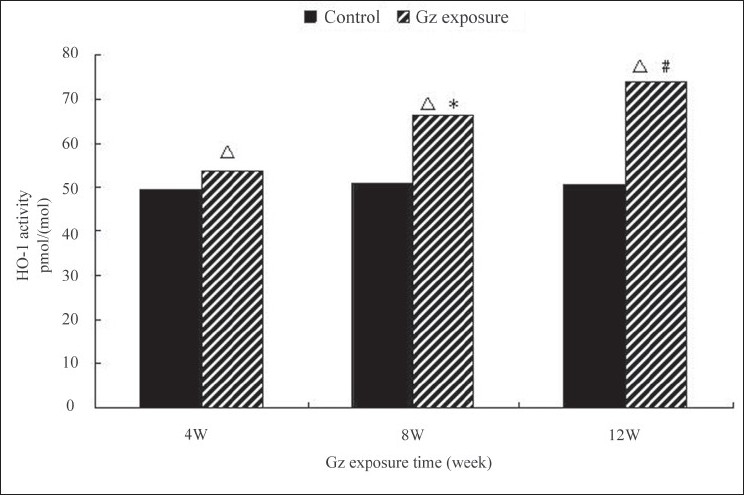
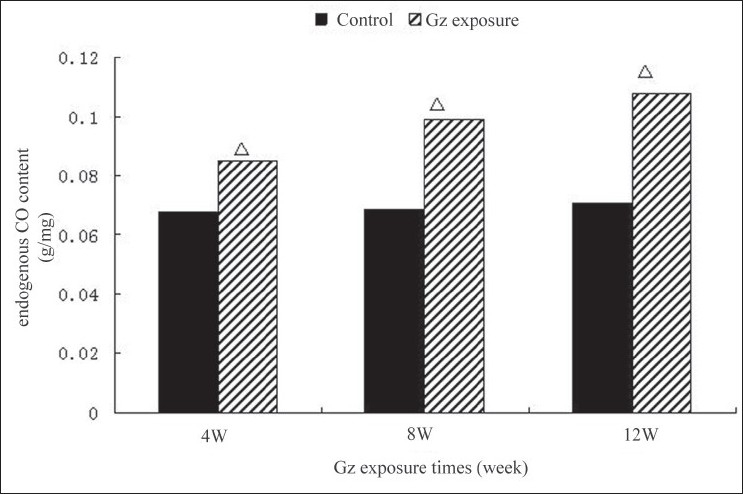
Methods and results: A total of 32 rabbits were randomly divided into 4 groups with 8 rabbits in each group. The control group was given a high cholesterol diet but no acceleration exposure, whereas the other 3 experimental groups were treated with a high cholesterol diet and acceleration exposure for 4, 8, and 12 weeks, respectively. In each group, samples of celiac vein blood and the aorta were collected after the last exposure for the measurement of endogenous CO and HO-1 activities, as well as the levels of total cholesterol (TC), triglyceride (TG), high-density lipoprotein cholesterol (HDL-C), and low-density lipoprotein cholesterol (LDL-C). As compared with the control group, the endocardial CO content and the HO-1 activity in aortic endothelial cells were significantly elevated at the 4th, 8th, and 12th weekend, respectively (P < 0.05 or <0.01). And these measures tended upward as the exposure time was prolonged. Levels of TC and LDL-C in the experimental groups were significantly higher than those in the control group, presenting an upward tendency. Levels of TG were found significantly increased in the 8-week-exposure group, but significantly declined in the 12-week-exposure group (still higher than those in the control group). Levels of the HDL-C were increased in the 4-week-exposure group, declined in the 8-week-exposure group, and once more increased in the 12-week-exposure group, without significant differences with the control group.
Conclusions: Positive acceleration exposure may lead to a significant increase of endogenous CO content and HO-1 activity and a metabolic disorder of serum lipid in high-cholesterol diet-fed rabbits, which implicates that the acceleration exposure might accelerate the progression of AS.
Keywords: Endogenous carbon monoxide; Heme oxygenase-1; lipoprotein; positive acceleration exposure; total cholesterol.
Conflict of interest statement
Figures
References
-
- Goldschmidt-Clermont PJ, Creager MA, Losordo DW, Lam GK, Wassef M, Dzau VJ. Atherosclerosis 2005: Recent discoveries and novel hypotheses. Circulation. 2005;112:3348–53. - PubMed
-
- Praticò D. Antioxidants and endothelium protection. Atherosclerosis. 2005;181:215–24. - PubMed
-
- Martin DS, D’Aunno DS, Wood ML, South DA. Repetitive high G exposure is associated with increased occurrence of cardiac valvular regurgitation. Aviat Space Environ Med. 1999;70:1197–200. - PubMed
-
- Grubb A. Diagnostic value of analysis of cystatin C and protein HC in biological fluids. Clin Nephrol. 1992;38:S20–7. - PubMed
-
- Miyamoto Y, Shimazu H, Nakamura A. Plasma catecholamine and cortisol concentrations during acceleration stress. Eur J Appl Physiol Occup Physiol. 1995;70:407–12. - PubMed
LinkOut - more resources
Full Text Sources
Research Materials
Miscellaneous