. 2011 Jun;20(6):977-88.
doi: 10.1089/scd.2010.0152. Epub 2010 Nov 1.

Endothelial differentiation of adipose-derived stem cells from elderly patients with cardiovascular disease

Affiliations

Endothelial differentiation of adipose-derived stem cells from elderly patients with cardiovascular disease

Ping Zhang et al. Stem Cells Dev. 2011 Jun.

Abstract

Adipose-derived stem cells (ASCs) possess significant therapeutic potential for tissue engineering and regeneration. This study investigates the endothelial differentiation and functional capacity of ASCs isolated from elderly patients. Isolation of ASCs from 53 patients (50-89 years) revealed that advanced age or comorbidity did not negatively impact stem cell harvest; rather, higher numbers were observed in older donors (>70 years) than in younger. ASCs cultured in endothelial growth medium-2 for up to 3 weeks formed cords upon Matrigel and demonstrated acetylated-low-density lipoprotein and lectin uptake. Further stimulation with vascular endothelial growth factor and shear stress upregulated endothelial cell-specific markers (CD31, von Willebrand factor, endothelial nitric oxide synthase, and VE-cadherin). Inhibition of the PI(3)K but not mitogen-activated protein kinase pathway blocked the observed endothelial differentiation. Shear stress promoted an anti-thrombogenic phenotype as demonstrated by production of tissue-plasminogen activator and nitric oxide, and inhibition of plasminogen activator inhibitor-1. Shear stress augmented integrin α(5)β(1) expression and subsequently increased attachment of differentiated ASCs to basement membrane components. Finally, ASCs seeded onto a decellularized vein graft resisted detachment despite application of shear force up to 9 dynes. These results suggest that (1) advanced age and comorbidity do not negatively impact isolation of ASCs, and (2) these stem cells retain significant capacity to acquire key endothelial cell traits throughout life. As such, adipose tissue is a practical source of autologous stem cells for vascular tissue engineering.


Figures
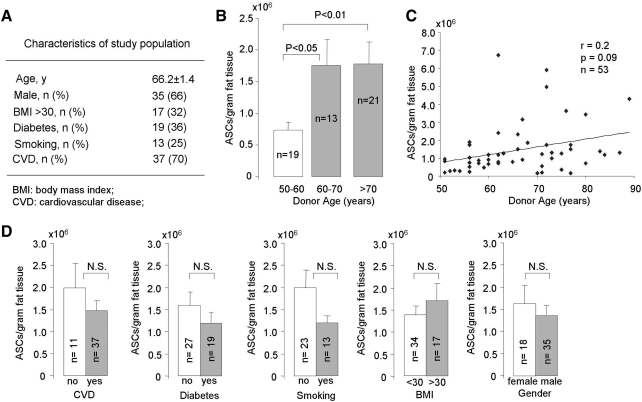
FIG. 1.
FIG. 1.
Isolation of ASCs from elderly patients with cardiovascular disease. (A) Overall patient characteristics. (B) Number of ASCs isolated per gram of adipose tissue compared with patient age subdivided into decades. (C) Overall correlation between the number of ASCs isolated per gram of adipose tissue and patient age (n = 53). (D) Univariate analysis comparing isolation number and various patient characteristics. ASCs, adipose-derived stem cells; N.S., not significant.
FIG. 2.
FIG. 2.
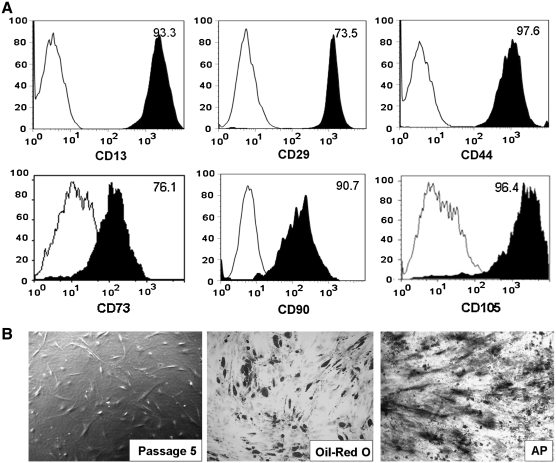
Immunophenotype characterization and multipotency of ASCs. (A) Representative FACS analysis of cultured ASCs (passage 3–5) revealing the majority of ASCs express surface antigens consistent with mesenchymal stem cell markers. Plots show the isotype control (white) versus specific antibody staining (black; n = 12; mean age: 67.4 ± 3). (B) Photomicrograph of ASCs before differentiation (left; phase contrast, 20 ×), and after 3 weeks of culture in adipogenic (middle; Oil Red O stain, 20 ×) and osteogenic (right; AP stain, 20 ×) media (n = 6; mean age: 68 ± 6 years). AP, alkaline phosphatase.
FIG. 3.
FIG. 3.
Acquisition of endothelial characteristics by ASCs. (A) After culture for 2 weeks in EGM-2 (“EGM2”), expression of each of these endothelial markers is identified (n = 12; mean age 69 ± 3 years). With the addition of VEGF to the medium (50 ng/mL; “EGM2/VEGF”), further upregulation is noted for vWF and eNOS by quantitative real-time PCR (n = 5; mean age 67 ± 6 years; *P < 0.05 vs. control EGM2). Flow cytometry and western blotting analysis demonstrated protein expression of vWF and CD31 in differentiated ASCs (right panel). (B) Fluorescent photomicrograph (40 ×) of differentiated ASCs revealing concomitant uptake of Dil-labeled acetylated-low-density lipoprotein (red) and FITC-labeled human lectin (green). (C) Photomicrograph (phase contrast, 40 ×) of differentiated ASCs and HUVECs and (D) 24 h after plating onto Matrigel demonstrating their ability to form capillary-like structures, suggesting the ability to participate in angiogenesis. (E) Photomicrograph (phase contrast, 40 ×) of ASCs grown in the differentiating medium supplemented with the PI3K inhibitor LY294002 demonstrating inhibition of capillary growth upon plating on Matrigel. (F) Photomicrograph (phase contrast, 40 ×) of ASCs grown in the differentiating medium supplemented with the mitogen-activated protein kinase inhibitor PD98059 conversely reveals the ability of the ASCs to form capillary-like structures. (G) Reverse transcription (RT)-PCR (left panel) and quantitative PCR analysis (left panel) reveals that expression of both vWF and CD31 in differentiating ASCs appears significantly inhibited by PI3K inhibition (LY) rather than mitogen-activated protein kinase inhibition (PD) (n = 3; mean age 72 ± 6 years; *P < 0.05, **P < 0.01 vs. control). EGM2, endothelial growth medium-2; PCR, polymerase chain reaction; HUVECs, human umbilical vein endothelial cells; VEGF, vascular endothelial growth factor; vWF, von Willebrand factor.
FIG. 4.
FIG. 4.
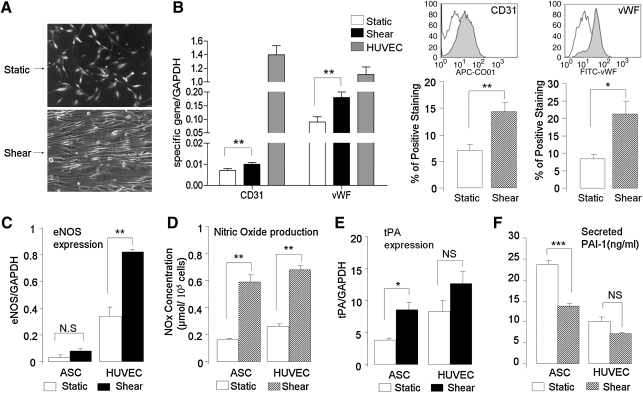
Effects of shear stress on ASC differentiation. (A) Photomicrographs (phase contrast, 20 ×) of differentiated ASCs cultured under static conditions or exposed to shear stress (12 dyne × 48 h) revealing re-alignment in the direction of flow. (B) Quantitative PCR (left panels) of differentiated ASCs reveals that exposure to shear stress (12 dyne × 48 h) significantly upregulates expression of the EC markers CD31 and vWF (n = 6; mean age 67 ± 4 years; **P < 0.01 vs. control). Flow cytometry (right panels) confirms that shear stress upregulates protein expression of CD31 and vWF (n = 4; mean age 69 ± 7 years; *P < 0.05, **P < 0.01 vs. control). (C) Quantitative PCR analysis of eNOS expression reveals a small amount of eNOS expression in differentiated ASCs compared to EC controls (n = 4; mean age 65 ± 6 years; **P < 0.01 vs. control). Although the effect did not reach statistical significance, the application of shear stress appeared to upregulate eNOS message. (D) Measurement of total nitric oxide (NOx) production using a chemiluminescence NO detector suggesting significant amounts of NO production by differentiated ASCs, including stimulation by shear stress (n = 4; mean age 68 ± 7 years; **P < 0.01 vs. control). Shear stress increased tPA expression (E, quantitative PCR) and decreased PAI-1 expression (F, ELISA), suggesting the acquisition of an antithrombogenic phenotype by the differentiated ASCs (n = 4; mean age 68 ± 7 years; *P < 0.05, ***P < 0.001 vs. control). EC, endothelial cell; eNOS; endothelial nitric oxide synthase; PAI-1, plasminogen activator inhibitor-1; tPA, tissue-plasminogen activator.
FIG. 5.
FIG. 5.
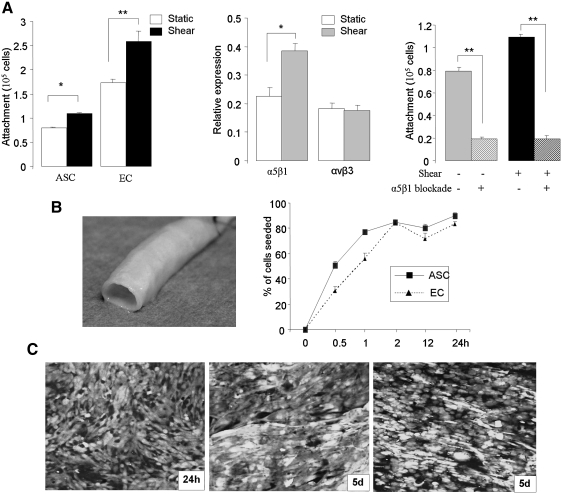
Attachment of differentiated ASCs to vascular basement membrane. (A) Effect of shear stress and α5β1 integrin expression on ASC attachment. The left panel reveals that cell attachment to fibronectin by ASCs is improved by shear stress (12 dynes × 48 h), but not to the degree that EC attach (n = 3; *P < 0.05, **P < 0.01 vs. control). Integrin-mediated cell adhesion analysis (middle panel) demonstrates that shear stress significantly increased α5β1 expression in differentiated ASCs but not αvβ3 (n = 3; *P < 0.05 vs. control). Specific blockade of the α5β1 integrin (right panel) significantly reduced ASC attachment to fibronectin and eliminated the effect of shear stress (n = 3; **P < 0.01 vs. control). (B) Kinetics of attachment to vascular basement membrane. Photographs of intact human saphenous vein (left) that has subsequently been decellularized for seeding experiments. Attachment of the cells reveals that both differentiated ASCs and EC attach maximally to the scaffolding by 2 h, and remain attached at 24 h after static seeding (right). (C) Cell retention under physiological fluid flow conditioning. Confocal microscopy images of seeded differentiated ASCs and HUVECs on decellularized vein scaffold. Cells were labeled using Cell Tracker Green to allow for observation. Images were taken 24 h and 5 days after seeding and linearly increasing shear force up to 9 dynes.

References

    1. Adams B. Xiao Q. Xu Q. Stem cell therapy for vascular disease. Trends Cardiovasc Med. 2007;17:246–251. - PubMed
    1. de Mel A. Bolvin C. Edirisinghe M. Hamilton G. Seifalian AM. Development of cardiovascular bypass grafts: endothelialization and applications of nanotechnology. Expert Rev Cardiovas Ther. 2008;6:1259–1277. - PubMed
    1. Sarkar S. Schmitz-Rixen T. Hamilton G. Seifalian AM. Achieving the ideal properties for vascular bypass grafts using a tissue engineered approach: a review. Med Bio Eng. 2007;45:327–336. - PubMed
    1. Isenberg BC. Williams C. Tranquillo RT. Small-diameter artificial arteries engineered in vitro. Circ Res. 2006;98:25–35. - PubMed
    1. Griese DP. Ehsan A. Melo LG. Kong D. Zhang L. Mann MJ. Pratt RE. Mulligan RC. Dzau VJ. Isolation and transplantation of autologous circulating endothelial cells into denuded vessels and prosthetic grafts: implications for cell-based vascular therapy. Circulation. 2003;108:2710–2715. - PubMed

Publication types

MeSH terms

Substances