Remifentanil infusion as a modality for opioid-based anaesthesia in paediatric practice
- PMID: 20882174
- PMCID: PMC2943701
- DOI: 10.4103/0019-5049.68375
Remifentanil infusion as a modality for opioid-based anaesthesia in paediatric practice
Abstract
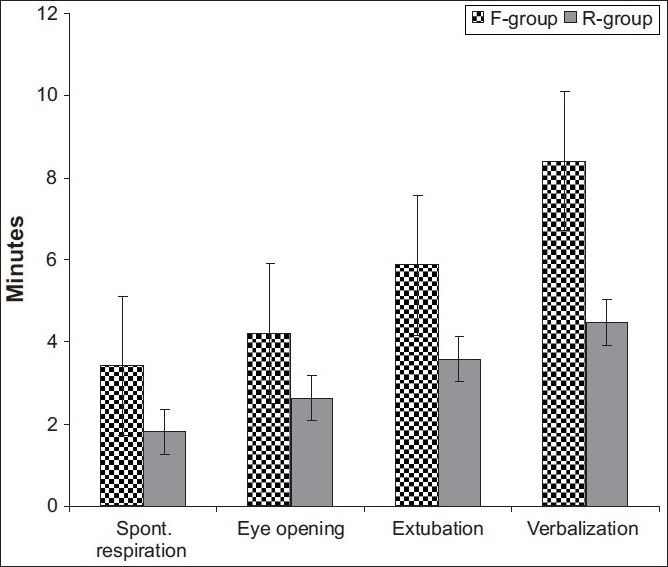
This study was designed to compare the intra-operative and post-operative analgesic requirements and side effects of using fentanyl infusion versus remifentanil infusion during short-duration surgical procedures in children. The study comprised of 40 children randomly allocated into two equal groups: fentanyl (F-group) or remifentanil (R-group). Both were administered a continuous intravenous (i.v.) infusion. Anaesthetic recovery was assessed using the Brussels sedation scale every 5 min from the time of entry till discharge from recovery room. Post-operative analgesia was assessed throughout the first three post-operative (PO) hours using observational pain-discomfort scale (OPS) and adverse events were recorded. Haemodynamic variables showed a non-significant difference between both the groups. Patients who received remifentanil showed significantly shorter time to spontaneous respiration, eye opening, extubation and verbalization compared to those who received fentanyl. Discharge time was significantly shorter in R-group, and 18 patients fulfilled criteria for recovery-room discharge at ≤25 min with a significant difference in favour of remifentanil. Fentanyl provided significantly better PO analgesia than remifentanil and children in F-group showed a significantly lower mean cumulative OPS record than those in R-group; however, the number of patients requiring rescue analgesia did not show a significant difference between both the groups. Two cases in F-group and one in R-group had bradycardia, one case in R-group had mild hypotension and PO vomiting had occurred in three patients in the F-group and two patients in the R-group. In conclusion, remifentanil is appropriate for opioid-based anaesthesia for paediatric patients as it provides haemodynamic stability and rapid recovery with minimal post-operative side effects.
Keywords: Opioid based; paediatric; remifentanil.
Conflict of interest statement
Figures


References
-
- Mazoit JK. Pharmacokinetic/pharmacodynamic modeling of anaesthetics in children: Therapeutic implications. Paediatr Drugs. 2006;8:139–50. - PubMed
-
- Duthie DJ. Remifentanil and tramadol. Br J Anesth. 1998;81:51–7. - PubMed
-
- Mastronardi P, Dellacasa P. Observational study on the use of remifentanil in general anaesthesia. Drug utilization research. Minerva Anestesiol. 2004;70:605–16. - PubMed
-
- Tsui BC, Wagner A, Usher AG, Cave DA, Tang C. Combined propofol and remifentanil intravenous anaesthesia for paediatric patients undergoing magnetic resonance imaging. Paediatr Anaesth. 2005;15:397–401. - PubMed
-
- Davis P, Finkel J, Orr R, Fazi L, Mulroy J, Woefel S, et al. A randomized, double-blinded study of remifentanil versus fentanyl for tonsillectomy and adenoidectomy surgery in paediatric ambulatory surgical patients. Anesth Analg. 2000;90:863–71. - PubMed