. 2010 Dec;62(11-12):773-80.
doi: 10.1007/s00251-010-0481-9. Epub 2010 Sep 30.

Characterization of Mauritian cynomolgus macaque major histocompatibility complex class I haplotypes by high-resolution pyrosequencing

Affiliations

Characterization of Mauritian cynomolgus macaque major histocompatibility complex class I haplotypes by high-resolution pyrosequencing

Melisa L Budde et al. Immunogenetics. 2010 Dec.

Abstract

Major histocompatibility complex (MHC) class I alleles of nonhuman primates have been associated with disease susceptibility, resistance, and resolution. Here, using high-resolution pyrosequencing, we characterized MHC class I transcripts expressed in Mauritian cynomolgus macaques (MCM), a nonhuman primate population with restricted MHC diversity. Using this approach, we identified 67 distinct MHC class I transcripts encoded by the seven most frequent MCM MHC class I haplotypes, 40 (60%) of which span the complete open reading frames. These results double the number of MHC class I sequences previously defined by cloning and Sanger sequencing of cDNA-PCR products and provide a rapid, high-throughput, and economical method for MHC characterization. Overall, this approach significantly expanded our knowledge of MCM haplotypes and will facilitate future studies on disease pathogenesis and protective cellular immunity.


Figures
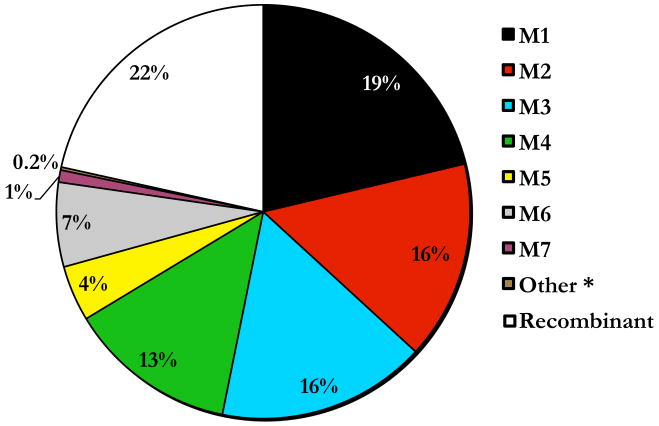
Figure 1
Figure 1. Frequencies of MHC class I haplotypes in MCM
Microsatellite analysis was used to determine the MCM MHC class I haplotype frequencies from 425 feral MCM (850 chromosomes). The seven most frequent haplotypes were designated M1 to M7 and assigned colors (M1, black; M2, red; M3, blue; M4, green; M5, yellow; M6, gray; and M7, purple) throughout the figures for clarification. *We have detected an eighth haplotype by microsatellite analysis in two wild-caught MCMs, as well as a parent and offspring in an independent captive breeding facility. Due to the limited number of individuals with this putative haplotype we were unable to characterize it.
Figure 2
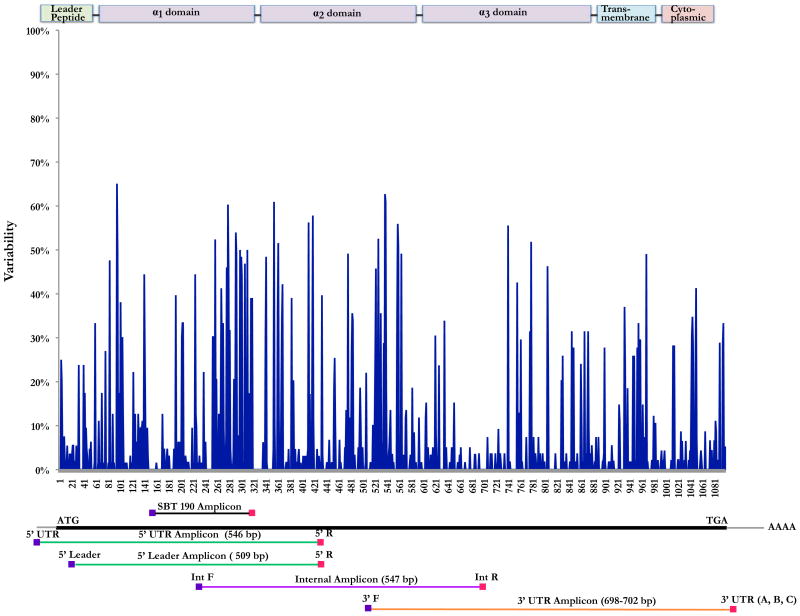
Figure 2. Polymorphic variation of known MCM MHC class I transcripts
Distribution of nucleotide variability for MCM MHC class I products. We aligned all 67 distinct MCM MHC class I sequences identified by pyrosequencing and plotted the frequency of the nucleotide differences. Below the variability plot is a depiction of the cDNA-PCR amplicons used in this study as well as the location of the 190-base pair amplicon used previously (Wiseman et al. 2009). Above the variability plot is a depiction of the macaque MHC class I domain structure. The alpha 1 and alpha 2 domains form the highly polymorphic peptide-binding pocket of the MHC class I transcript.
Figure 3
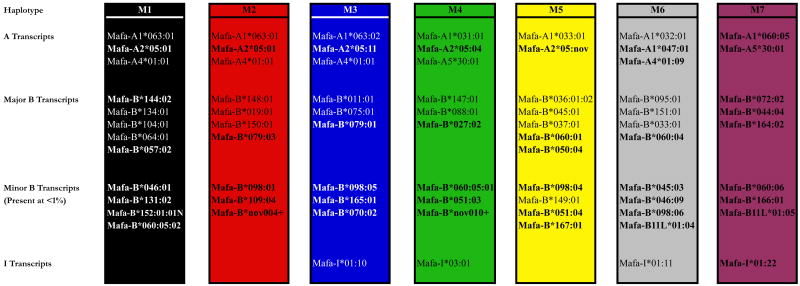
Figure 3. MCM MHC class I haplotypes
MHC class I A, B, and I transcripts associated with each MCM haplotype were identified by pyrosequencing of three overlapping cDNA-PCR amplicons. Our cohort for this experiment included ten animals, seven homozygotes and three heterozygotes. The transcripts that were not previously detected by cloning and Sanger sequencing are denoted in bold. Further, the Mafa-B transcripts are divided into major and minor transcripts. We defined minor transcripts as those present at less than 1% of the total MHC class I reads identified in total PBMC. Two putative minor transcripts, denoted by a +, were identified using the 190-bp amplicon in Wiseman et al. 2009 but not in this experiment.

References

    1. Blackwell JM, Jamieson SE, Burgner D. HLA and infectious diseases. Clin Microbiol Rev. 2009;22:370–85. - PMC - PubMed
    1. Burwitz BJ, Pendley CJ, Greene JM, Detmer AM, Lhost JJ, Karl JA, Piaskowski SM, Rudersdorf RA, Wallace LT, Bimber BN, Loffredo JT, Cox DG, Bardet W, Hildebrand W, Wiseman RW, O'Connor SL, O'Connor DH. Mauritian cynomolgus macaques share two exceptionally common major histocompatibility complex class I alleles that restrict simian immunodeficiency virus-specific CD8+ T cells. J Virol. 2009;83:6011–6019. - PMC - PubMed
    1. Daza-Vamenta R, Glusman G, Rowen L, Guthrie B, Geraghty DE. Genetic divergence of the rhesus macaque major histocompatibility complex. Genome Res. 2004;14:1501–1515. - PMC - PubMed
    1. Krebs KC, Jin Z, Rudersdorf R, Hughes AL, O'Connor DH. Unusually high frequency MHC class I alleles in Mauritian origin cynomolgus macaques. J Immunol. 2005;175:5230–5239. - PubMed
    1. Lawler SH, Sussman RW, Taylor LL. Mitochondrial DNA of the Mauritian macaques (Macaca fascicularis): an example of the founder effect. Am J Phys Anthropol. 1995;96:133–141. - PubMed

Publication types