


Promotoras as mental health practitioners in primary care: a multi-method study of an intervention to address contextual sources of depression
- PMID: 20882400
- PMCID: PMC3051073
- DOI: 10.1007/s10900-010-9313-y
Promotoras as mental health practitioners in primary care: a multi-method study of an intervention to address contextual sources of depression
Abstract
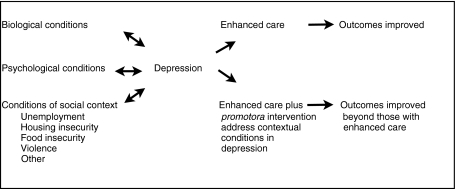
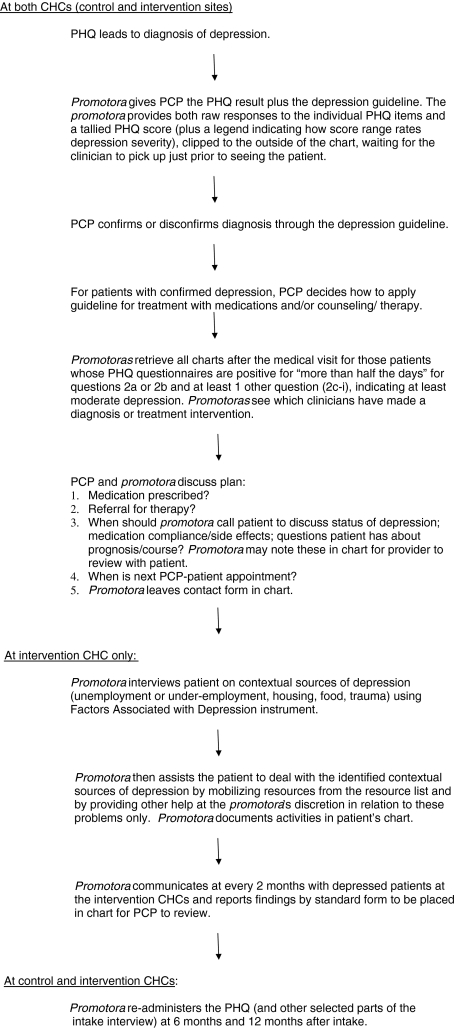
We assessed the role of promotoras--briefly trained community health workers--in depression care at community health centers. The intervention focused on four contextual sources of depression in underserved, low-income communities: underemployment, inadequate housing, food insecurity, and violence. A multi-method design included quantitative and ethnographic techniques to study predictors of depression and the intervention's impact. After a structured training program, primary care practitioners (PCPs) and promotoras collaboratively followed a clinical algorithm in which PCPs prescribed medications and/or arranged consultations by mental health professionals and promotoras addressed the contextual sources of depression. Based on an intake interview with 464 randomly recruited patients, 120 patients with depression were randomized to enhanced care plus the promotora contextual intervention, or to enhanced care alone. All four contextual problems emerged as strong predictors of depression (chi square, p < .05); logistic regression revealed housing and food insecurity as the most important predictors (odds ratios both 2.40, p < .05). Unexpected challenges arose in the intervention's implementation, involving infrastructure at the health centers, boundaries of the promotoras' roles, and "turf" issues with medical assistants. In the quantitative assessment, the intervention did not lead to statistically significant improvements in depression (odds ratio 4.33, confidence interval overlapping 1). Ethnographic research demonstrated a predominantly positive response to the intervention among stakeholders, including patients, promotoras, PCPs, non-professional staff workers, administrators, and community advisory board members. Due to continuing unmet mental health needs, we favor further assessment of innovative roles for community health workers.
Figures
References
-
- National Institute of Mental Health. (2010). Strategic plan. Retrieved August 23, 2010 at http://www.nimh.nih.gov/about/strategic-planning-reports/index.shtml.
-
- Wang PS, Lane M, Olfson M, et al. Twelve-month use of mental health services in the United States: Results from the National Comorbidity Survey Replication. Archives of General Psychiatry. 2005;62(6):629–640. - PubMed
-
- Holman EA, Silver RC, Waitzkin H. Traumatic life events in primary care patients: A study in an ethnically diverse sample. Archives of Family Medicine. 2000;9(9):802–810. - PubMed
Publication types
MeSH terms
Grants and funding
LinkOut - more resources
Full Text Sources
Medical
