


Increased T regulatory cells lead to development of Th2 immune response in male SJL mice
- PMID: 20883149
- PMCID: PMC3733367
- DOI: 10.3109/08916934.2010.519746
Increased T regulatory cells lead to development of Th2 immune response in male SJL mice
Abstract
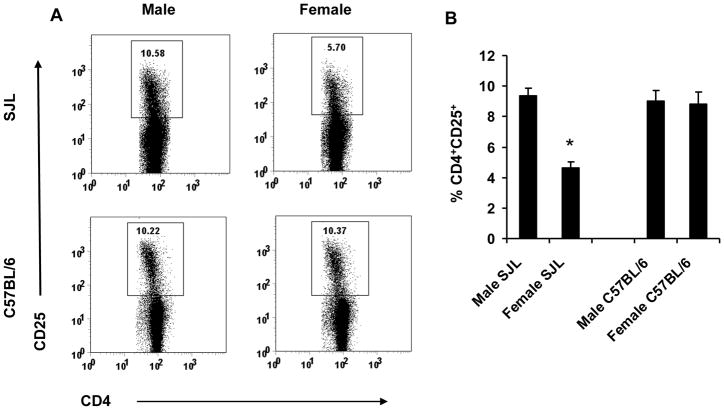
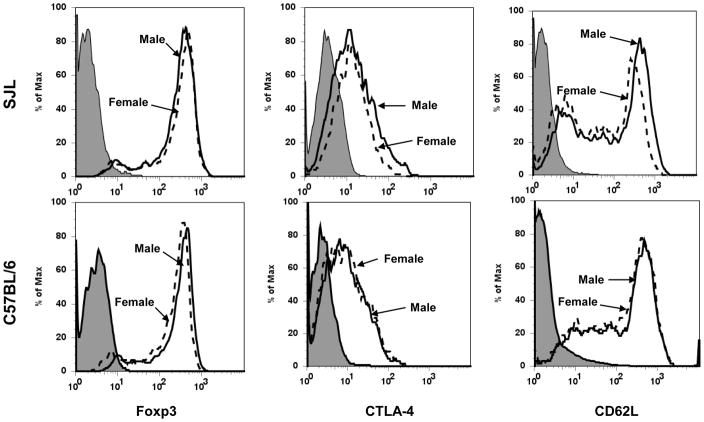
SJL mice represent a mouse model in which young adult females are susceptible to autoimmune disease, while age-matched males are relatively resistant. T cells primed in female SJL mice secrete cytokines associated with a Th1 phenotype. By contrast, T cells primed in males secrete cytokines associated with a Th2 phenotype. Activation of Th2-type T cells in males vs. Th1 cells in females correlates with increased CD4(+)CD25(+) T regulatory cells (Treg) in males. T cells primed in males depleted of CD4(+)CD25(+) T cells preferentially secrete IFN-γ and decreased IL-4 and IL-10 compared to CD4(+)CD25(+) T-cell-sufficient males, suggesting that Treg influence subsequent antigen-specific cytokine secretion. Treg from males and females exhibit equivalent in vitro T-cell suppression. Treg from males express increased CTLA-4 and CD62L and preferentially secrete IL-10. These data suggest that an increased frequency of IL-10 secreting Treg in male SJL mice may contribute resistance to autoimmune disease by favoring the development of Th2 immune responses.
Figures
References
-
- Brusko TM, Putnam AL, Bluestone JA. Human regulatory T cells: role in autoimmune disease and therapeutic opportunities. Immunol Rev. 2008;223:371–90. - PubMed
-
- Van Wijk F, Roord ST, Vastert B, De Kleer I, Wulffraat N, Prakken BJ. Regulatory T cells in autologous stem cell transplantation for autoimmune disease. Autoimmunity. 2008;41:585–91. - PubMed
-
- Houot R, Perrot I, Garcia E, Durand I, Lebecque S. Human CD4+CD25high regulatory T cells modulate myeloid but not plasmacytoid dendritic cells activation. J Immunol. 2006;176:5293–8. - PubMed
Publication types
MeSH terms
Substances
Grants and funding
LinkOut - more resources
Full Text Sources
Research Materials
