


Immunogenicity and protective efficacy in mice and hamsters of a β-propiolactone inactivated whole virus SARS-CoV vaccine
- PMID: 20883165
- PMCID: PMC2967819
- DOI: 10.1089/vim.2010.0028
Immunogenicity and protective efficacy in mice and hamsters of a β-propiolactone inactivated whole virus SARS-CoV vaccine
Abstract
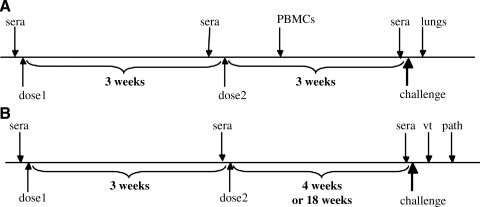
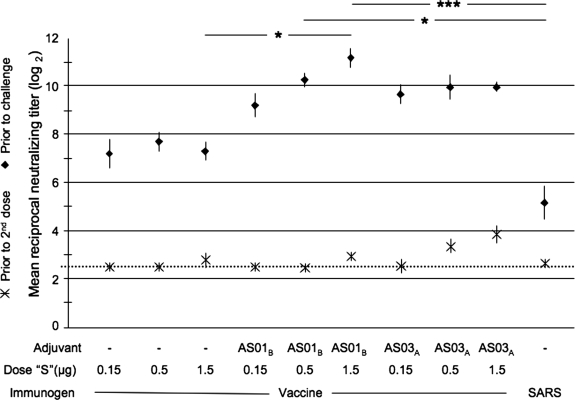
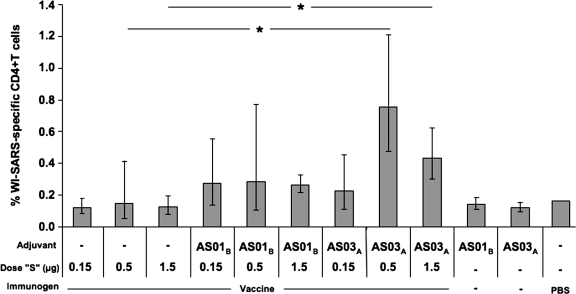
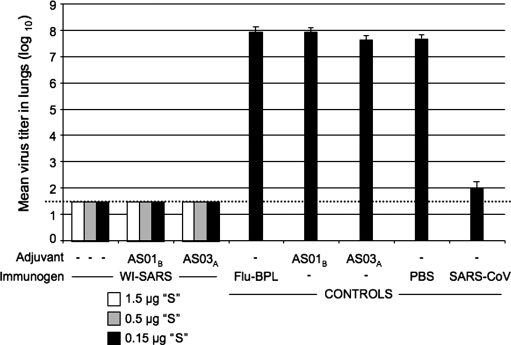
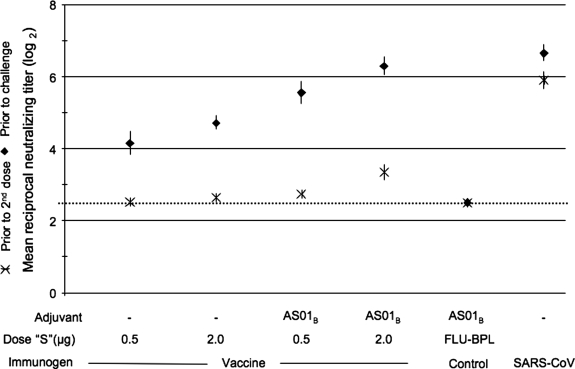
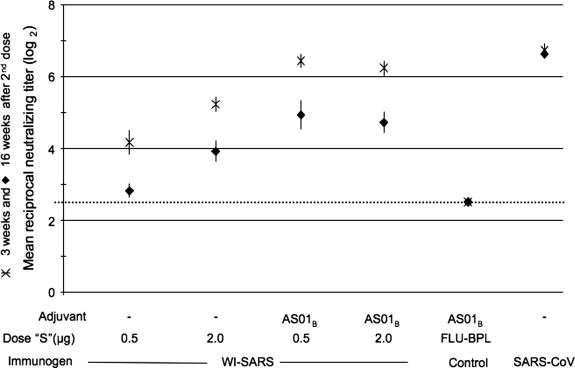
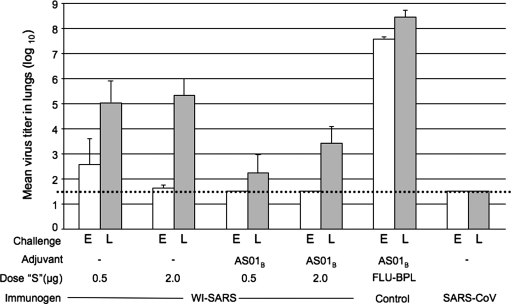
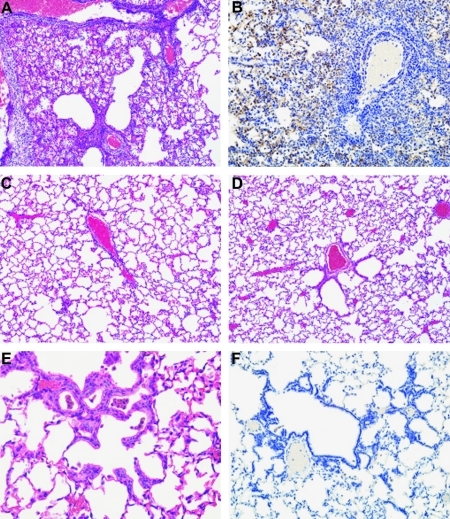
The immunogenicity and efficacy of β-propiolactone (BPL) inactivated whole virion SARS-CoV (WI-SARS) vaccine was evaluated in BALB/c mice and golden Syrian hamsters. The vaccine preparation was tested with or without adjuvants. Adjuvant Systems AS01(B) and AS03(A) were selected and tested for their capacity to elicit high humoral and cellular immune responses to WI-SARS vaccine. We evaluated the effect of vaccine dose and each adjuvant on immunogenicity and efficacy in mice, and the effect of vaccine dose with or without the AS01(B) adjuvant on the immunogenicity and efficacy in hamsters. Efficacy was evaluated by challenge with wild-type virus at early and late time points (4 and 18 wk post-vaccination). A single dose of vaccine with or without adjuvant was poorly immunogenic in mice; a second dose resulted in a significant boost in antibody levels, even in the absence of adjuvant. The use of adjuvants resulted in higher antibody titers, with the AS01(B)-adjuvanted vaccine being slightly more immunogenic than the AS03(A)-adjuvanted vaccine. Two doses of WI-SARS with and without Adjuvant Systems were highly efficacious in mice. In hamsters, two doses of WI-SARS with and without AS01(B) were immunogenic, and two doses of 2 μg of WI-SARS with and without the adjuvant provided complete protection from early challenge. Although antibody titers had declined in all groups of vaccinated hamsters 18 wk after the second dose, the vaccinated hamsters were still partially protected from wild-type virus challenge. Vaccine with adjuvant provided better protection than non-adjuvanted WI-SARS vaccine at this later time point. Enhanced disease was not observed in the lungs or liver of hamsters following SARS-CoV challenge, regardless of the level of serum neutralizing antibodies.
Figures
References
-
- Wang JT. Chang SC. Severe acute respiratory syndrome. Curr Opin Infect Dis. 2004;17:143–148. - PubMed
-
- Guan Y. Zheng BJ. He YQ, et al. Isolation and characterization of viruses related to the SARS coronavirus from animals in Southern China. Science. 2003;302:276–278. - PubMed
-
- Li W. Shi Z. Yu M, et al. Bats are natural reservoirs of SARS-like coronaviruses. Science. 2005;310:676–679. - PubMed
-
- Li F. Li W. Farzan M. Harrison SC. Structure of SARS coronavirus spike receptor-binding domain complexed with receptor. Science. 2005;309:1864–1868. - PubMed
Publication types
MeSH terms
Substances
Grants and funding
LinkOut - more resources
Full Text Sources
Other Literature Sources
Miscellaneous
