


Review
doi: 10.1161/CIRCRESAHA.110.223818.
PGC-1 coactivators in cardiac development and disease
Affiliations
- PMID: 20884884
- PMCID: PMC2955978
- DOI: 10.1161/CIRCRESAHA.110.223818
Item in Clipboard
Review
PGC-1 coactivators in cardiac development and disease
Circ Res.
.
Abstract
The beating heart requires a constant flux of ATP to maintain contractile function, and there is increasing evidence that energetic defects contribute to the development of heart failure. The last 10 years have seen a resurgent interest in cardiac intermediary metabolism and a dramatic increase in our understanding of transcriptional networks that regulate cardiac energetics. The PPAR-γ coactivator (PGC)-1 family of proteins plays a central role in these pathways. The mechanisms by which PGC-1 proteins regulate transcriptional networks and are regulated by physiological cues, as well as the roles they play in cardiac development and disease, are reviewed here.
Figures
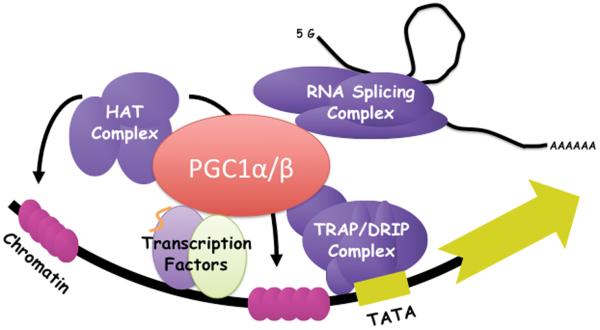
PGC-1 binds directly to transcription factors and serves as a docking scaffold for histone modifying enzymes, TRAP/DRIP/Mediator complex and RNA splicing machinery. B.) The PGC-1 family of coactivators. PGC1 family members share significant primary sequence homology in their activation and RNA binding domains, as well as domain organization.
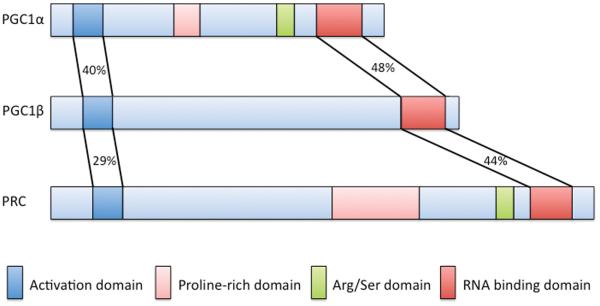
PGC-1 binds directly to transcription factors and serves as a docking scaffold for histone modifying enzymes, TRAP/DRIP/Mediator complex and RNA splicing machinery. B.) The PGC-1 family of coactivators. PGC1 family members share significant primary sequence homology in their activation and RNA binding domains, as well as domain organization.
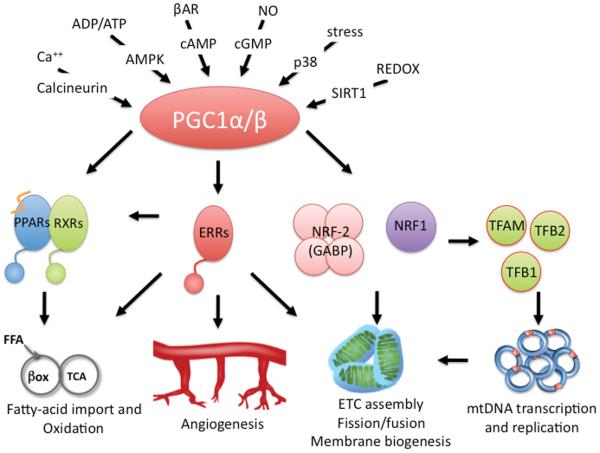
Multiple stimuli activate PGC-1, leading to the coactivation of key transcription factors involved in fatty-acid oxidation and import, angiogenesis, electron transport chain assembly, membrane biogenesis, and mitochondrial DNA replication and transcription.
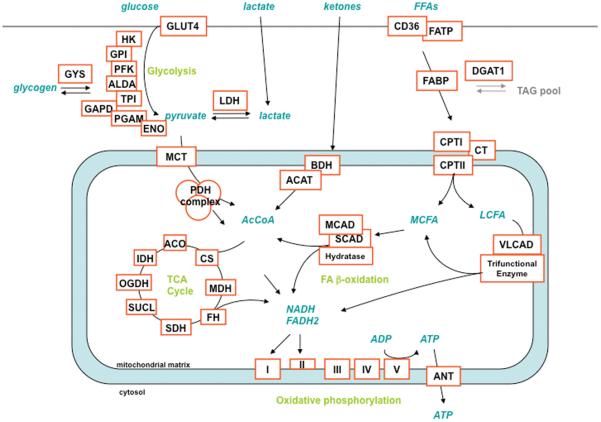
Neonatal rat ventricular myocytes (NRVM) were infected with adenovirus expressing PGC-1α versus GFP control, and 48hrs later gene expression was measured by qPCR. Metabolic pathways are noted in green. Induced genes are noted in red boxes. Glucose transporter 4 (GLUT4), hexokinase (HK), glucosephosphate isomerase (GPI), phosphofructose kinase (PFK), aldoase A (ALDA), triosephosphate isomerase (TPI), glyceraldehyde-3-phosphate dehydrogenase (GAPD), phosphoglycerate mutase (PGAM),enolase (ENO), glycogen synthase (GYS), lactate dehydrogenase (LDH), monocarboxylic acid transporter (MCT), pyruvate dehydrogenase (PDH), aconitase (ACO), citrate synthase (CS), isocitrate dehydrogenase (IDH), alpha-ketoglutarate dehydrogenase (OGDH), succinate-CoA-ligase (SUCL), succinate dehydrogenase (SDH), fumarase (FH), malate dehydrogenase (MDH), 3-alpha-hydroxybutyrate dehydrogenase (BDH), acetyl-CoA acetyltransferase (ACAT), medium-chain acyl-CoA dehydrogenase (MCAD), short-chain acyl-CoA dehydrogenase (SCAD), very long-chain acyl-CoA dehydrogenase (VLCAD), fatty-acid translocase (CD36), fatty-acid transport protein (FATP), fatty-acid binding protein (FABP), diacylglycerol O-acyltransferase (DGAT), carnitine palmitoyltransferase (CPT), carnitine translocase (CT), adenine nucleotide translocator (ANT), complex I (I), complex II (II), complex III (III), complex IV (IV), complex V (V), medium-chain fatty acid (MCFA), long-chain fatty acid (LCFA).
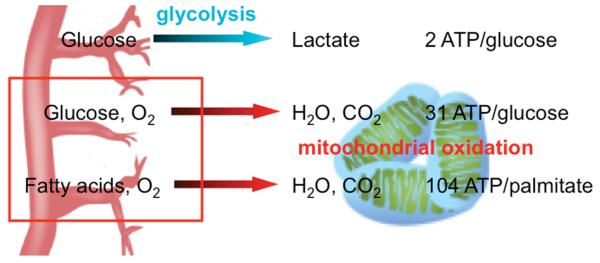
Vessels provide a constant supply of glucose, oxygen and fatty acids which are metabolized to produce ATP as an energy source. Net 2 ATP via anaerobic glycolysis and lactate production per glucose molecule or 30 ATP per molecule of glucose via oxidative consumption within the mitochondria. Catabolism of long chain fatty-acids such as palmitate within the mitochondria can yield 104 ATP per molecule.
References
-
- Lopaschuk GD, Spafford MA. Energy substrate utilization by isolated working hearts from newborn rabbits. Am J Physiol. 1990;258:H1274–1280. - PubMed
-
- Lopaschuk GD, Collins-Nakai RL, Itoi T. Developmental changes in energy substrate use by the heart. Cardiovasc Res. 1992;26:1172–1180. - PubMed
-
- Puigserver P, Wu Z, Park CW, Graves R, Wright M, Spiegelman BM. A cold-inducible coactivator of nuclear receptors linked to adaptive thermogenesis. Cell. 1998;92:829–839. - PubMed
-
- Lin J, Handschin C, Spiegelman BM. Metabolic control through the pgc-1 family of transcription coactivators. Cell Metab. 2005;1:361–370. - PubMed
Publication types
MeSH terms
Substances
Grants and funding
LinkOut - more resources
Full Text Sources
Other Literature Sources
Medical
