Germline variation controls the architecture of somatic alterations in tumors
- PMID: 20885788
- PMCID: PMC2944791
- DOI: 10.1371/journal.pgen.1001136
Germline variation controls the architecture of somatic alterations in tumors
Abstract
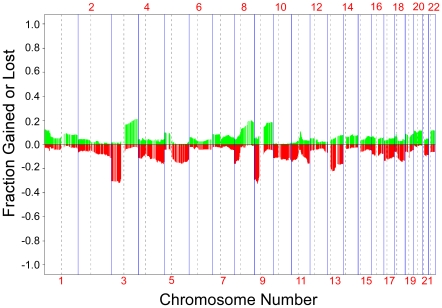
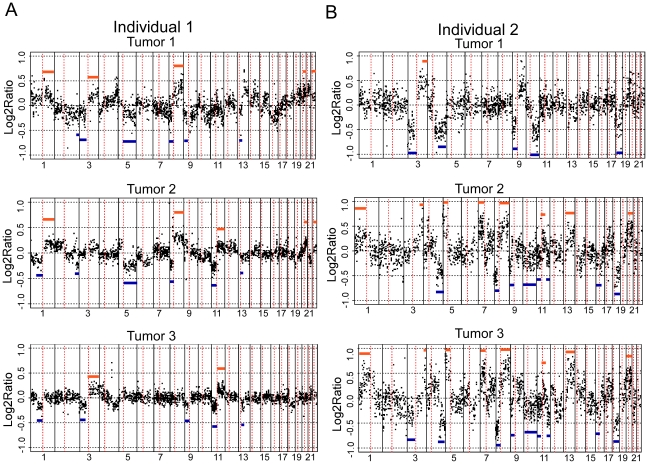
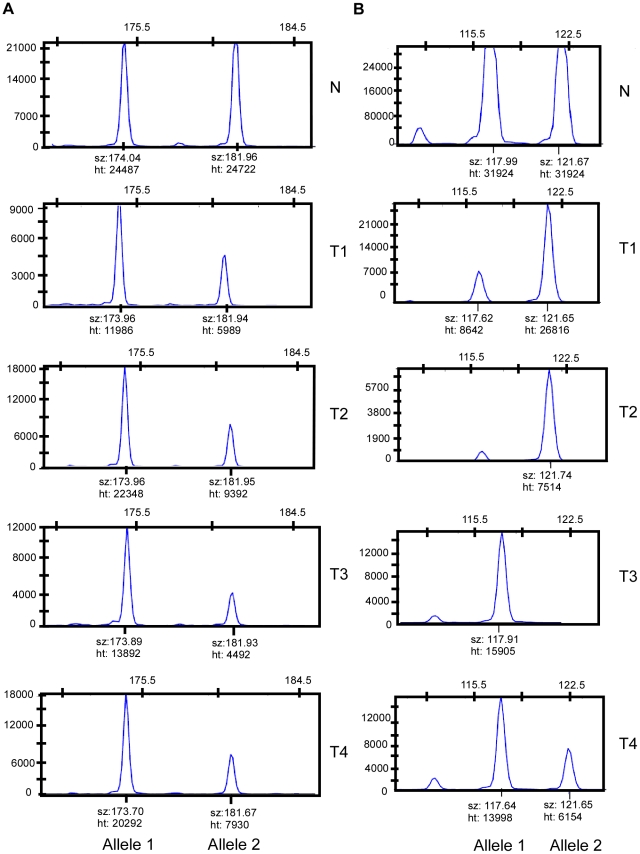
Studies have suggested that somatic events in tumors can depend on an individual's constitutional genotype. We used squamous cell carcinomas (SCC) of the skin, which arise in high multiplicity in organ transplant recipients, as a model to compare the pattern of somatic alterations within and across individuals. Specifically, we performed array comparative genomic hybridization on 104 tumors from 25 unrelated individuals who each had three or more independently arisen SCCs and compared the profiles occurring within patients to profiles of tumors across a larger set of 135 patients. In general, chromosomal aberrations in SCCs were more similar within than across individuals (two-sided exact-test p-value<1x10(-7)), consistent with the notion that the genetic background was affecting the pattern of somatic changes. To further test this possibility, we performed allele-specific imbalance studies using microsatellite markers mapping to 14 frequently aberrant regions of multiple independent tumors from 65 patients. We identified nine loci which show evidence of preferential allelic imbalance. One of these loci, 8q24, corresponded to a region in which multiple single nucleotide polymorphisms have been associated with increased cancer risk in genome-wide association studies (GWAS). We tested three implicated variants and identified one, rs13281615, with evidence of allele-specific imbalance (p-value=0.012). The finding of an independently identified cancer susceptibility allele with allele-specific imbalance in a genomic region affected by recurrent DNA copy number changes suggest that it may also harbor risk alleles for SCC. Together these data provide strong evidence that the genetic background is a key driver of somatic events in cancer, opening an opportunity to expand this approach to identify cancer risk alleles.
Conflict of interest statement
The authors have declared that no competing interests exist.
Figures
References
-
- Jonsson G, Naylor TL, Vallon-Christersson J, Staaf J, Huang J, et al. Distinct genomic profiles in hereditary breast tumors identified by array-based comparative genomic hybridization. Cancer Res. 2005;65:7612–7621. - PubMed
-
- Landi MT, Bauer J, Pfeiffer RM, Elder DE, Hulley B, et al. MC1R germline variants confer risk for BRAF-mutant melanoma. Science. 2006;313:521–522. - PubMed
-
- Maldonado JL, Fridlyand J, Patel H, Jain AN, Busam K, et al. Determinants of BRAF mutations in primary melanomas. J Natl Cancer Inst. 2003;95:1878–1890. - PubMed
-
- Ewart-Toland A, Briassouli P, de Koning JP, Mao JH, Yuan J, et al. Identification of Stk6/STK15 as a candidate low-penetrance tumor-susceptibility gene in mouse and human. Nat Genet. 2003;34:403–412. - PubMed
Publication types
MeSH terms
LinkOut - more resources
Full Text Sources
Medical
Research Materials