


Computational modeling of the mechanism of urease
- PMID: 20886006
- PMCID: PMC2945649
- DOI: 10.1155/2010/364891
Computational modeling of the mechanism of urease
Abstract
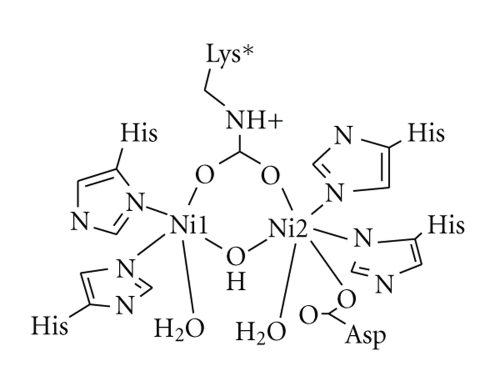
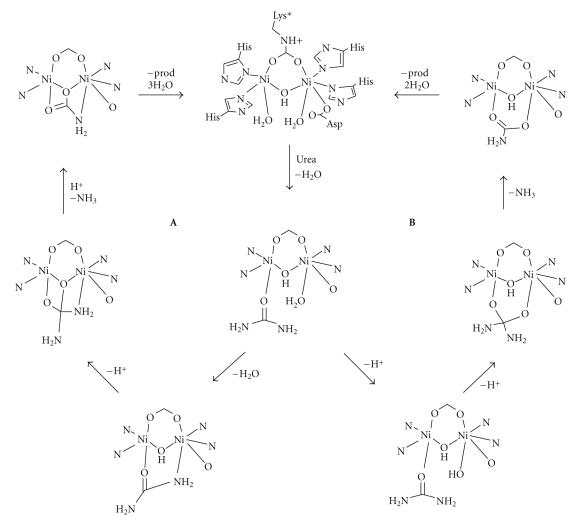
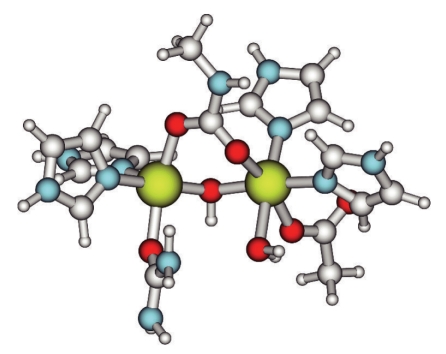
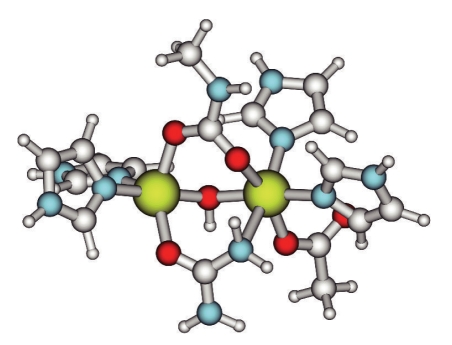
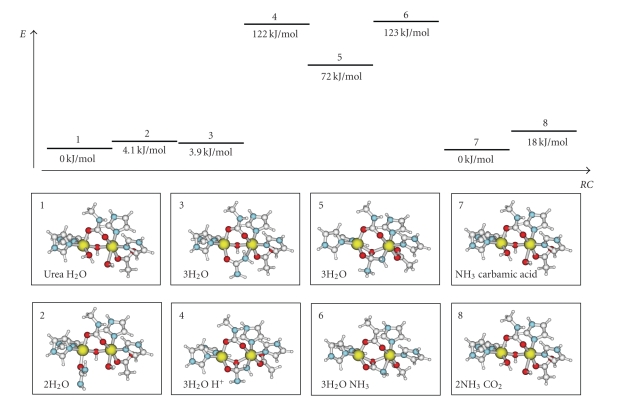
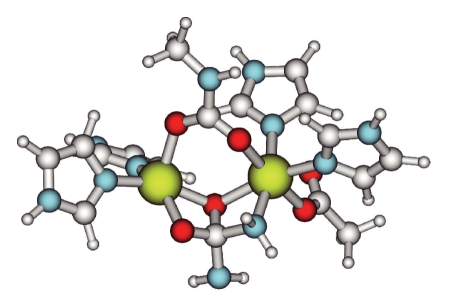
In order to elucidate aspects of the mechanism of the hydrolytic enzyme urease, theoretical calculations were undertaken on a model of the active site, using density functional theory. The bridging oxygen donor that has been found in the crystal structures was determined to be a hydroxide ion. The initial coordination of urea at the active site occurs most likely through the urea oxygen to the nickel ion with the lowest coordination number. This coordination can be made without much gain in energy. The calculations also showed that weak coordination of one of the urea amine nitrogen atoms to the second nickel atom is energetically feasible. Furthermore, a proposed mechanism including a tetrahedral intermediate generated by hydrolytic attack on the urea carbon by the bridging hydroxide was modeled, and the tetrahedral intermediate was found to be energetically unfavorable relative to terminal coordination of the substrate (urea).
Figures
References
-
- Karplus PA, Pearson MA, Hausinger RP. 70 years of crystalline urease: what have we learned? Accounts of Chemical Research. 1997;30(8):330–337.
-
- Sumner JB. The isolation and crystallization of the enzyme urease. The Journal of Biological Chemistry. 1926;69:435–441.
-
- Stingl K, De Reuse H. Staying alive overdosed: how does Helicobacter pylori control urease activity. International Journal of Medical Microbiology. 2005;295(5):307–315. - PubMed
-
- Bremner JM. Recent research on problems in the use of urea as a nitrogen fertilizer. Fertilizer Research. 1995;42(1–3):321–329.
LinkOut - more resources
Full Text Sources
