


Review
doi: 10.1086/655972.
What infants and breasts can teach us about natural protection from HIV infection
Affiliations
- PMID: 20887226
- PMCID: PMC2951298
- DOI: 10.1086/655972
Item in Clipboard
Review
What infants and breasts can teach us about natural protection from HIV infection
J Infect Dis.
.
Abstract
Most individuals exposed to human immunodeficiency virus (HIV), adults and children alike, do not become infected. Understanding the basis of this protection depends on systematically and comprehensively defining factors that determine the infectiousness of the host and the susceptibility of the recipient. Successful transmission depends on the relative balance between infectiousness and susceptibility, both of which are influenced by biologic, behavioral, and environmental factors. In this review, we discuss the advantages and disadvantages of mother‐to‐child HIV transmission as a model in which to elucidate correlates of immune protection.
Conflict of interest statement
Figures
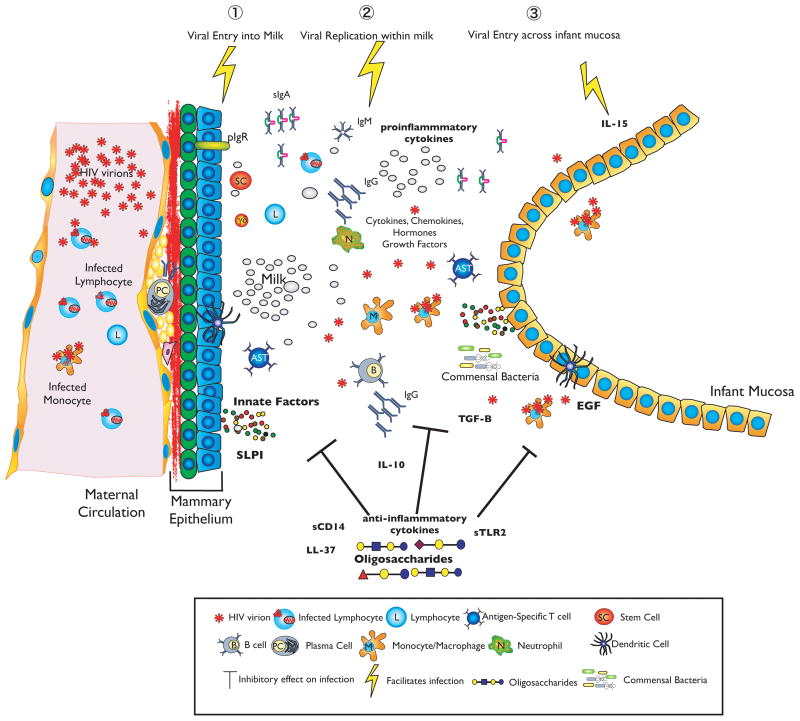
HIV can cross from maternal blood through the mammary epithelium into milk. Mucosal factors are likely to regulate the passage of HIV into milk by modulating mammary epithelia integrity. Within milk, substances may inactivate HIV and/or prevent binding to the infant mucosa and/or infant target cells. Milk also contains many factors anti-inflammatory factors that would limit viral replication within milk as well as maintaining the integrity of both the mammary and infant mucosal epithelium. Tropic substances (e.g. epithelial growth factor) are concentrated in breast milk and promote intestinal maturation and integrity. Inflammatory conditions within the infant mucosa such as thrush or gastroenteritis may facilitate infection by disrupting the epithelial barrier and/or activating HIV target cells. Many innate factors such as oligosaccharides, sTLR2 are concentrated in milk and appear to act at all 3 steps. These factors promote epithelial integrity both within the breast (reduce transmissibility) and in the infant oral or gut mucosa (reduce susceptibility) as well as interfere with HIV binding.
References
-
- Lederman MM, Penn-Nicholson A, Cho M, Mosier D. Biology of CCR5 and its role in HIV infection and treatment. JAMA. 2006;296:815–26. - PubMed
-
- Adams KM, Nelson JL. Microchimerism: an investigative frontier in autoimmunity and transplantation. JAMA. 2004;291:1127–31. - PubMed
-
- Langston C, Lewis DE, Hammill HA, et al. Excess intrauterine fetal demise associated with maternal human immunodeficiency virus infection. J Infect Dis. 1995;172:1451–60. - PubMed
-
- Walter J, Kuhn L, Aldrovandi GM. Advances in basic science understanding of mother-to-child HIV-1 transmission. Curr Opin HIV AIDS. 2008;3:146–50. - PubMed
