


Validation and simplification of the Radiation Therapy Oncology Group recursive partitioning analysis classification for glioblastoma
- PMID: 20888136
- PMCID: PMC3783211
- DOI: 10.1016/j.ijrobp.2010.06.012
Validation and simplification of the Radiation Therapy Oncology Group recursive partitioning analysis classification for glioblastoma
Abstract
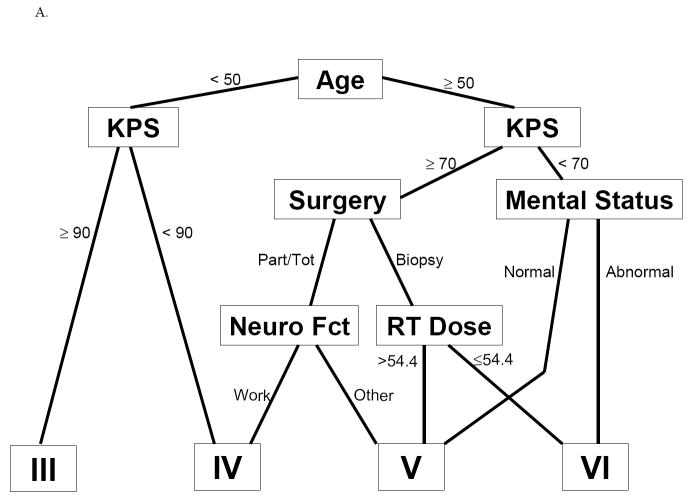
Purpose: Previous recursive partitioning analysis (RPA) of patients with malignant glioma (glioblastoma multiforme [GBM] and anaplastic astrocytoma [AA]) produced six prognostic groups (I-VI) classified by six factors. We sought here to determine whether the classification for GBM could be improved by using an updated Radiation Therapy Oncology Group (RTOG) GBM database excluding AA and by considering additional baseline variables.
Methods and materials: The new analysis considered 42 baseline variables and 1,672 GBM patients from the expanded RTOG glioma database. Patients receiving radiation only were excluded such that all patients received radiation+carmustine. "Radiation dose received" was replaced with "radiation dose assigned." The new RPA models were compared with the original model by applying them to a test dataset comprising 488 patients from six other RTOG trials. Fitness of the original and new models was evaluated using explained variation.
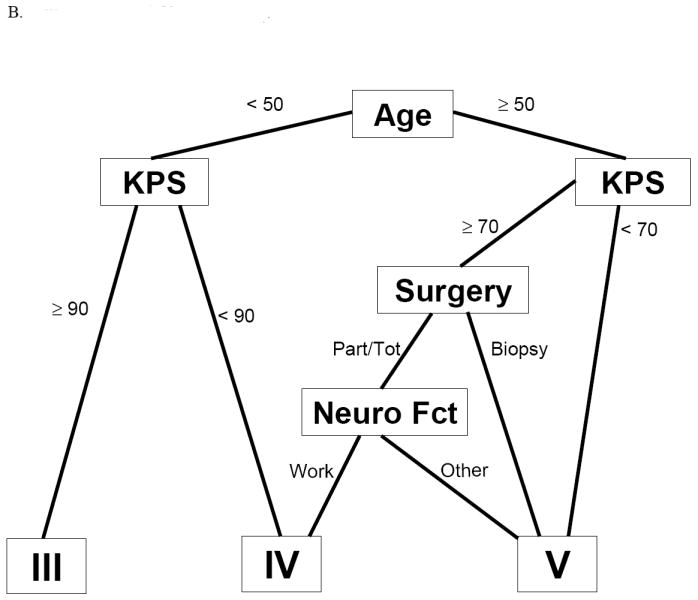
Results: The original RPA model explained more variations in survival in the test dataset than did the new models (20% vs. 15%) and was therefore chosen for further analysis. It was reduced by combining Classes V and VI to produce three prognostic classes (Classes III, IV, and V+VI), as Classes V and VI had indistinguishable survival in the test dataset. The simplified model did not further improve performance (explained variation 18% vs. 20%) but is easier to apply because it involves only four variables: age, performance status, extent of resection, and neurologic function. Applying this simplified model to the updated GBM database resulted in three distinct classes with median survival times of 17.1, 11.2, and 7.5 months for Classes III, IV, and V+VI, respectively.
Conclusions: The final model, the simplified original RPA model combining Classes V and VI, resulted in three distinct prognostic groups defined by age, performance status, extent of resection, and neurologic function. This classification will be used in future RTOG GBM trials.
Copyright © 2011 Elsevier Inc. All rights reserved.
Conflict of interest statement
Minesh Mehta serves as a consultant for Schering-Plough and Genentech, which market drugs for treating GBM. He also serves as a consultant for Tomotherapy Inc and Adnexus and is on the Board of Directors of Pharmacyclics. Other authors have no conflict of interest to disclose.
Figures

References
-
- Curran WJ, Jr, Scott CB, Horton J, et al. Recursive partitioning analysis of prognostic factors in three Radiation Therapy Oncology Group malignant glioma trials. J Natl Cancer Inst. 1993;85:704–710. - PubMed
-
- Walker MD, Green SB, Byar DP, et al. Randomized comparisons of radiotherapy and nitrosoureas for the treatment of malignant glioma after surgery. N Engl J Med. 1980;303:1323–1329. - PubMed
-
- Laperriere N, Zuraw L, Cairncross G. Radiotherapy for newly diagnosed malignant glioma in adults: a systematic review. Radiother Oncol. 2002;64:259–273. - PubMed
-
- Perry J, Laperriere N, Zuraw L, et al. Adjuvant chemotherapy for adults with malignant glioma: a systematic review. Can J Neurol Sci. 2007;34:402–410. - PubMed
-
- Deutsch M, Green SB, Strike TA, et al. Results of a randomized trial comparing BCNU plus radiotherapy, streptozotocin plus radiotherapy, BCNU plus hyperfractionated radiotherapy, and BCNU following misonidazole plus radiotherapy in the postoperative treatment of malignant glioma. Int J Radiat Oncol Biol Phys. 1989;16:1389–1396. - PubMed
Publication types
MeSH terms
Substances
Grants and funding
LinkOut - more resources
Full Text Sources
Medical
