


Sucking patterns and behavioral state in 1- and 2-day-old full-term infants
- PMID: 20919998
- PMCID: PMC2951282
- DOI: 10.1111/j.1552-6909.2010.01173.x
Sucking patterns and behavioral state in 1- and 2-day-old full-term infants
Abstract
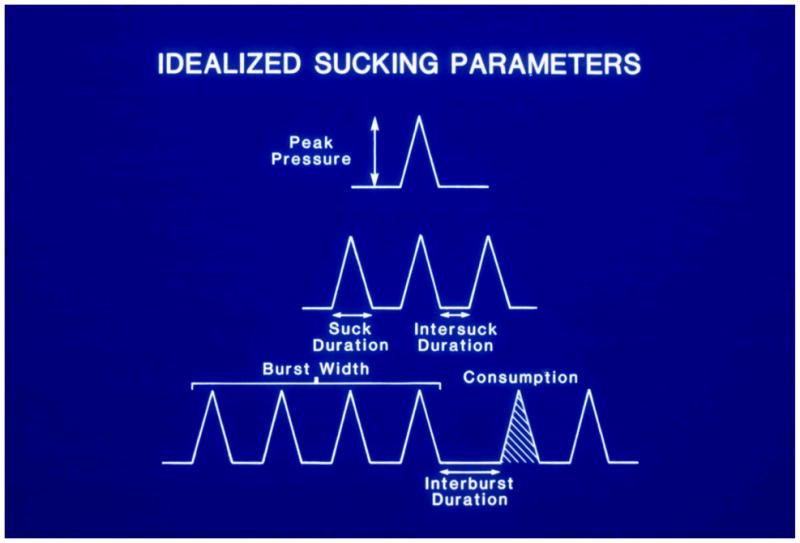
Objective: To provide a comprehensive analysis of the temporal structure of sucking in full-term neonates.
Design: Descriptive study.
Setting: Newborn nursery in a city teaching institution.
Patients/participants: Fifty-six full-term infants with a mean birth weight of 3,128±370 g completed sucking assessments on the first and second day of life.
Methods: A 5-minute sucking assessment was completed on the first and second day of life. Instruments included an Infant Nutritive Sucking Apparatus and the Anderson Behavioral Assessment Scale.
Results: The number of sucks (p<.001), intersuck width (p=.008) and interburst width (p<.05) were significantly different between the first and second day of life. On the second day of life the infants generated significantly more sucks, a decrease in interburst width and a decrease in intersuck width. There was a significant increase in the presence of an alert behavioral state from the first to second sucking assessment (p<.01). In addition, with a more alert infant state there was an increased time spent bursting (p<.001).
Conclusion: Our results show that sucking analysis is sensitive to infant status and suggest that the development of sucking methodology can be considered as a useful clinical tool to assess the normal developmental course of sucking patterns.
© 2010 AWHONN, the Association of Women's Health, Obstetric and Neonatal Nurses.
References
-
- Burroughs A, Asonye U, Anderson G, Vidyasagar D. The effects of nutritive sucking on transcutaneous oxygen tension in noncrying, preterm neonates. Research in Nursing and Health. 1978;1:69–75. - PubMed
-
- Crook C. The Organization and Control of Infant Sucking. Advances in Child Development and Behavior. 1979;14:209–253. - PubMed
-
- da Costa S, van den Engle-Hock L, Bos A. Sucking and swallowing in infants and diagnostic tools. Journal of Perinatology. 2008;28:247–257. - PubMed
-
- da Costa SP, van der Schans CP, Boelema SR, van der Meij E, Boerman MA, Bos AF. Sucking patterns in fullterm infants between birth and 10 weeks of age. Infant Behavior and Development. 2010;33(1):61–67. - PubMed
-
- Diggle P, Liang K, Zeger Sd. Anaylsis of Longitudinal Data. London: Oxford University Press; 1994.
Publication types
MeSH terms
Grants and funding
LinkOut - more resources
Full Text Sources
Other Literature Sources
