


Two-year changes in quality of life in elderly patients with low-energy hip fractures. A case-control study
- PMID: 20920239
- PMCID: PMC2954991
- DOI: 10.1186/1471-2474-11-226
Two-year changes in quality of life in elderly patients with low-energy hip fractures. A case-control study
Abstract
Background: The long-term effect of hip fracture on health-related quality of life (HRQOL) and global quality of life (GQOL) has not been thoroughly studied in prospective case-control studies.
Aims: a) to explore whether patients with low-energy hip fracture regain their pre-fracture levels in HRQOL and GQOL compared with changes in age- and sex-matched controls over a two year period; b) to identify predictors of changes in HRQOL and GQOL after two years.
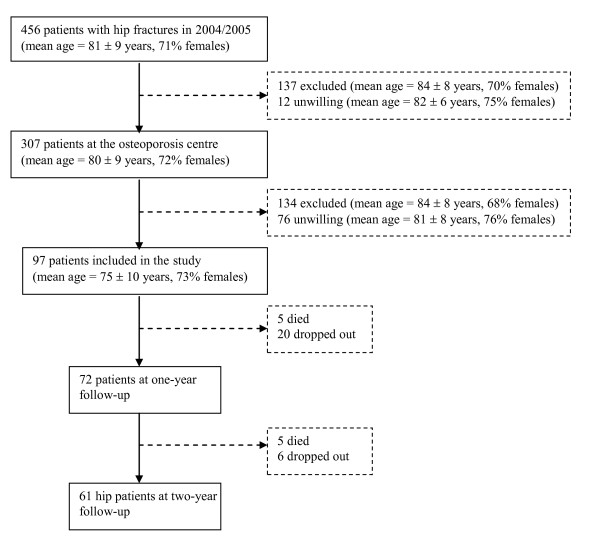
Methods: We examined 61 patients (mean age = 74 years, SD = 10) and 61 matched controls (mean age = 73 years, SD = 8). The Short Form 36 assessed HRQOL and the Quality of Life Scale assessed GQOL. Paired samples t tests and multiple linear regression analyses were applied.
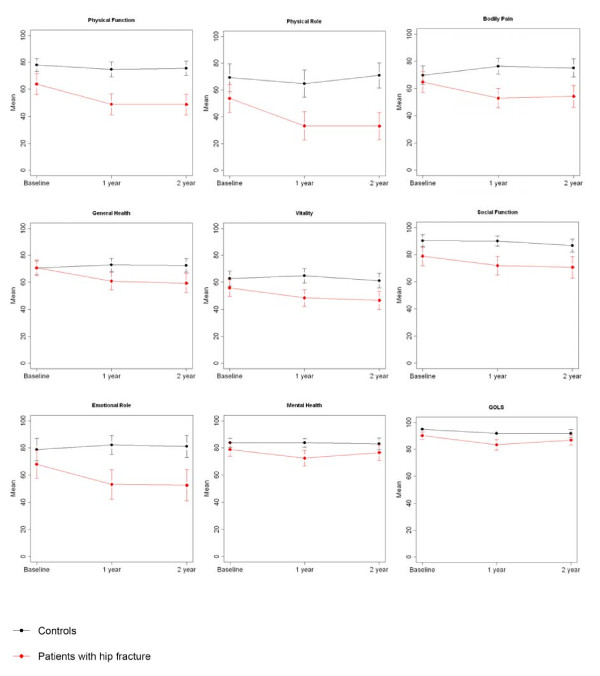
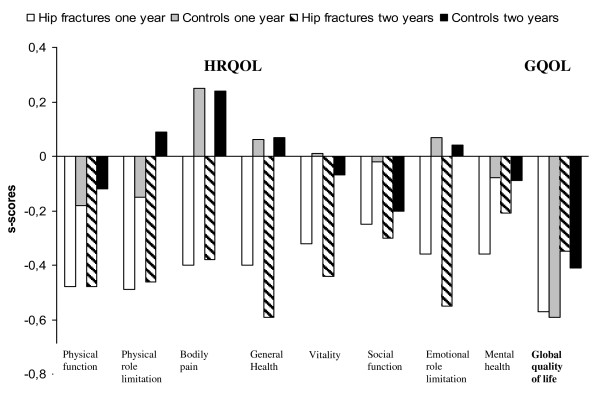
Results: HRQOL decreased significantly between baseline and one-year follow-up in patients with hip fractures, within all the SF-36 domains (p < 0.04), except for social functioning (p = 0.091). There were no significant decreases within the SF-36 domains in the controls. Significantly decreased GQOL scores (p < 0.001) were observed both within patients and within controls between baseline and one-year follow-up. The same pattern persisted between baseline and two-year follow-up, except for the HRQOL domain mental health (p = 0.193). The patients with hip fractures did not regain their HRQOL and GQOL. Worsened physical health after two years was predicted by being a patient with hip fracture (B = -5.8, p < 0.001) and old age (B = -1.0, p = 0.015), while worsened mental health was predicted by co-morbidity (B = -2.2, p = 0.029). No significant predictors of differential changes in GQOL were identified.
Conclusion: A hip fracture has a long-term impact on HRQOL and is a strong predictor of worsened physical health. Our data emphasize the importance of preventing hip fracture in the elderly to maintain physical health. This knowledge should be included in decision-making and health care plans.
Figures
References
Publication types
MeSH terms
LinkOut - more resources
Full Text Sources
Medical
