


Guidelines for insulin dosing in continuous subcutaneous insulin infusion using new formulas from a retrospective study of individuals with optimal glucose levels
- PMID: 20920437
- PMCID: PMC2956816
- DOI: 10.1177/193229681000400516
Guidelines for insulin dosing in continuous subcutaneous insulin infusion using new formulas from a retrospective study of individuals with optimal glucose levels
Abstract
Background: Successful insulin pump therapy depends on correct insulin doses based on an optimal total daily dose (TDD) and optimal pump settings for basal infusion, carbohydrate factor (CarbF), and glucose correction factor (CorrF) based on the TDD. There are limited data in the literature to guide providers and patients regarding methods to optimize these critical parameters for glucose control.
Methods: Anonymous data downloads from 1020 insulin pumps used throughout the United States and overseen by a variety of clinicians were analyzed retrospectively to find insulin doses that provided the best glucose control. A subset of 396 pumps was chosen for glucose data reliability, with over 85% of their glucose data directly entered from a meter. This subset was divided into tertiles based on glucose levels, and the low glucose tertile was analyzed to derive formulas for optimal insulin pump settings.
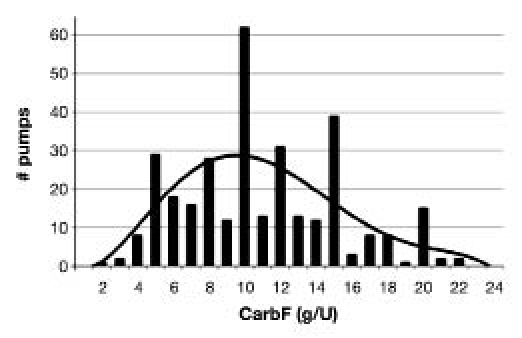
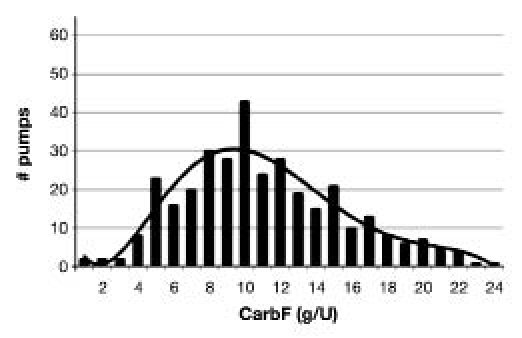
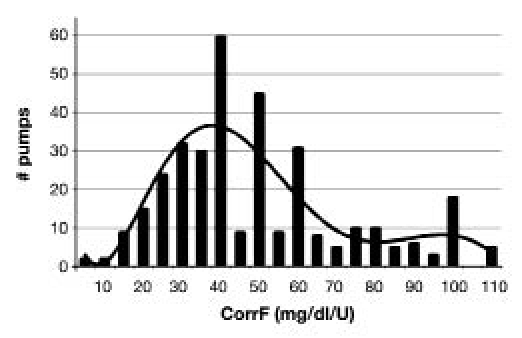
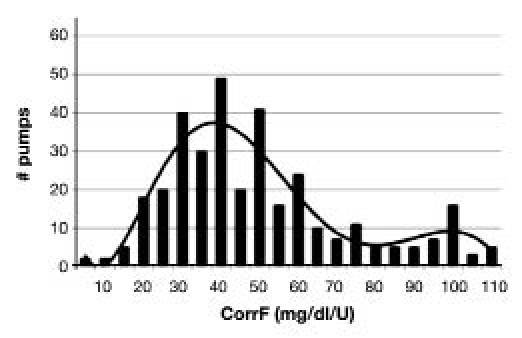
Results: An inconsistent clustering of pump settings was found for the CarbF and the CorrF. This was less pronounced when CarbFs and CorrFs were determined from the actual bolus doses delivered once adjustments were made to the initial dose calculations by users and, to a larger extent, internally by the bolus calculator itself. Common beliefs that hyperglycemia is related to less carb counting, fewer carb boluses, or delivery of less insulin per day were not substantiated in this data. New or verified insulin dosing formulas presented include basal U/day = TDD × 0.48; CarbF = [2.6 × Wt(lb)]/TDD; and CorrF = 1960/TDD.
Conclusions: Insulin pump users cannot reap full benefit from their pump bolus calculator if the settings on which bolus doses are based are less than optimal. Our data show that CarbFs and CorrFs tend to be unevenly distributed, suggesting that these factors are not selected in a systematic manner through use of formulas. Poor glucose outcomes among insulin pump users appear to be related to pump setting errors and being relatively underinsulinized, even though those in poor control use more total insulin per day. We have developed a model with the hypothesis that improved glucose outcomes will result from the use of formulas to derive appropriate pump settings. Prospective validation of these concepts is needed.
© 2010 Diabetes Technology Society.
Figures
References
-
- Walsh J, Roberts R. Pumping insulin. 2nd ed. San Diego: Torrey Pines Press; 1994.
-
- Davidson PC, Hebblewhite HR, Bode BW, Steed RD, Welch NS, Greenlee MC, Richardson PL, Johnson J. Statistically based CSII parameters: correction factor, CF (1700 rule), carbohydrate-to-insulin ratio, CIR (2.8 rule), and basal-to-total ratio. Diabetes Technol Ther. 2003;3:237.
-
- Davidson PC, Hebblewhite HR, Steed RD, Bode BW. Analysis of guidelines for basal-bolus dosing: basal insulin, correction factor, and carbohydrate-to-insulin ratio. Endocr Pract. 2008;14(9):1095–1101. - PubMed
-
- Adamsson U, Lins PE. Clinical views on insulin resistance in type-1 diabetes. In: Agardh CD, Berne C, Östman J, editors. Diabetes. Stockholm: Almqvist & Wiksell; 1992. pp. 142–150.
MeSH terms
Substances
LinkOut - more resources
Full Text Sources
Other Literature Sources
Medical
