


We need tighter regulatory standards for blood glucose monitoring, but they should be for accuracy disclosure
- PMID: 20920449
- PMCID: PMC2956814
- DOI: 10.1177/193229681000400528
We need tighter regulatory standards for blood glucose monitoring, but they should be for accuracy disclosure
Abstract
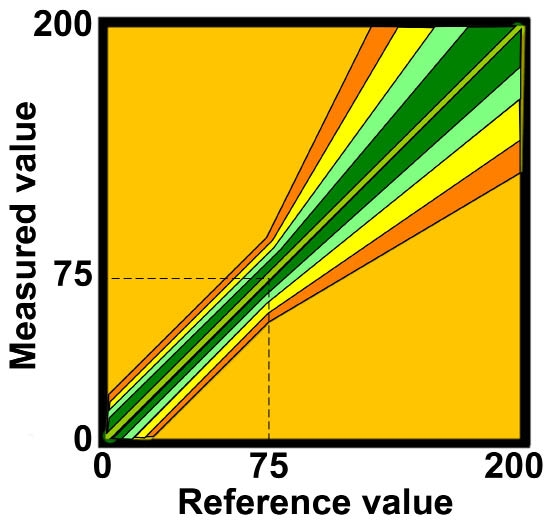
Regulatory interest has focused on the accuracy of blood glucose monitoring systems. Currently, almost all systems meet the International Organization for Standardization (ISO) 15197 clinical standard (≥95% of the values within 20% of the reference for values above 75 mg/dl and within 15 mg/dl below that level). Should the systems have to meet one of the extended ISO standards of 15%, 10%, or even 5%? There is a wide variety of people with diabetes doing glucose monitoring, and the majority do not need better accuracy. Indeed, when selecting an insulin dose, the inaccuracy of the glucose reading has little effect compared with the inaccuracy in counting carbohydrates and the variability in insulin absorption. It might be far better to evaluate the accuracy in a standard method and provide the accuracy values on a standard label. Patients and health care providers could then select the monitoring system that best meets their needs.
© 2010 Diabetes Technology Society.
Figures
References
-
- Hirsch IB, Bode BW, Childs BP, Close KL, Fisher WA, Gavin JR, Ginsberg BH, Raine CH, Verderese CA. Self-monitoring of blood glucose (SMBG) in insulin- and non-insulin-using adults with diabetes: consensus recommendations for improving SMBG accuracy, utilization, and research. Diabetes Technol Ther. 2008;10(6):419–439. - PubMed
-
- Klonoff DC, Bergenstal R, Blonde L, Boren SA, Church TS, Gaffaney J, Jovanovic L, Kendall DM, Kollman C, Kovatchev BP, Leippert C, Owens DR, Polonsky WH, Reach G, Renard E, Riddell MC, Rubin RR, Schnell O, Siminiero LM, Vigersky RA, Wilson DM, Wollitzer AO. Consensus report of the coalition for clinical research—self-monitoring of blood glucose. J Diabetes Sci Technol. 2008;2(6):1030–1053. - PMC - PubMed
-
- International Organization for Standardization In vitro diagnostic test systems. Requirements for blood-glucose monitoring systems for self-testing in managing diabetes mellitus. ISO 15197:2003. http://www.iso.org/iso/catalogue_detail.htm?csnumber=26309
MeSH terms
Substances
LinkOut - more resources
Full Text Sources
Medical
