. 2010 Oct 8;87(4):513-22.
doi: 10.1016/j.ajhg.2010.09.010.

Mutations in the SPTLC2 subunit of serine palmitoyltransferase cause hereditary sensory and autonomic neuropathy type I

Affiliations

Mutations in the SPTLC2 subunit of serine palmitoyltransferase cause hereditary sensory and autonomic neuropathy type I

Annelies Rotthier et al. Am J Hum Genet. .

Abstract

Hereditary sensory and autonomic neuropathy type I (HSAN-I) is an axonal peripheral neuropathy associated with progressive distal sensory loss and severe ulcerations. Mutations in the first subunit of the enzyme serine palmitoyltransferase (SPT) have been associated with HSAN-I. The SPT enzyme catalyzes the first and rate-limiting step in the de novo sphingolipid synthesis pathway. However, different studies suggest the implication of other genes in the pathology of HSAN-I. Therefore, we screened the two other known subunits of SPT, SPTLC2 and SPTLC3, in a cohort of 78 HSAN patients. No mutations were found in SPTLC3, but we identified three heterozygous missense mutations in the SPTLC2 subunit of SPT in four families presenting with a typical HSAN-I phenotype. We demonstrate that these mutations result in a partial to complete loss of SPT activity in vitro and in vivo. Moreover, they cause the accumulation of the atypical and neurotoxic sphingoid metabolite 1-deoxy-sphinganine. Our findings extend the genetic heterogeneity in HSAN-I and enlarge the group of HSAN neuropathies associated with SPT defects. We further show that HSAN-I is consistently associated with an increased formation of the neurotoxic 1-deoxysphinganine, suggesting a common pathomechanism for HSAN-I.


Figures

Figure 1
Figure 1
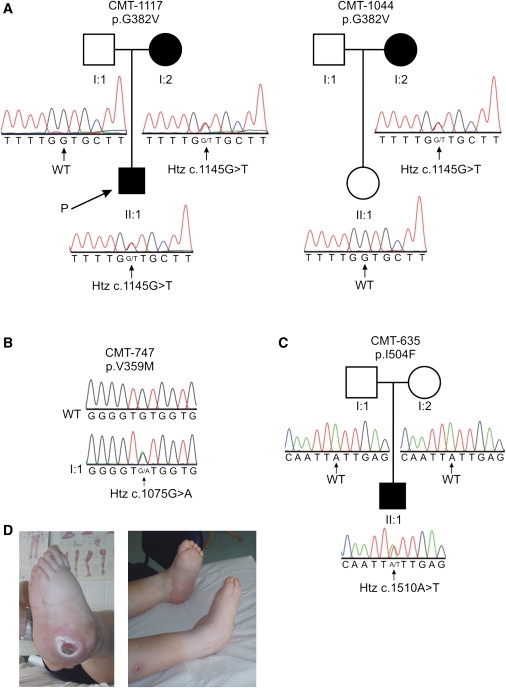
Missense Mutations in SPTLC2 Are Associated with HSAN-I (A) Sequence trace files of the G382V mutation in families CMT-1117 (proband indicated by arrow) and CMT-1044. (B) Isolated patient CMT-747.I:1 with the V359M mutation. (C) Patient CMT-635.II:1 carrying a de novo I504F mutation. (D) Severe ulcerations and deformation of the foot of patient CMT-635.II:1 at the age of 10 yrs. Htz, heterozygous; WT, wild type.
Figure 2
Figure 2
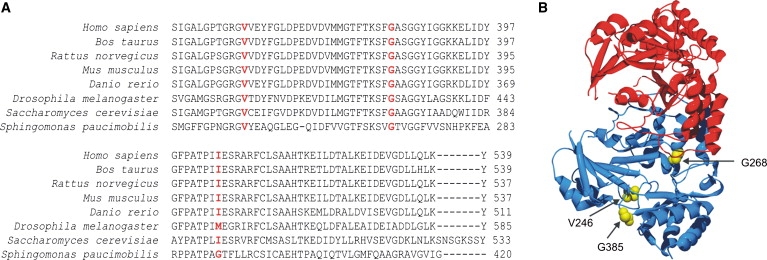
Conservation of Mutations among Species and Structural View of the Bacterial SPT Enzyme (A) ClustalW multiple protein alignment of the SPTLC2 orthologues from human (Homo sapiens), mouse (Mus musculus), rat (Rattus norvegicus), taurus (Bos Taurus), zebrafish (Danio rerio), fly (Drosophila melanogaster), baker's yeast (Saccharomyces cerevisiae), and Gram-negative bacteria with SPT activity (Sphingomonas paucimobilis). (B) SPT structure of the Sphingomonas paucimobilis SPT homodimer (PDB ID: 2JGT) with the dimeric subunits represented in red and blue. The highlighted amino acids (V246, G268, and G385) correspond to the amino acids (V359, G382, and I504) mutated in the HSAN-I patients (see alignment in A).
Figure 3
Figure 3
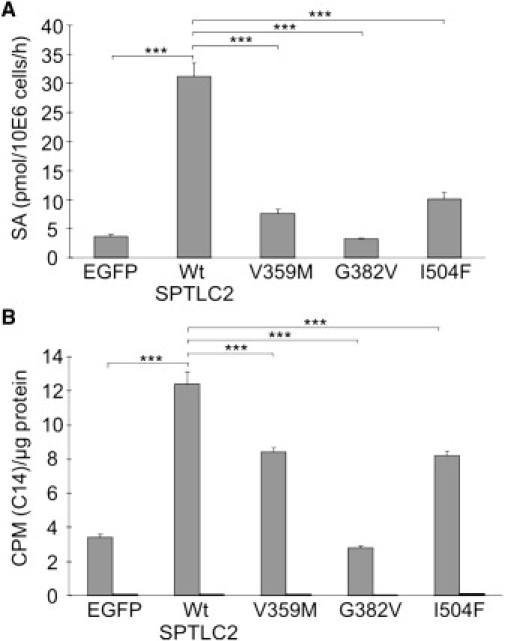
In Vitro SPT Activity Measurements of HSAN-I Associated SPTLC2 Mutants (A) Fumonisin B1 block assay. SPT activity in HEK293 cells stably expressing WT or mutant SPTLC2 is analyzed by measuring SA accumulation after treatment with Fumonisin B1. Stable expression of WT SPTLC2 generates an 8.5-fold increase in SPT activity (p = 3.24 × 10⁻⁵), whereas the G382V mutant does not increase SPT activity (p = 0.18). The V359M and I504F mutations increase the activity significantly (p = 0.00063 and 0.00064, respectively) but not to the same extent as WT SPTLC2. Enhanced GFP (EGFP)-transfected cells served as control. (B) Radioactivity-based SPT activity assay. SPT activity of HEK293 cells stably expressing WT or mutant SPTLC2 was determined by measuring the incorporation of 14C-labeled L-serine in vitro. Stable expression of WT SPTLC2 results in a significant increase in SPT activity, whereas the expression of G382V fails to raise SPT activity above basal levels. Expression of the V359M or I504F mutant elevates SPT activity, but not as drastically as WT SPTLC2. The right bars represent SPT activity in the presence of the SPT inhibitor myriocin (negative control; see Figure S1). CPM, counts per minute; SA, sphinganine. ∗∗∗ p < 0.001. Data are represented as mean, with error bars representing standard deviations. Error bars and standard deviation were calculated on the basis of three independent experiments.
Figure 4
Figure 4
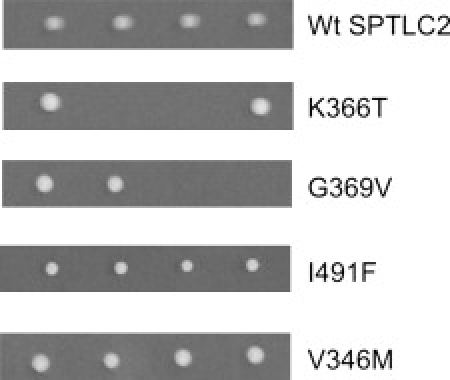
Genetic Complementation Test in S. cerevisiae by Tetrad Dissection of a Heterozygous LCB2/lcb2::KanMX Strain Complemented with Different YCplac111_LCB2 Constructs WT LCB2 can complement LCB2 deficiency, as shown by the appearance of four equally sized colonies on YPD medium without phytosphingosine at 37°C. The V346M (corresponding to V359M in SPTLC2) and I491F (corresponding to I504F in SPTLC2) LCB2 mutants also rescue the absence of endogenous LCB2. However, yeast transformed with the G369V (corresponding to G382V in SPTLC2) or K366T (dominant negative) mutants yields only colonies when endogenous LCB2 is present, demonstrating the failure of these mutants to complement LCB2 deficiency.
Figure 5
Figure 5
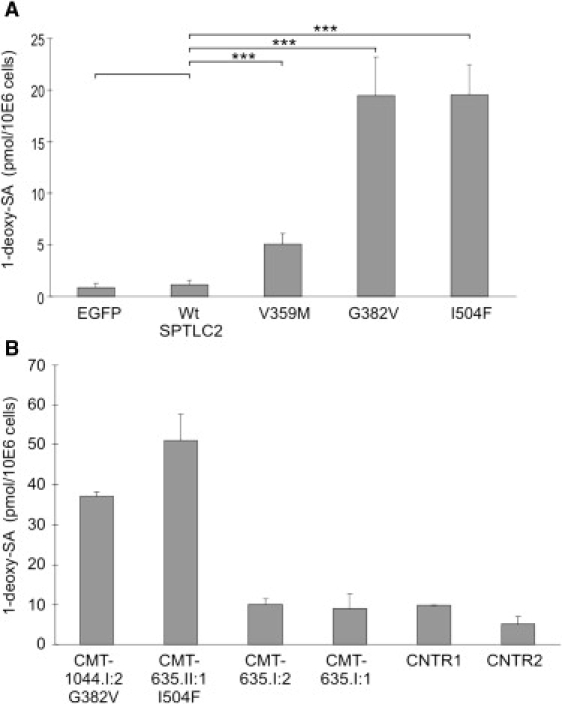
SPTLC2 Mutations Affect the Enzymatic Affinity of SPT (A) Levels of 1-deoxy-SA in HEK293 cells stably expressing WT or mutant SPTLC2 are measured after an acid and base hydrolysis assay of the extracted lipids. Expression of WT SPTLC2 does not change cellular 1-deoxy-SA levels (p = 0.55), whereas all three HSAN-I-associated mutants result in significantly elevated 1-deoxy-SA levels (p = 0.0025 for V359M; 0.00093 for G382V; 0.00048 for I504F). (B) 1-deoxy-SA levels in HSAN-I patient lymphoblastoid cell lines. The two HSAN-I patients CMT-1044.I:2 (G382V mutation) and CMT-635.II:1 (I504F mutation) show higher levels of 1-deoxy-SA compared to the unaffected parents of CMT-635.II:1 and to two unrelated control individuals. Unfortunately, no lymphoblast cells were available of patient CMT-747.I:1 carrying the V359M mutation. ∗∗∗ p value < 0.001. SA, sphinganine. Data are represented as mean, with error bars representing standard deviations. Error bars and standard deviation were calculated on the basis of three independent experiments.

References

    1. Dyck P.J., Chance P., Lebo R., Carney J.A. Hereditary motor and sensory neuropathies. In: Dyck P.J., Thomas P.K., Griffin J.W., Low P.A., Poduslo J.F., editors. Peripheral neuropathy. Third Edition. W.B. Saunders; Philadelphia: 1993. pp. 1065–1093.
    1. Auer-Grumbach M. Hereditary sensory neuropathies. Drugs Today (Barc) 2004;40:385–394. - PubMed
    1. Verpoorten N., De Jonghe P., Timmerman V. Disease mechanisms in hereditary sensory and autonomic neuropathies. Neurobiol. Dis. 2006;21:247–255. - PubMed
    1. Bejaoui K., Wu C., Scheffler M.D., Haan G., Ashby P., Wu L., de Jong P., Brown R.H., Jr. SPTLC1 is mutated in hereditary sensory neuropathy, type 1. Nat. Genet. 2001;27:261–262. - PubMed
    1. Dawkins J.L., Hulme D.J., Brahmbhatt S.B., Auer-Grumbach M., Nicholson G.A. Mutations in SPTLC1, encoding serine palmitoyltransferase, long chain base subunit-1, cause hereditary sensory neuropathy type I. Nat. Genet. 2001;27:309–312. - PubMed

Publication types

Associated data