Association of bacteria and viruses with wheezy episodes in young children: prospective birth cohort study
- PMID: 20921080
- PMCID: PMC2950260
- DOI: 10.1136/bmj.c4978
Association of bacteria and viruses with wheezy episodes in young children: prospective birth cohort study
Abstract
Objective: To study the association between wheezy symptoms in young children and the presence of bacteria in the airways.
Design: Birth cohort study.
Setting: Clinical research unit in Copenhagen.
Participants: Children of asthmatic mothers, from age 4 weeks to 3 years, with planned visits and acute admissions to the research clinic.
Main outcome measure: Frequency of bacteria and virus carriage in airway aspirates during wheezy episodes and at planned visits without respiratory symptoms.
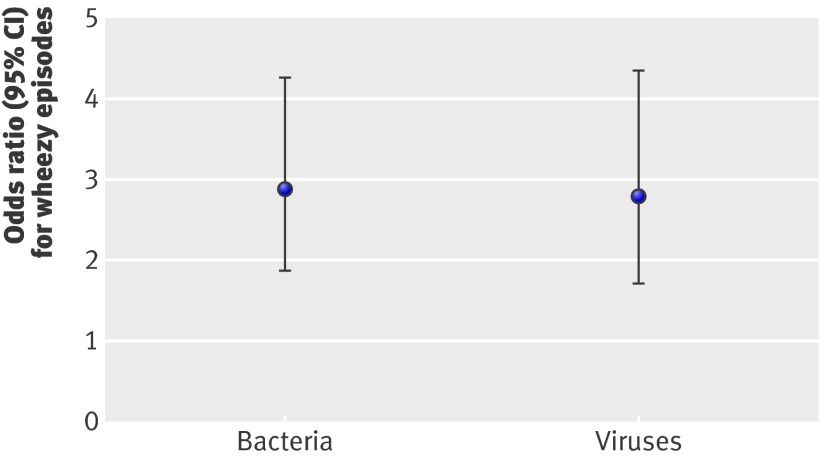
Results: 984 samples (361 children) were analysed for bacteria, 844 (299 children) for viruses, and 696 (277 children) for both viruses and bacteria. Wheezy episodes were associated with both bacterial infection (odds ratio 2.9, 95% confidence interval 1.9 to 4.3; P<0.001) and virus infection (2.8, 1.7 to 4.4; P<0.001). The associations of bacteria and viruses were independent of each other.
Conclusion: Acute wheezy episodes in young children were significantly associated with bacterial infections similar to but independent of the association with virus infections.
Conflict of interest statement
All authors have completed the Unified Competing Interest form at
Figures
Comment in
-
Bacteria in the respiratory tract and wheeze in children.BMJ. 2010 Oct 4;341:c4836. doi: 10.1136/bmj.c4836. BMJ. 2010. PMID: 20921079 No abstract available.
References
-
- Kocevar VS, Bisgaard H, Jonsson L, Valovirta E, Kristensen F, Yin DD, et al. Variations in pediatric asthma hospitalization rates and costs between and within Nordic countries. Chest 2004;125:1680-4. - PubMed
-
- Bush A. Practice imperfect—treatment for wheezing in preschoolers. N Engl J Med 2009;360:409-10. - PubMed
-
- Kusel MM, de Klerk NH, Holt PG, Kebadze T, Johnston SL, Sly PD. Role of respiratory viruses in acute upper and lower respiratory tract illness in the first year of life: a birth cohort study. Pediatr Infect Dis J 2006;25:680-6. - PubMed
-
- Lemanske RF Jr, Jackson DJ, Gangnon RE, Evans MD, Li Z, Shult PA, et al. Rhinovirus illnesses during infancy predict subsequent childhood wheezing. J Allergy Clin Immunol 2005;116:571-7. - PubMed
Publication types
MeSH terms
LinkOut - more resources
Full Text Sources
Medical