


Repeated transient mRNA bursts precede increases in transcriptional and mitochondrial proteins during training in human skeletal muscle
- PMID: 20921196
- PMCID: PMC3010147
- DOI: 10.1113/jphysiol.2010.199448
Repeated transient mRNA bursts precede increases in transcriptional and mitochondrial proteins during training in human skeletal muscle
Abstract
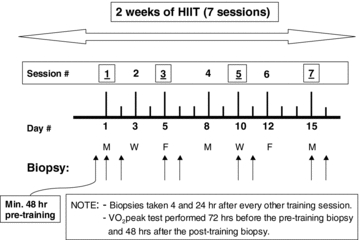
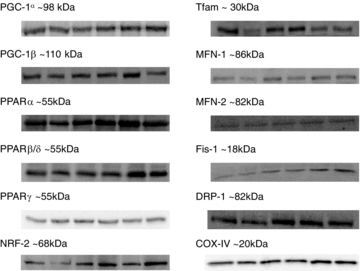
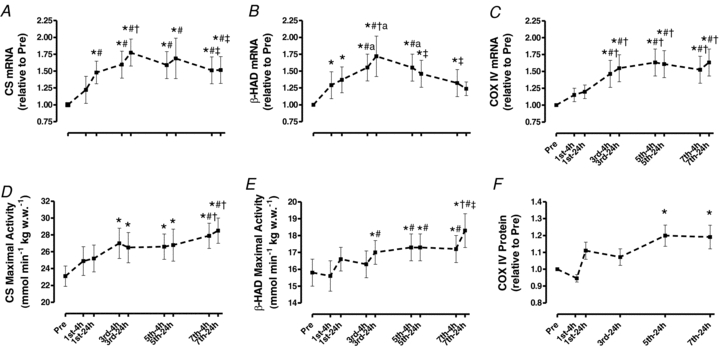
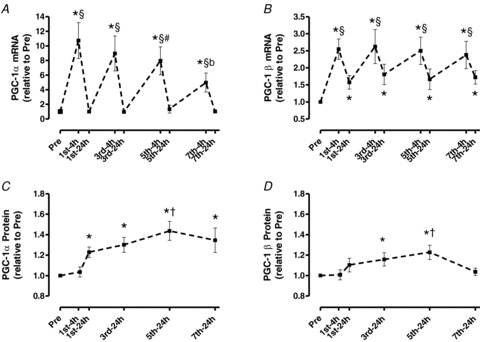
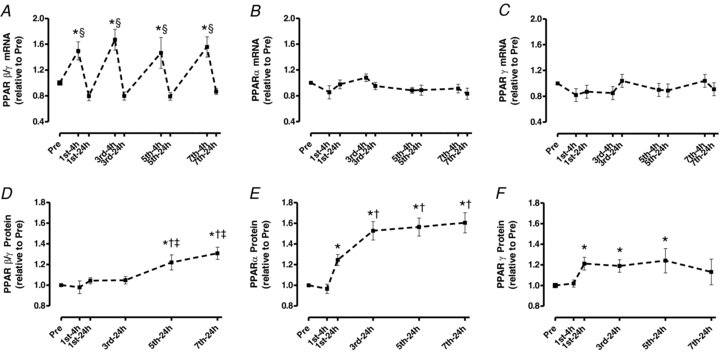
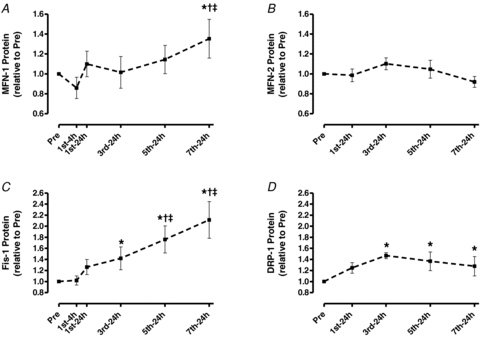
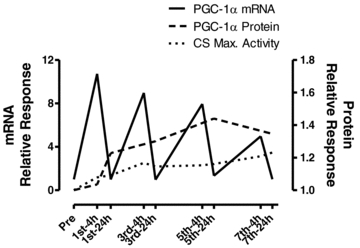
Exercise training induces mitochondrial biogenesis, but the time course of molecular sequelae that accompany repetitive training stimuli remains to be determined in human skeletal muscle. Therefore, throughout a seven-session, high-intensity interval training period that increased (12%), we examined the time course of responses of (a) mitochondrial biogenesis and fusion and fission proteins, and (b) selected transcriptional and mitochondrial mRNAs and proteins in human muscle. Muscle biopsies were obtained 4 and 24 h after the 1st, 3rd, 5th and 7th training session. PGC-1α mRNA was increased >10-fold 4 h after the 1st session and returned to control within 24 h. This 'saw-tooth' pattern continued until the 7th bout, with smaller increases after each bout. In contrast, PGC-1α protein was increased 24 h after the 1st bout (23%) and plateaued at +30-40% between the 3rd and 7th bout. Increases in PGC-1β mRNA and protein were more delayed and smaller, and did not persist. Distinct patterns of increases were observed in peroxisome proliferator-activated receptor (PPAR) α and γ protein (1 session), PPAR β/δ mRNA and protein (5 sessions) and nuclear respiratory factor-2 protein (3 sessions) while no changes occurred in mitochondrial transcription factor A protein. Citrate synthase (CS) and β-HAD mRNA were rapidly increased (1 session), followed 2 sessions later (session 3) by increases in CS and β-HAD activities, and mitochondrial DNA. Changes in COX-IV mRNA (session 3) and protein (session 5) were more delayed. Training also increased mitochondrial fission proteins (fission protein-1, >2-fold; dynamin-related protein-1, 47%) and the fusion protein mitofusin-1 (35%) but not mitofusin-2. This study has provided the following novel information: (a) the training-induced increases in transcriptional and mitochondrial proteins appear to result from the cumulative effects of transient bursts in their mRNAs, (b) training-induced mitochondrial biogenesis appears to involve re-modelling in addition to increased mitochondrial content, and (c) the 'transcriptional capacity' of human muscle is extremely sensitive, being activated by one training bout.
Figures
Comment in
-
Regulating the regulators: the role of transcriptional regulatory proteins in the adaptive response to exercise in human skeletal muscle.J Physiol. 2011 Apr 1;589(Pt 7):1511-2. doi: 10.1113/jphysiol.2011.205401. J Physiol. 2011. PMID: 21486836 Free PMC article. No abstract available.
References
-
- Arany Z, Lebrasseur N, Morris C, Smith E, Yang W, Ma Y, Chin S, Spiegelman BM. The transcriptional coactivator PGC-1β drives the formation of oxidative type IIX fibers in skeletal muscle. Cell Metab. 2007;5:35–46. - PubMed
-
- Bach D, Pich S, Soriano FX, Vega N, Baumgartner B, Oriola J, Daugaard JR, Lloberas J, Camps M, Zierath JR, Rabasa-Lhoret R, Wallberg-Henriksson H, Laville M, Palacin M, Vidal H, Rivera F, Brand M, Zorzano A. Mitofusin-2 determines mitochondrial network architecture and mitochondrial metabolismA novel regulatory mechanism altered in obesity. J Biol Chem. 2003;278:17190–17197. - PubMed
-
- Bengtsson J, Gustafsson T, Widegren U, Jansson E, Sundberg CJ. Mitochondrial transcription factor A and respiratory complex IV increase in response to exercise training in humans. Pflugers Arch. 2001;443:61–66. - PubMed
-
- Benton CR, Holloway GP, Han XX, Yoshida Y, Snook LA, Lally J, Glatz JF, Luiken JJ, Chabowski A, Bonen A. Increased levels of peroxisome proliferator-activated receptor γ, coactivator 1α (PGC-1α) improve lipid utilisation, insulin signalling and glucose transport in skeletal muscle of lean and insulin-resistant obese Zucker rats. Diabetologia. 2010;53:2008–2019. - PubMed
Publication types
MeSH terms
Substances
LinkOut - more resources
Full Text Sources
Medical
Research Materials
