. 2010 Dec;16(12):2537-52.
doi: 10.1261/rna.2242610. Epub 2010 Oct 4.

Optimization of enzymatic reaction conditions for generating representative pools of cDNA from small RNA

Affiliations

Optimization of enzymatic reaction conditions for generating representative pools of cDNA from small RNA

Daniela B Munafó et al. RNA. 2010 Dec.

Abstract

Small regulatory RNA repertoires in biological samples are heterogeneous mixtures that may include species arising from varied biosynthetic pathways and modification events. Small RNA profiling and discovery approaches ought to capture molecules in a way that is representative of expression level. It follows that the effects of RNA modifications on representation should be minimized. The collection of high-quality, representative data, therefore, will be highly dependent on bias-free sample manipulation in advance of quantification. We examined the impact of 2'-O-methylation of the 3'-terminal nucleotide of small RNA on key enzymatic reactions of standard front-end manipulation schemes. Here we report that this common modification negatively influences the representation of these small RNA species. Deficits occurred at multiple steps as determined by gel analysis of synthetic input RNA and by quantification and sequencing of derived cDNA pools. We describe methods to minimize the effects of 2'-O-methyl modification of small RNA 3'-termini using T4 RNA ligase 2 truncated, and other optimized reaction conditions, demonstrating their use by quantifying representation of miRNAs and piRNAs in cDNA pools prepared from biological samples.


Figures

FIGURE 1.
FIGURE 1.
Poly(A) polymerase and poly(U) polymerase tailing bias against 2′-O-methylated small RNA 3′-ends. (A) Gel analysis of small RNA polyadenylation. Products of poly(A) polymerase (PAP), or poly(U) polymerase (PUP) polyadenylation reactions were resolved by denaturing PAGE and visualized by SYBR Gold staining. Tailing reactions contained 21-nt RNAs that were unmodified (2′-OH) or 2′-O-methylated (2′-O-Me) as indicated. (B) Quantification of 2′-O-methyl 3′-end nucleotide bias. Small RNA polyadenylation reactions using PAP or PUP were performed on unmodified or 2′-O-methylated small RNAs that terminated with A, C, G, or U. The extent of polyadenylation was determined by densitometry. Plotted points represent the mean ± standard error of the mean (SEM); n = 3 experimental replicates.
FIGURE 2.
FIGURE 2.
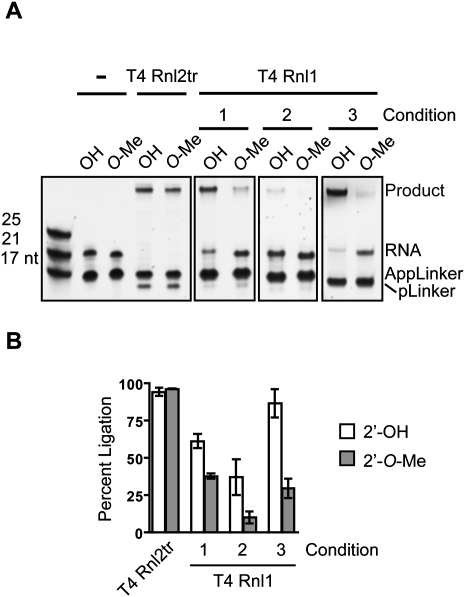
RNA 3′-end attachment. (A) Comparison of optimized T4 Rnl2tr ligation to published ligation conditions. Synthetic ssRNA oligonucleotides with either 2′-hydroxyl (OH) or 2′-O-methyl (O-Me) 3′-ends were ligated to pre-adenylated DNA adapter (AppLinker) using T4 Rnl2tr or T4 Rnl1 under different ligation conditions (conditions 1, 2, 3; detailed in Materials and Methods). Ligation products were resolved and visualized by SYBR Gold staining. (B) Quantification of ligation efficiency. Percent ligation refers to the amount of input RNA converted to ligated species as measured by densitometry. Data points represent the mean ± SEM; n = 3 experimental replicates.
FIGURE 3.
FIGURE 3.
RNA 3′-end adapter ligation bias against 2′-O-methylated small RNA 3′-ends. Synthetic ssRNA oligonucleotides with either 2′-hydroxyl (OH) or 2′-O-methyl (O-Me) 3′-ends and different 3′-terminal nucleotides (A, C, G, or U) were ligated to a pre-adenylated DNA adapter (AppLinker) using either T4 Rnl2tr or T4 Rnl1. Ligation products were resolved and visualized by SYBR Gold staining. Percent ligation refers to the relative amount of input RNA converted to ligated species as measured by densitometry. Data points represent the mean ± SEM; n = 3 experimental replicates.
FIGURE 4.
FIGURE 4.
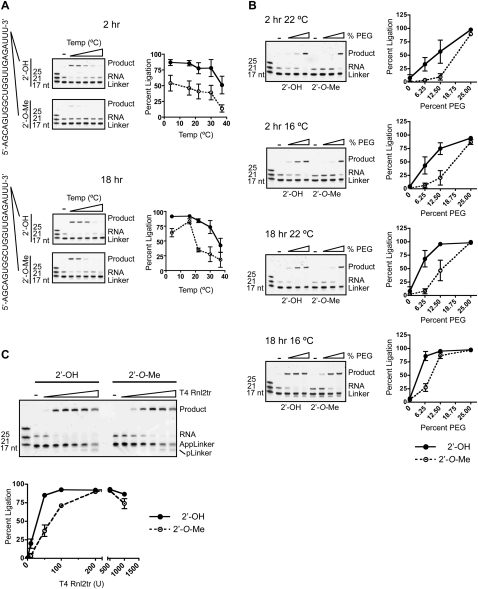
Optimization of RNA 3′-end adapter ligation. (A) Temperature optimization. Synthetic ssRNA oligonucleotides with either 2′-hydroxyl (OH) or 2′-O-methyl (O-Me) 3′-ends were ligated to pre-adenylated DNA adapters (Linker) at different temperatures for either 2 or 18 h with 200 units of T4 Rnl2tr or without enzyme (−; input control). Ligation products were resolved and visualized by SYBR Gold staining. Ligation efficiency at varying temperatures is graphically represented as the mean ± SEM of four independent experiments. (B) Polyethylene glycol (PEG) as a ligation enhancer. Ligations were performed in the presence of varying concentrations of polyethylene glycol 8000 (PEG). Final concentrations in the reaction were 6.25%, 12.5%, and 25% (w/v). Ligation reactions were incubated for either 2 h or 18 h at 22°C or 16°C as indicated using 200 units of T4 Rnl2tr. (−) Indicates the absence of ligase. Ligation efficiency at varying concentrations of PEG 8000 is graphically represented as the mean ± SEM of three independent experiments. (C) Enzyme concentration. Ligations were performed using increasing amounts truncated T4 Rnl2tr (0, 10, 50, 100, 200, 500, 1000 units) in a reaction buffer containing 25% PEG 8000 (w/v) for 2 h at room temperature. Ligation efficiency using increasing amounts of enzyme are graphically represented as the mean ± SEM of three independent experiments.
FIGURE 5.
FIGURE 5.
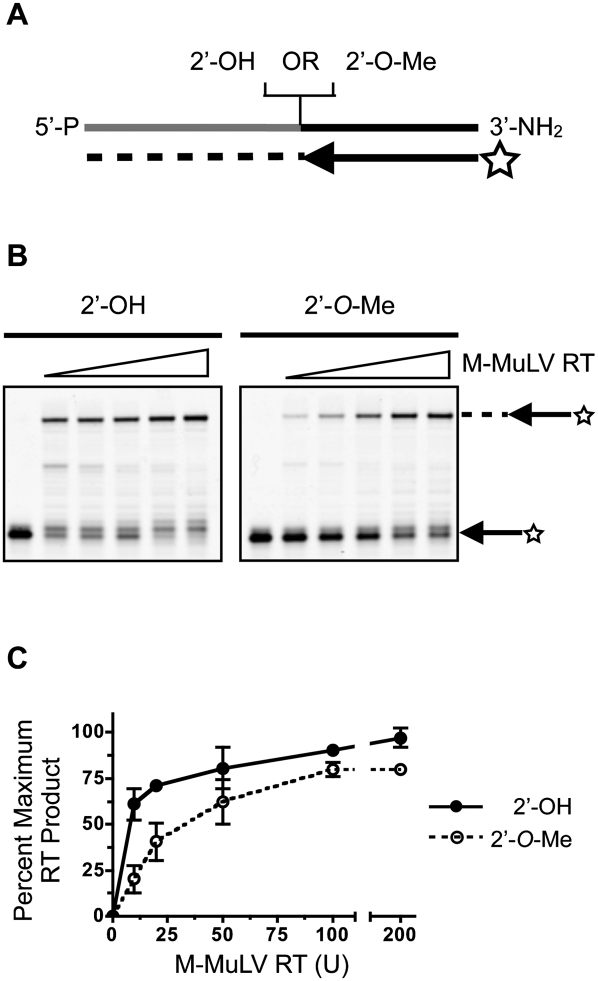
Impairment of reverse transcription across 2′-O-methyl residues in small RNA ligation products. (A) Schematic representation of reverse transcription reactions. 5′-End IRDye 700 labeled reverse transcription primers were hybridized to a chimeric single-stranded RNA/DNA oligo that mimics 3′-ligated small RNAs. The RNA residue adjacent to the 5′-most DNA residue was either 2′-O-methyl, or 2′-hydroxyl as indicated. (Gray) The RNA part of the oligo; (black) the DNA; (star) IRDye 700; (dashed line) cDNA. (B) M-MuLV Reverse transcriptase titration. Reverse transcription was performed using increasing amounts of M-MuLV-RT (0, 10, 20, 50, 100, and 200 units). Primer extension products were resolved by denaturing PAGE and visualized by IR fluorescence imaging. (−) No enzyme. (C) Reverse transcription efficiency. Reverse transcription efficiency of 2′-OH and 2′-O-Me templates was quantified by densitometry of scanned gels. Percent maximum yield refers to the proportion of extension products normalized for the molar excess of primer over template. The data shown represent the mean ± SEM of two independent experiments.
FIGURE 6.
FIGURE 6.
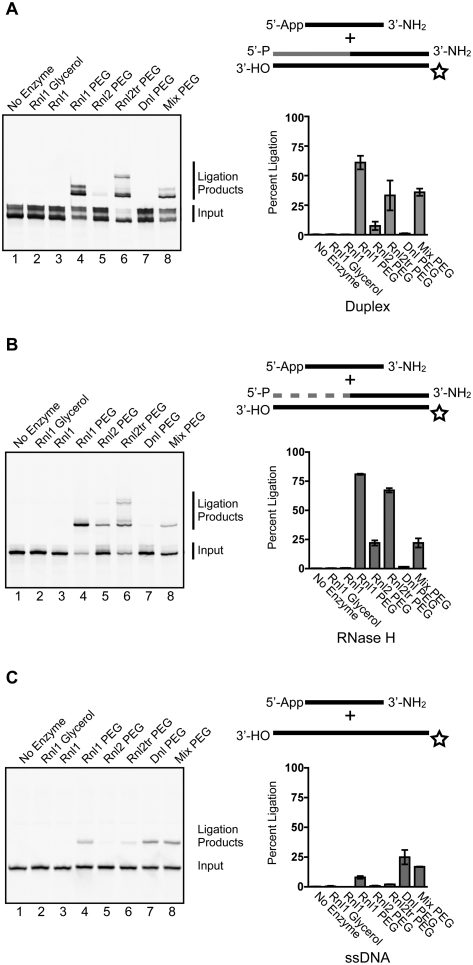
Ligation of adenylated adapters to cDNA 3′-ends. Pre-adenylated DNA oligonucleotides were ligated to synthetic double-stranded, partially double-stranded, or single-stranded oligonucleotides that mimic reaction products from reverse transcription of 3′-end ligated small RNAs. In the schematic representations of ligation inputs shown: (black lines) DNA; (gray lines) RNA; (star) IRDye 700. (A) Ligation of pre-adenylated DNA adapters to double-stranded reverse transcription products. Ligation products were separated by denaturing PAGE and visualized by IR fluorescence scanning. Ligation efficiency was determined as described in the Materials and Methods and is presented as the mean ± SEM of three independent experiments. Incubation and buffer conditions are detailed in the Materials and Methods section. (B) Ligation of pre-adenylated adapters to RNase H-treated reverse transcription products. The efficiency of ligation of pre-adenylated DNA adapters to RNase H-treated substrates is represented graphically as the mean ± SEM of three independent experiments. Ligase, buffer composition, and incubation conditions correspond to those in panel A. (C) Ligation of pre-adenylated adapters to single-stranded DNA oligonucleotides. The efficiency of ligation of pre-adenylated DNA adapters to synthetic single-stranded DNA oligonucleotides is represented graphically as the mean ± SEM of three independent experiments. Ligase, buffer composition, and incubation conditions correspond to those in panel A.
FIGURE 7.
FIGURE 7.
Under-representation of 2′-O-methylated small RNAs in cDNA pools. (A) Schematic representation of ligated small RNA qPCR. Size-fractionated small RNA from mouse testis was ligated to a pre-adenylated DNA adapter. The RT primer contained a 5′-overhang region that provides a PCR priming site. QPCR was performed for specific small RNA targets in the pools using unique forward primers with a common reverse primer. (B) Relative quantification of ligated small RNA. Normalized amounts of small RNAs in cDNA pools were compared in cDNA pools prepared using T4 Rnl1 and T4 Rnl2tr. Signals corresponding to small RNAs in T4 Rnl2tr pools are shown as means ± SEM of three or more experimental replicates relative to signal from T4 Rnl1 cDNA pools. (C) Schematic representation of cloning workflow. Equimolar mixtures of unmodified or 2′-O-methylated 21-nt RNAs were ligated to a pre-adenylated DNA adapter. Input RNAs were distinguishable by reversal of the nucleotides at positions 10 and 11 (bold). Samples were further processed in parallel and subjected to sequence analysis. (D) Quantification of sequenced small RNAs. Identities of recovered clones corresponding to input small RNAs were scored in a blinded fashion. Proportions of cDNAs arising from unmodified or 2′-O-methylated RNA sequenced were compared to an expected recovery ratio of 1:1 using the exact binomial test. P-values from these tests are shown below (n = 3 experimental replicates, 248 ligation junctions sequenced).

References

    1. Affymetrix/Cold Spring Harbor Laboratory ENCODE Transcriptome Project 2009. Post-transcriptional processing generates a diversity of 5′-modified long and short RNAs. Nature 457: 1028–1032 - PMC - PubMed
    1. Ameres SL, Horwich MD, Hung J-H, Xu J, Ghildiyal M, Weng Z, Zamore PD 2010. Target RNA-directed trimming and tailing of small silencing RNAs. Science 328: 1534–1539 - PMC - PubMed
    1. Aravin A, Tuschl T 2005. Identification and characterization of small RNAs involved in RNA silencing. FEBS Lett 579: 5830–5840 - PubMed
    1. Bissels U, Wild S, Tomiuk S, Holste A, Hafner M, Tuschl T, Bosio A 2009. Absolute quantification of microRNAs by using a universal reference. RNA 15: 2375–2384 - PMC - PubMed
    1. Bullard DR, Bowater RP 2006. Direct comparison of nick-joining activity of the nucleic acid ligases from bacteriophage T4. Biochem J 398: 135–144 - PMC - PubMed

Publication types

MeSH terms

LinkOut - more resources