


Twenty years of follow-up of survivors of childhood osteosarcoma: a report from the Childhood Cancer Survivor Study
- PMID: 20922787
- PMCID: PMC3025070
- DOI: 10.1002/cncr.25446
Twenty years of follow-up of survivors of childhood osteosarcoma: a report from the Childhood Cancer Survivor Study
Abstract
Background: Osteosarcoma survivors have received significant chemotherapy and have undergone substantial surgeries. Their very long-term outcomes (20 year) are reported here.
Methods: The authors assessed the long-term outcomes of 733 5-year survivors of childhood osteosarcoma diagnosed from 1970 to 1986 to provide a comprehensive evaluation of medical and psychosocial outcomes for survivors enrolled in the Childhood Cancer Survivor Study (CCSS). Outcomes evaluated included overall survival, second malignant neoplasms (SMNs), recurrent osteosarcoma, chronic health conditions, health status (general and mental health and functional limitations), and psychosocial factors. Outcomes of osteosarcoma survivors were compared with general-population statistics, other CCSS survivors, and CCSS siblings.
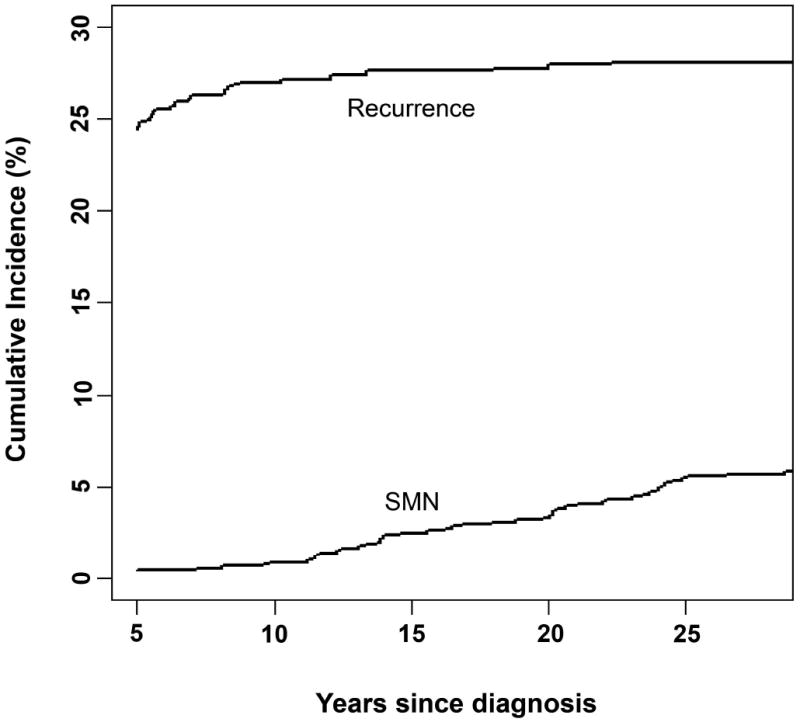
Results: Survivors had a mean follow-up of 21.6 years. The overall survival of children diagnosed with osteosarcoma who survived 5 years at 20 years from original diagnosis was 88.6% (95% confidence interval [CI], 86.6%-90.5%). The cumulative incidence of SMNs at 25 years was 5.4%, with a standardized incidence ratio of 4.79 (95% CI, 3.54-6.33; P<.01). Overall, 86.9% of osteosarcoma survivors experienced at least 1 chronic medical condition, and >50% experienced ≥2 conditions. Compared with survivors of other cancers, osteosarcoma survivors did not differ in their reported general health status (odds ratio [OR], 0.9; 95% CI, 0.7-1.2), but were more likely to report an adverse health status in at least 1 domain (OR, 1.9; 95% CI, 1.6-2.2), with activity limitations (29.1%) being the most common.
Conclusions: Childhood osteosarcoma survivors in this cohort did relatively well, considering their extensive treatment, but are at risk of experiencing chronic medical conditions and adverse health status. Survivors warrant life-long follow-up.
Copyright © 2010 American Cancer Society.
Figures

References
-
- Ries L, Smith M, Gurney J, Linet M, Tamra T, Young J, et al. National Cancer Institute, SEER program. Bethesda, MD: 1999. Cancer Incidence and Survival among Children and Adolescents: United States SEER Program 1975-1995.
-
- Bielack SS, Kempf-Bielack B, Delling G, Exner GU, Flege S, Helmke K, et al. Prognostic factors in high-grade osteosarcoma of the extremities or trunk: an analysis of 1,702 patients treated on neoadjuvant cooperative osteosarcoma study group protocols. J Clin Oncol. 2002;20(3):776–90. - PubMed
-
- Meyers PA, Schwartz CL, Krailo M, Kleinerman ES, Betcher D, Bernstein ML, et al. Osteosarcoma: a randomized, prospective trial of the addition of ifosfamide and/or muramyl tripeptide to cisplatin, doxorubicin, and high-dose methotrexate. J Clin Oncol. 2005;23(9):2004–11. - PubMed
-
- Bhatia S, Landier W, Robison L. Late effects of childhood cancer therapy. In: DeVita V, Hellman S, Rosenberg S, editors. Progress in Oncology 2002. Sudbury, MA: Jone and Barlett Publications; 2003. pp. 171–201.
-
- Nagarajan R, Neglia JP, Clohisy DR, Robison LL. Limb salvage and amputation in survivors of pediatric lower-extremity bone tumors: what are the long-term implications? Journal of Clinical Oncology. 2002;20(22):4493–501. - PubMed
Publication types
MeSH terms
Grants and funding
LinkOut - more resources
Full Text Sources
Other Literature Sources
Medical
