. 2010 Dec;186(4):1127-37.
doi: 10.1534/genetics.110.123232. Epub 2010 Oct 5.

Discovery of mutations in Saccharomyces cerevisiae by pooled linkage analysis and whole-genome sequencing

Affiliations

Discovery of mutations in Saccharomyces cerevisiae by pooled linkage analysis and whole-genome sequencing

Shanda R Birkeland et al. Genetics. 2010 Dec.

Abstract

Many novel and important mutations arise in model organisms and human patients that can be difficult or impossible to identify using standard genetic approaches, especially for complex traits. Working with a previously uncharacterized dominant Saccharomyces cerevisiae mutant with impaired vacuole inheritance, we developed a pooled linkage strategy based on next-generation DNA sequencing to specifically identify functional mutations from among a large excess of polymorphisms, incidental mutations, and sequencing errors. The VAC6-1 mutation was verified to correspond to PHO81-R701S, the highest priority candidate reported by VAMP, the new software platform developed for these studies. Sequence data further revealed the large extent of strain background polymorphisms and structural alterations present in the host strain, which occurred by several mechanisms including a novel Ty insertion. The results provide a snapshot of the ongoing genomic changes that ultimately result in strain divergence and evolution, as well as a general model for the discovery of functional mutations in many organisms.


Figures
F<sc>igure</sc> 1.—
Figure 1.—
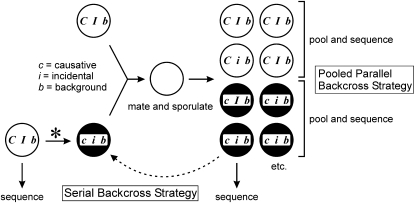
The pooled parallel backcross strategy. In the scenario depicted, a yeast strain with a novel phenotype (indicated by a solid circle) is derived by mutagenesis of a parental wild-type strain (indicated by an open circle). The mutant is backcrossed against the parental strain and asci are scored. In the serial backcross strategy, this process is repeated until a single mutant segregant is ultimately chosen for sequencing. In the pooled parallel backcross strategy, all wild-type and all mutant segregants from several asci from the first backcross are pooled and sequenced in two separate libraries. Letters indicate the three classes of mutation that must be tracked. C/c refers to wild-type and mutant alleles of the gene bearing the causative mutation, which by definition always cosegregates with the mutant phenotype. I/i refers to an unlinked incidental mutation induced by EMS, which will sort randomly with respect to the phenotype. B/b refers to a mutation present in the strain background prior to EMS mutagenesis.
F<sc>igure</sc> 2.—
Figure 2.—
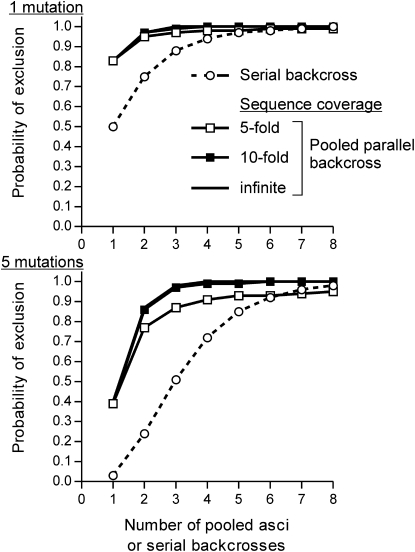
Statistical power of pooled linkage analysis by sequencing. Graphs show the probability of excluding either one (top) or five (bottom) incidental mutation(s) as the causative allele as a function of the number of pooled asci (solid lines) or serial backcrosses (dashed lines with open circles). For the pooled parallel backcross strategy, an obscured solid line indicates the theoretical maximum probability of exclusion corresponding to infinitely deep sequencing of the strain pools, while solid lines with open and solid squares show the results of a 10,000-iteration simulation conducted at 5- and 10-fold average genome coverage per pool, respectively.
F<sc>igure</sc> 3.—
Figure 3.—
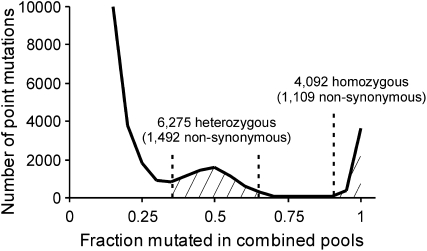
Frequency distribution of observed point mutations and SNPs. Sequence data from the VAC6 wild-type and mutant spore pools were combined to show the point mutation content in the diploid backcross strain. True sequence changes are expected to cluster in peaks at frequencies of 50% and 100%, corresponding to heterozygous and homozygous changes in the diploid strain, respectively. Frequencies need not be precisely 50% or 100% because of stochastic effects in pool sampling. Heterozygous (35–65% frequency) and homozygous (>90% frequency) mutation counts are shown. The off-scale peak of sequence changes at <25% frequency corresponds to sequencing errors.
F<sc>igure</sc> 4.—
Figure 4.—
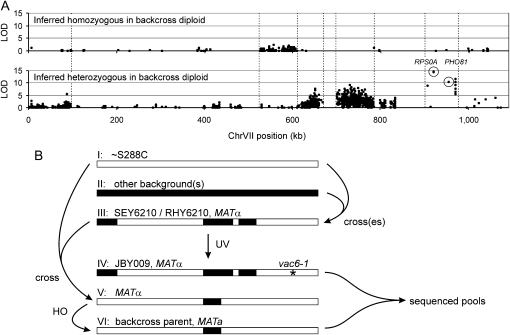
Most VAC6-1 strain mutations occur in nonrandom blocks. (A) Chromosome distribution plots were constructed for all inferred homozygous (top) and heterozygous (bottom) mutations observed in the VAC6 wild-type and mutant pools (see Figure 3). Only chromosome VII, which contains the causative PH081 mutation, is shown (similar trends could be observed on all chromosomes). Every mutation is plotted as a single point, although there is often insufficient resolution to visualize all loci. The y-axes are the linkage LOD scores for the mutation relative to the VAC6 mutant phenotype. Mutations from the high-priority candidate list (Table 2) are circled and labeled. Vertical dashed lines indicate the edge of chromosome blocks that contain clustered mutations. (B) Drawings depict the strain history of JBY009/VAC6-1 to illustrate the inferred origin of high-density mutation blocks from prior meiotic recombination events. For each strain, chromosome VII is depicted as open when it generally matches the S288C reference genome and as solid when a high density of non-S288C values are present. Early crosses led to the mosaic strain III used for VAC6-1 mutagenesis. Inferred but undocumented crossing of strains I and III allowed further partial recombination of some high-density blocks in strain V and then strain VI, the strain ultimately used as the VAC6-1 backcross parent, leading to the zygosity pattern observed in A.
F<sc>igure</sc> 5.—
Figure 5.—
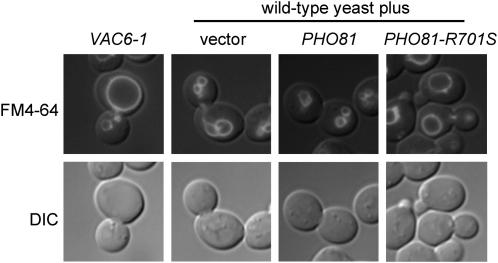
PHO81-R701S is the causative mutation in VAC6-1. Transformation of wild-type yeast with either pRS413 vector or pRS413-PHO81 had no effect on vacuole inheritance, whereas transformation with pRS413-PHO81-R701S caused an enlarged vacuole in the mother cell and a vacuole inheritance defect (right panels). Wild-type cells bearing pRS413-PHO81-R701S showed the same phenotype as VAC6-1 itself (left).
F<sc>igure</sc> 6.—
Figure 6.—
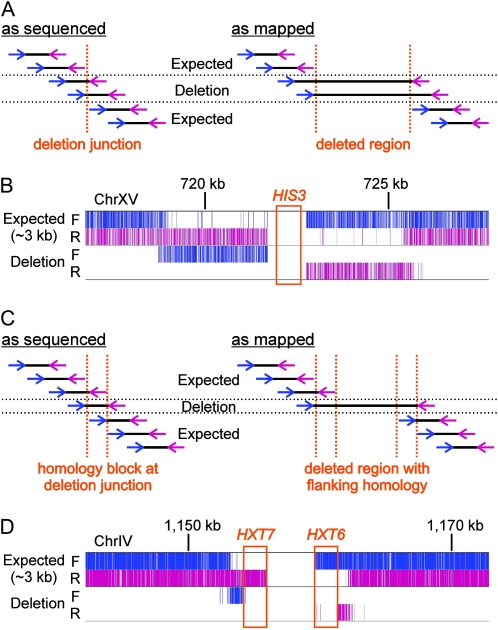
Two mechanisms of chromosome deletion. (A) It is assumed that “as sequenced” all mate-pairs corresponded to ∼3-kb physical DNA fragments present in the strain genome. However, “as mapped” to the reference genome mate-pairs flanking a deletion junction show an excessively large spacing. (B) An example deletion corresponding to his3-Δ200. All expected (∼3 kb) and deletion reads in both the forward (F) and reverse (R) orientations in the displayed region of chromosome XV are drawn as vertical lines. Forward and reverse read colors match the arrows in A. Although not illustrated, every forward deletion read was paired with a corresponding reverse deletion read on the opposite side of HIS3. The presence of a homozygous deletion is confirmed by the loss of expected reads within and surrounding the deleted segment in a pattern consistent with A. (C) Similar to A, showing the expected pattern of reads when the deletion occurs by homologous recombination via a homology block flanking the deleted locus. (D) Similar to B, showing a deletion inferred to have occurred by homologous recombination between HXT7 and HXT6 by the logic in C.
F<sc>igure</sc> 7.—
Figure 7.—
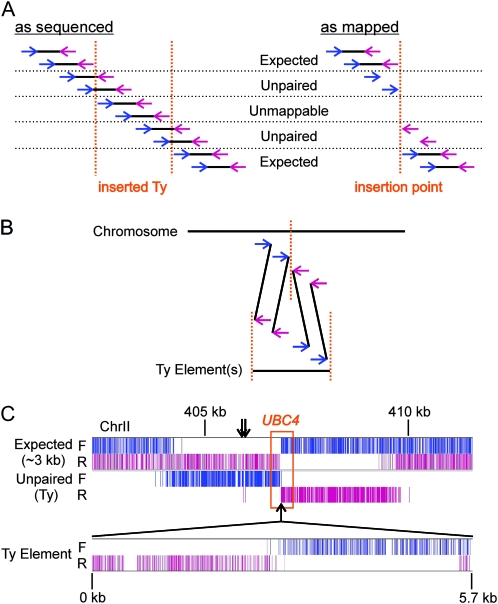
A novel Ty insertion. (A) Similar to Figure 6A, showing the expected orientation of reads and fragments in the vicinity of a Ty element not present in the reference genome. (B) The strategy for identifying novel Ty insertions by comparing independent mappings of mate-pairs to (i) chromosome sequences and (ii) a training set of known Ty repeat elements. (C) An identified novel Ty insertion, illustrated as in Figure 6B, now with a track corresponding to those unpaired reads whose partners independently mapped to a Ty element(s). (Bottom) The partner reads aligned to the Ty element assembled from the data. Arrows denote the location of two closely spaced tRNA genes, tR(UCU)B and tD(GUC)B.

References

    1. Araya, C. L., C. Payen, M. J. Dunham and S. Fields, 2010. Whole-genome sequencing of a laboratory-evolved yeast strain. BMC Genomics 11 88. - PMC - PubMed
    1. Bolton, E. C., and J. D. Boeke, 2003. Transcriptional interactions between yeast tRNA genes, flanking genes and Ty elements: a genomic point of view. Genome Res. 13 254–263. - PMC - PubMed
    1. Bonangelino, C. J., N. L. Catlett and L. S. Weisman, 1997. Vac7p, a novel vacuolar protein, is required for normal vacuole inheritance and morphology. Mol. Cell. Biol. 17 6847–6858. - PMC - PubMed
    1. Brauer, M. J., C. M. Christianson, D. A. Pai and M. J. Dunham, 2006. Mapping novel traits by array-assisted bulk segregant analysis in Saccharomyces cerevisiae. Genetics 173 1813–1816. - PMC - PubMed
    1. Campagna, D., A. Albiero, A. Bilardi, E. Caniato, C. Forcato et al., 2009. PASS: a program to align short sequences. Bioinformatics 25 967–968. - PubMed

Publication types