Optimal caliper widths for propensity-score matching when estimating differences in means and differences in proportions in observational studies
- PMID: 20925139
- PMCID: PMC3120982
- DOI: 10.1002/pst.433
Optimal caliper widths for propensity-score matching when estimating differences in means and differences in proportions in observational studies
Abstract
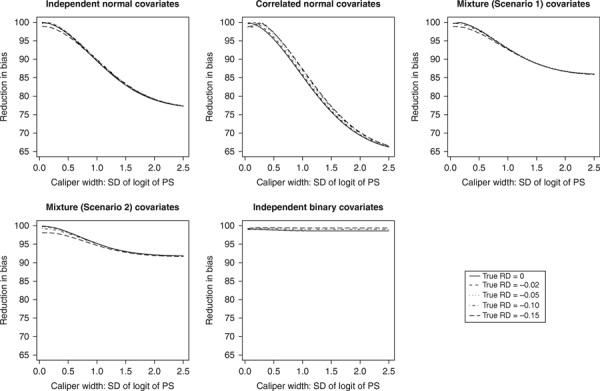
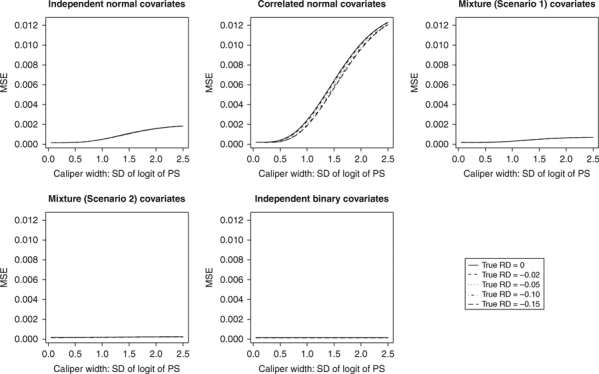
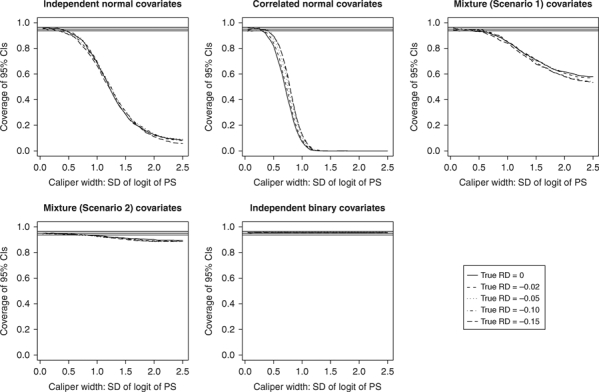
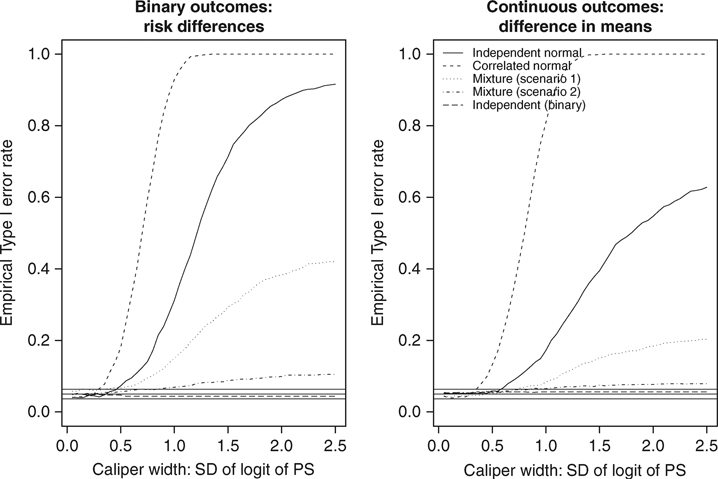
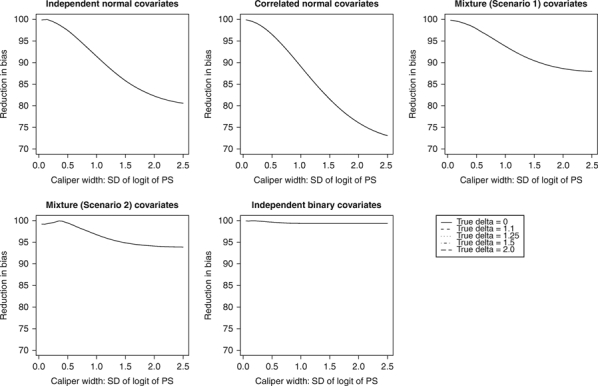
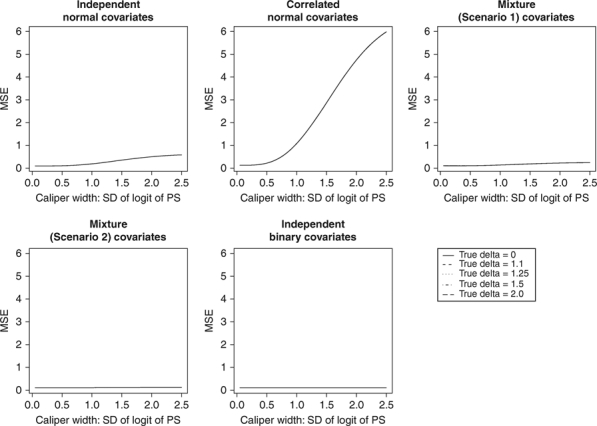
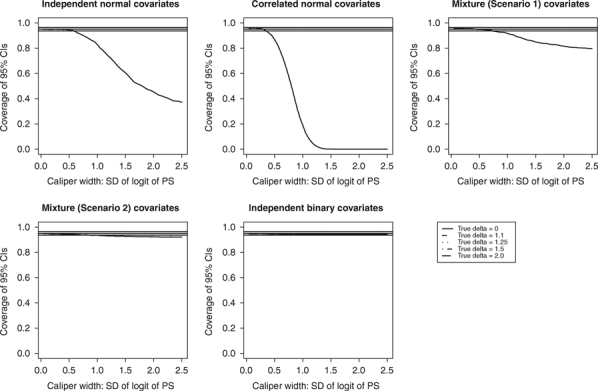
In a study comparing the effects of two treatments, the propensity score is the probability of assignment to one treatment conditional on a subject's measured baseline covariates. Propensity-score matching is increasingly being used to estimate the effects of exposures using observational data. In the most common implementation of propensity-score matching, pairs of treated and untreated subjects are formed whose propensity scores differ by at most a pre-specified amount (the caliper width). There has been a little research into the optimal caliper width. We conducted an extensive series of Monte Carlo simulations to determine the optimal caliper width for estimating differences in means (for continuous outcomes) and risk differences (for binary outcomes). When estimating differences in means or risk differences, we recommend that researchers match on the logit of the propensity score using calipers of width equal to 0.2 of the standard deviation of the logit of the propensity score. When at least some of the covariates were continuous, then either this value, or one close to it, minimized the mean square error of the resultant estimated treatment effect. It also eliminated at least 98% of the bias in the crude estimator, and it resulted in confidence intervals with approximately the correct coverage rates. Furthermore, the empirical type I error rate was approximately correct. When all of the covariates were binary, then the choice of caliper width had a much smaller impact on the performance of estimation of risk differences and differences in means.
Copyright © 2010 John Wiley & Sons, Ltd.
Figures
References
-
- Rosenbaum PR, Rubin DB. The central role of the propensity score in observational studies for causal effects. Biometrika. 1983;70:41–55.
-
- Rosenbaum PR, Rubin DB. Reducing bias in observational studies using subclassification on the propensity score. Journal of the American Statistical Association. 1984;79:516–524.
-
- Austin PC, Mamdani MM. A comparison of propensity score methods: a case-study estimating the effectiveness of post-AMI statin use. Statistics in Medicine. 2006;25:2084–2106. - PubMed
-
- Rosenbaum PR, Rubin DB. Constructing a control group using multivariate matched sampling methods that incorporate the propensity score. The American Statistician. 1985;39:33–38.
-
- Austin PC. A critical appraisal of propensity score matching in the medical literature from 1996 to 2003. Statistics in Medicine. 2008;27:2037–2049. - PubMed
Publication types
MeSH terms
Grants and funding
LinkOut - more resources
Full Text Sources
Medical