


Factors associated with access to HIV care and treatment in a prevention of mother to child transmission programme in urban Zimbabwe
- PMID: 20925943
- PMCID: PMC2978127
- DOI: 10.1186/1758-2652-13-38
Factors associated with access to HIV care and treatment in a prevention of mother to child transmission programme in urban Zimbabwe
Abstract
Background: This cross-sectional study assessed factors affecting access to antiretroviral therapy (ART) among HIV-positive women from the prevention of mother to child transmission HIV programme in Chitungwiza, Zimbabwe.
Methods: Data were collected between June and August 2008. HIV-positive women attending antenatal clinics who had been referred to the national ART programme from January 2006 until December 2007 were surveyed. The questionnaire collected socio-demographic data, treatment-seeking behaviours, and positive or negative factors that affect access to HIV care and treatment.
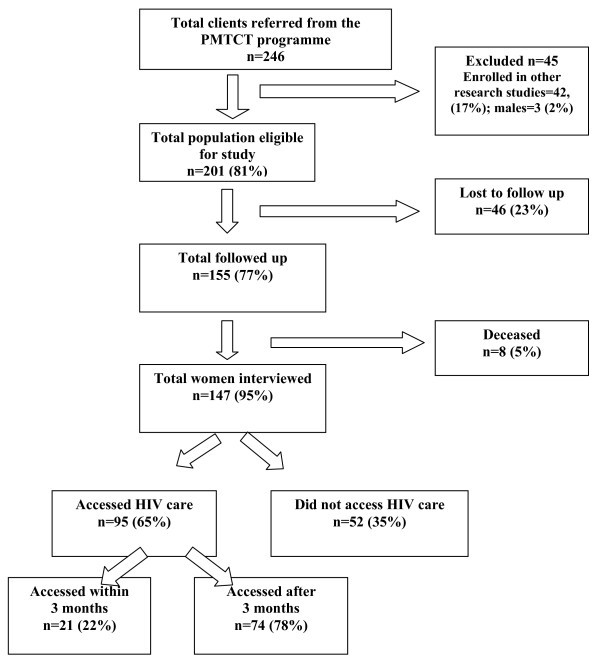
Results: Of the 147 HIV-positive women interviewed, 95 (65%) had registered with the ART programme. However, documentation of the referral was noted in only 23 (16%) of cases. Of the 95 registered women, 35 (37%) were receiving ART; 17 (18%) had not undergone CD4 testing. Multivariate analysis revealed that participants who understood the referral process were three times more likely to access HIV care and treatment (OR = 3.21, 95% CI 1.89-11.65) and participants enrolled in an HIV support group were twice as likely to access care and treatment (OR = 2.34, 95% CI 1.13-4.88). Those living with a male partner were 60% less likely to access care and treatment (OR = 0.40, 95% CI 0.16-0.99). Participants who accessed HIV care and treatment faced several challenges, including long waiting times (46%), unreliable access to laboratory testing (35%) and high transport costs (12%). Of the 147 clients surveyed, 52 (35%) women did not access HIV care and treatment. Barriers included perceived long queues (50%), competing life priorities, such as seeking food or shelter (33%) and inadequate referral information (15%).
Conclusions: Despite many challenges, the majority of participants accessed HIV care. Development of referral tools and decentralization of CD4 testing to clinics will improve access to ART. Psychosocial support can be a successful entry point to encourage client referral to care and treatment programmes.
References
-
- UNAIDS. AIDS epidemic update. Geneva: United Nations Programme on HIV/AIDS; 2009. http://www.unaids.org/en/KnowledgeCentre/HIVData/EpiUpdate/EpiUpdArchive...
-
- Zimbabwe Ministry of Health and Child Welfare. AIDS and TB annual report 2007. Harare, Zimbabwe: Ministry of Health; 2007.
-
- WHO/UNAIDS/UNICEF. Towards universal access: scaling up priority HIV/AIDS interventions in the health sector. Progress report 2009. Geneva: World Health Organization; 2009.
Publication types
MeSH terms
Substances
LinkOut - more resources
Full Text Sources
Medical
Research Materials
