. 2010 Oct 6:3:24.
doi: 10.1186/1755-7682-3-24.

Dopaminergic reward system: a short integrative review

Affiliations

Dopaminergic reward system: a short integrative review

Oscar Arias-Carrión et al. Int Arch Med. .

Abstract

Memory is an essential element to adaptive behavior since it allows consolidation of past experience guiding the subject to consider them in future experiences. Among the endogenous molecules that participate in the consolidation of memory, including the drug-seeking reward, considered as a form of learning, is dopamine. This neurotransmitter modulates the activity of specific brain nucleus such as nuclei accumbens, putamen, ventral tegmental area (VTA), among others and synchronizes the activity of these nuclei to establish the neurobiological mechanism to set the hedonic element of learning. We review the experimental evidence that highlights the activity of different brain nuclei modulating the mechanisms whereby dopamine biases memory towards events that are of motivational significance.


Figures
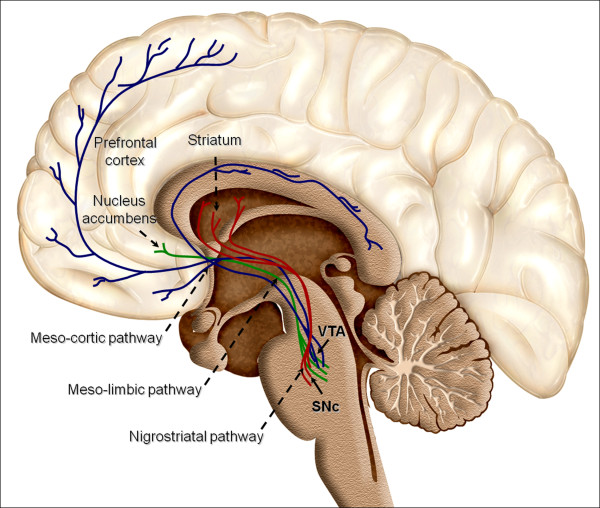
Figure 1
Figure 1
Overview of reward structures in the human brain. Dopaminergic neurons are located in the midbrain structures substantia nigra (SNc) and the ventral tegmental area (VTA). Their axons project to the striatum (caudate nucleus, putamen and ventral striatum including nucleus accumbens), the dorsal and ventral prefrontal cortex. Additional brain structures influenced by reward include the supplementary motor area in the frontal lobe, the rhinal cortex in the temporal lobe, the pallidum and subthalamic nucleus in the basal ganglia, and a few others.

References

    1. Carlsson A. The occurrence, distribution and physiological role of catecholamines in the nervous system. Pharmacological reviews. 1959;11(2, Part 2):490–493. - PubMed
    1. Bernheimer H, Hornykiewicz O. [Decreased homovanillic acid concentration in the brain in parkinsonian subjects as an expression of a disorder of central dopamine metabolism] Klinische Wochenschrift. 1965;43(13):711–715. doi: 10.1007/BF01707066. - DOI - PubMed
    1. Bernheimer H, Birkmayer W, Hornykiewicz O, Jellinger K, Seitelberger F. Brain dopamine and the syndromes of Parkinson and Huntington. Clinical, morphological and neurochemical correlations. Journal of the neurological sciences. 1973;20(4):415–455. doi: 10.1016/0022-510X(73)90175-5. - DOI - PubMed
    1. Di Chiara G, Bassareo V. Reward system and addiction: what dopamine does and doesn't do. Current opinion in pharmacology. 2007;7(1):69–76. doi: 10.1016/j.coph.2006.11.003. - DOI - PubMed
    1. Ross S, Peselow E. The neurobiology of addictive disorders. Clinical neuropharmacology. 2009;32(5):269–276. doi: 10.1097/WNF.0b013e3181a9163c. - DOI - PubMed

LinkOut - more resources