


Afebrile Plasmodium falciparum parasitemia decreases absorption of fortification iron but does not affect systemic iron utilization: a double stable-isotope study in young Beninese women
- PMID: 20926522
- PMCID: PMC2980964
- DOI: 10.3945/ajcn.2010.30051
Afebrile Plasmodium falciparum parasitemia decreases absorption of fortification iron but does not affect systemic iron utilization: a double stable-isotope study in young Beninese women
Erratum in
-
Erratum for Cercamondi et al. Afebrile Plasmodium falciparum parasitemia decreases absorption of fortification iron but does not affect systemic iron utilization: a double stable-isotope study in young Beninese women. Am J Clin Nutr 2010;92:1385-92.Am J Clin Nutr. 2015 Apr;101(4):894. doi: 10.3945/ajcn.115.107805. Am J Clin Nutr. 2015. PMID: 25833990 Free PMC article. No abstract available.
Abstract
Background: Iron deficiency anemia (IDA) affects many young women in sub-Saharan Africa. Its etiology is multifactorial, but the major cause is low dietary iron bioavailability exacerbated by parasitic infections such as malaria.
Objective: We investigated whether asymptomatic Plasmodium falciparum parasitemia in Beninese women would impair absorption of dietary iron or utilization of circulating iron.
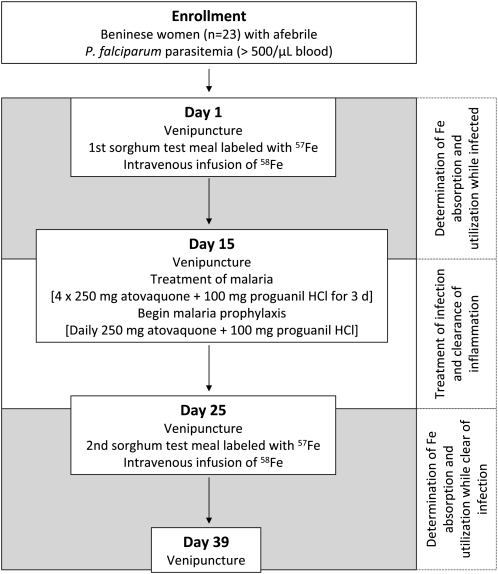
Design: Iron absorption and utilization from an iron-fortified sorghum-based meal were estimated by using oral and intravenous isotope labels in 23 afebrile women with a positive malaria smear (asexual P. falciparum parasitemia; > 500 parasites/μL blood). The women were studied while infected, treated, and then restudied 10 d after treatment. Iron status, hepcidin, and inflammation indexes were measured before and after treatment.
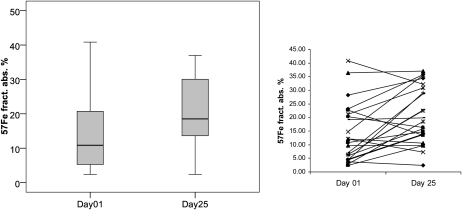
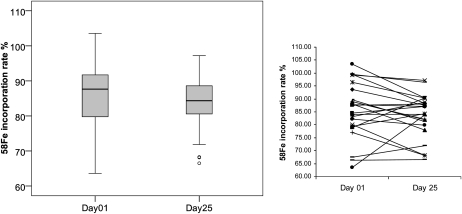
Results: Treatment reduced low-grade inflammation, as reflected by decreases in serum ferritin, C-reactive protein, interleukin-6, interleukin-8, and interleukin-10 (P < 0.05); this was accompanied by a reduction in median serum hepcidin of ≈ 50%, from 2.7 to 1.4 nmol/L (P < 0.005). Treatment decreased serum erythropoietin and growth differentiation factor 15 (P < 0.05). Clearance of parasitemia increased geometric mean dietary iron absorption (from 10.2% to 17.6%; P = 0.008) but did not affect systemic iron utilization (85.0% compared with 83.1%; NS).
Conclusions: Dietary iron absorption is reduced by ≈ 40% in asymptomatic P. falciparum parasitemia, likely because of low-grade inflammation and its modulation of circulating hepcidin. Because asymptomatic parasitemia has a protracted course and is very common in malarial areas, this effect may contribute to IDA and blunt the efficacy of iron supplementation and fortification programs. This trial was registered at clinicaltrials.gov as NCT01108939.
Figures
Comment in
-
Asymptomatic malaria in the etiology of iron deficiency anemia: a nutritionist's viewpoint.Am J Clin Nutr. 2010 Dec;92(6):1283-4. doi: 10.3945/ajcn.110.004465. Epub 2010 Nov 10. Am J Clin Nutr. 2010. PMID: 21068349 No abstract available.
-
Asymptomatic malaria in the etiology of iron deficiency anemia: a malariologist's viewpoint.Am J Clin Nutr. 2010 Dec;92(6):1285-6. doi: 10.3945/ajcn.110.006700. Epub 2010 Nov 10. Am J Clin Nutr. 2010. PMID: 21068352 No abstract available.
References
-
- Zimmermann MB, Hurrell RF. Nutritional iron deficiency. Lancet 2007;370:511–20 - PubMed
-
- Zimmermann MB, Chaouki N, Hurrell RF. Iron deficiency due to consumption of a habitual diet low in bioavailable iron: a longitudinal cohort study in Moroccan children. Am J Clin Nutr 2005;81:115–21 - PubMed
-
- Newton CRJC, Warn PA, Winstanley PA, et al. Severe anaemia in children living in a malaria endemic area of Kenya. Trop Med Int Health 1997;2:165–78 - PubMed
-
- Menendez C, Schellenberg D, Quinto L, et al. The effects of short-term iron supplementation on iron status in infants in malaria-endemic areas. Am J Trop Med Hyg 2004;71:434–40 - PubMed
-
- WHO, FAO Guidelines on food fortification with micronutrients. Geneva, Switzerland: WHO/FAO, 2006
Publication types
MeSH terms
Substances
Associated data
LinkOut - more resources
Full Text Sources
Other Literature Sources
Medical
Research Materials
Miscellaneous
