


PVALB, a new Hürthle adenoma diagnostic marker identified through gene expression
- PMID: 20926528
- PMCID: PMC3038489
- DOI: 10.1210/jc.2010-1318
PVALB, a new Hürthle adenoma diagnostic marker identified through gene expression
Abstract
Context: A better means to accurately identify malignant thyroid nodules and to distinguish them from benign tumors is needed. We previously identified markers for detecting thyroid malignancy, with sensitivity estimated at or close to 100%. One lingering problem with these markers was that false positives occurred with Hürthle cell adenomas (HCA) which lowered test specificity.
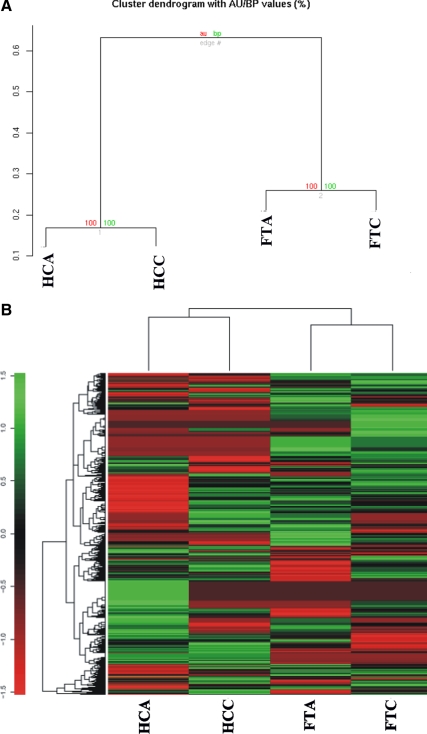
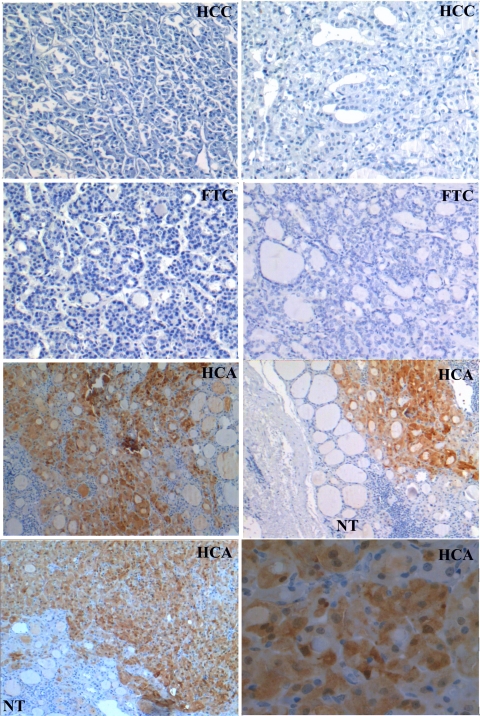
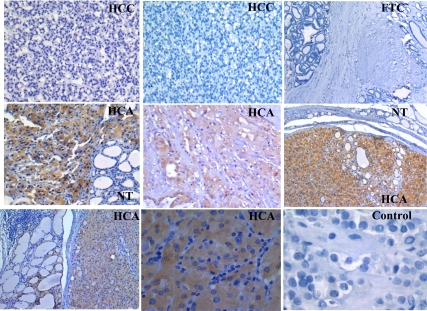
Methods: To locate accurate diagnostic markers, we profiled in depth the transcripts of a HCA and a Hürthle cell carcinoma (HCC). From 1146 differentially expressed genes, 18 transcripts specifically expressed in HCA were tested by quantitative PCR in a wide range of thyroid tumors (n = 76). Sensibility and specificity were calculated using receiver operating characteristic (ROC). Selected markers were further validated in an independent set of thyroid tumors (n = 82) by immunohistochemistry. To define the panel that would yield best diagnostic accuracy, these markers were tested in combination with our previous identified markers.
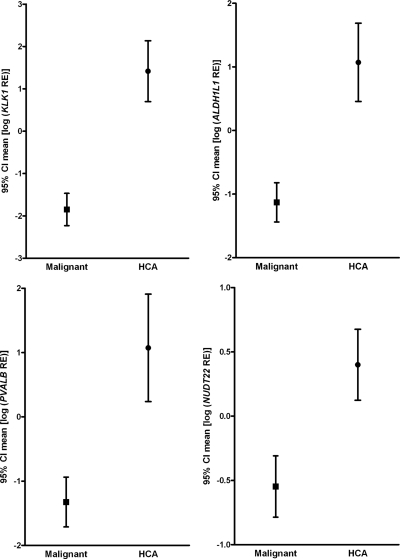
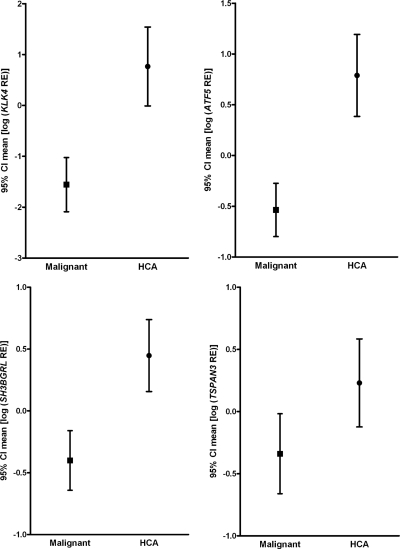
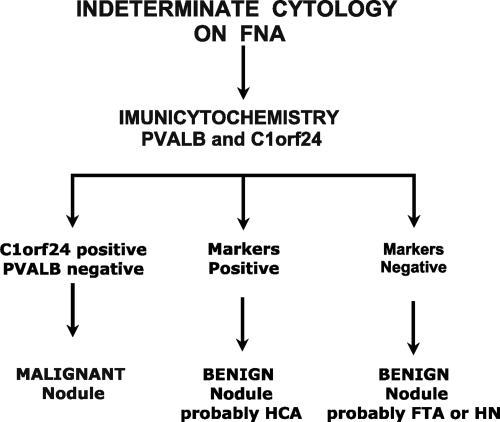
Results: Seventeen of the 18 genes showed statistical significance based on a mean relative level of expression (P < 0.05). KLK1 (sensitivity = 0.97) and PVALB (sensitivity = 0.94) were the best candidate markers. The combination of PVALB and C1orf24 increased specificity to >97% and maintained sensitivity for detection of carcinoma.
Conclusion: We identified tumor markers that can be used in combination for a more accurate preoperative diagnosis of thyroid nodules and for postoperative diagnosis of thyroid carcinoma in tumor sections. This improved test would help physicians rapidly focus treatment on true malignancies and avoid unnecessary treatment of benign tumors, simultaneously improving medical care and reducing costs.
Figures
References
-
- Mazzaferri EL 1993 Management of a solitary thyroid nodule. N Engl J Med 328:553–559 - PubMed
-
- Ezzat S, Sarti DA, Cain DR, Braunstein GD 1994 Thyroid incidentalomas. Prevalence by palpation and ultrasonography. Arch Intern Med 154:1838–1840 - PubMed
-
- Baloch ZW, LiVolsi VA, Asa SL, Rosai J, Merino MJ, Randolph G, Vielh P, DeMay RM, Sidawy MK, Frable WJ 2008 Diagnostic terminology and morphologic criteria for cytologic diagnosis of thyroid lesions: a synopsis of the National Cancer Institute Thyroid Fine-Needle Aspiration State of the Science Conference. Diagn Cytopathol 36:425–437 - PubMed
-
- Cerutti JM, Latini FR, Nakabashi C, Delcelo R, Andrade VP, Amadei MJ, Maciel RM, Hojaij FC, Hollis D, Shoemaker J, Riggins GJ 2006 Diagnosis of suspicious thyroid nodules using four protein biomarkers. Clin Cancer Res 12:3311–3318 - PubMed
Publication types
MeSH terms
Substances
Grants and funding
LinkOut - more resources
Full Text Sources
Medical
Miscellaneous
