. 2010 Dec;299(6):R1500-10.
doi: 10.1152/ajpregu.00431.2010. Epub 2010 Oct 6.

Effect of intracerebroventricular benzamil on cardiovascular and central autonomic responses to DOCA-salt treatment

Affiliations

Effect of intracerebroventricular benzamil on cardiovascular and central autonomic responses to DOCA-salt treatment

Joanna M Abrams et al. Am J Physiol Regul Integr Comp Physiol. 2010 Dec.

Abstract

DOCA-salt treatment increases mean arterial pressure (MAP), while central infusion of benzamil attenuates this effect. The present study used c-Fos immunoreactivity to assess the role of benzamil-sensitive proteins in the brain on neural activity following chronic DOCA-salt treatment. Uninephrectomized rats were instrumented with telemetry transmitters for measurement of MAP and with an intracerebroventricular (ICV) cannula for benzamil administration. Groups included rats receiving DOCA-salt treatment alone, rats receiving DOCA-salt treatment with ICV benzamil, and appropriate controls. At study completion, MAP in vehicle-treated DOCA-salt rats reached 142 ± 4 mmHg. In contrast DOCA-salt rats receiving ICV benzamil had lower MAP (124 ± 3 mmHg). MAP in normotensive controls was 102 ± 3 mmHg. c-Fos immunoreactivity was quantified in the supraoptic nucleus (SON) and across subnuclei of the hypothalamic paraventricular nucleus (PVN), as well as other cardiovascular regulatory sites. Compared with vehicle-treated normotensive controls, c-Fos expression was increased in the SON and all subnuclei of the PVN, but not in other key autonomic nuclei, such as the rostroventrolateral medulla. Moreover, benzamil treatment decreased c-Fos immunoreactivity in the SON and in medial parvocellular and posterior magnocellular neurons of the PVN in DOCA-salt rats but not areas associated with regulation of sympathetic activity. Our results do not support the hypothesis that DOCA-salt increases neuronal activity (as indicated by c-Fos immunoreactivity) of other key regions that regulate sympathetic activity. These results suggest that ICV benzamil attenuates DOCA-salt hypertension by modulation of neuroendocrine-related PVN nuclei rather than inhibition of PVN sympathetic premotor neurons in the PVN and rostroventrolateral medulla.


Figures
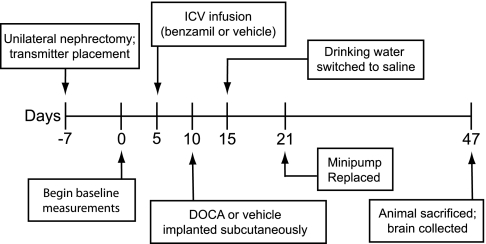
Fig. 1.
Fig. 1.
Timeline of the surgical procedures and experimental protocol. ICV, intracerebroventricular.
Fig. 2.
Fig. 2.
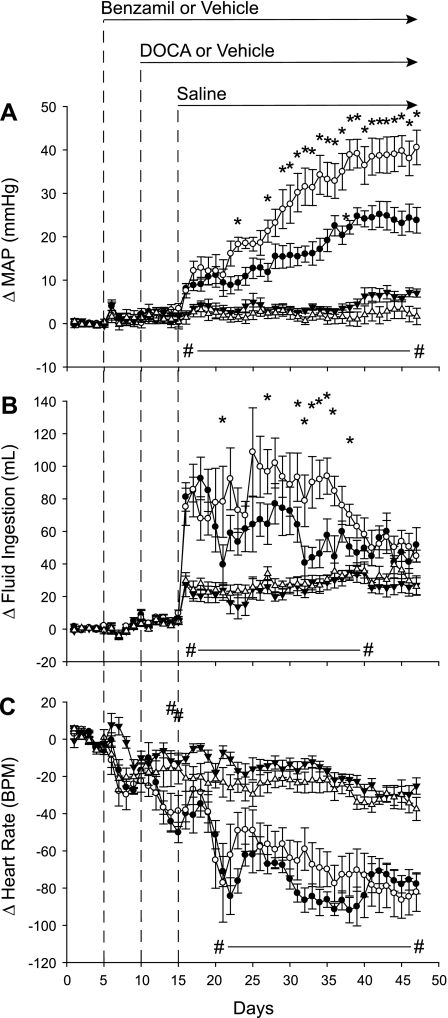
Changes in arterial pressure, fluid ingestion, and heart rate (HR) for Vehicle-Vehicle (n = 6, ▵), Vehicle-DOCA (n = 6, ○), Benzamil-Vehicle (n = 7, ▴), and Benzamil-DOCA (n = 7, ●) rats (24-h averages). Experimental interventions are noted by dotted lines. A: mean arterial pressure (MAP) increased in both DOCA groups compared with the Vehicle/Vehicle group, but the response of the Benzamil-DOCA group was reduced compared with the Vehicle-DOCA group. *P < 0.05, Benzamil-DOCA vs. Vehicle-DOCA rats; #P < 0.05, Vehicle-DOCA vs. Vehicle-Vehicle rats. B: fluid ingestion increased in both DOCA groups compared with the Vehicle-Vehicle group, but the response of the Benzamil-DOCA group was reduced compared with the Vehicle-DOCA group. *Days in which Benzamil-DOCA rats ingested less fluid than did Vehicle-DOCA rats; #days in which Vehicle-DOCA rats ingested more fluid than did Vehicle-Vehicle controls. C: both DOCA groups had lower HRs than did Vehicle-Vehicle rats; differences were not observed between the 2 DOCA groups; #days on which Vehicle-DOCA rats had lower HRs than did Vehicle-Vehicle controls. BPM, beats per minute.
Fig. 3.
Fig. 3.
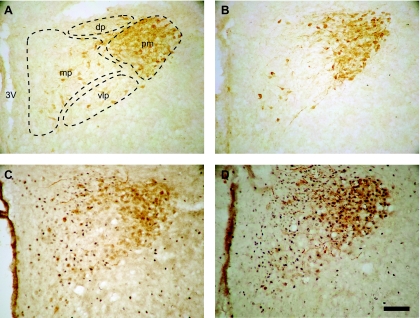
Immunolabeling for c-Fos (nuclear, black) and vasopressin (cytoplasmic, brown) in midrostral hypothalamic paraventricular nucleus (PVN) from Vehicle-Vehicle (A), Benzamil-Vehicle (B), Benzamil-DOCA (C), and Vehicle-DOCA (D) rats. Scale bar = 100 μ. 3V, third ventricle; mp, medial parvocellular neurons; dp, dorsal parvocellular neurons; vlp, ventrolateral parvocellular neurons; pm, posterior magnocellular neurons.
Fig. 4.
Fig. 4.
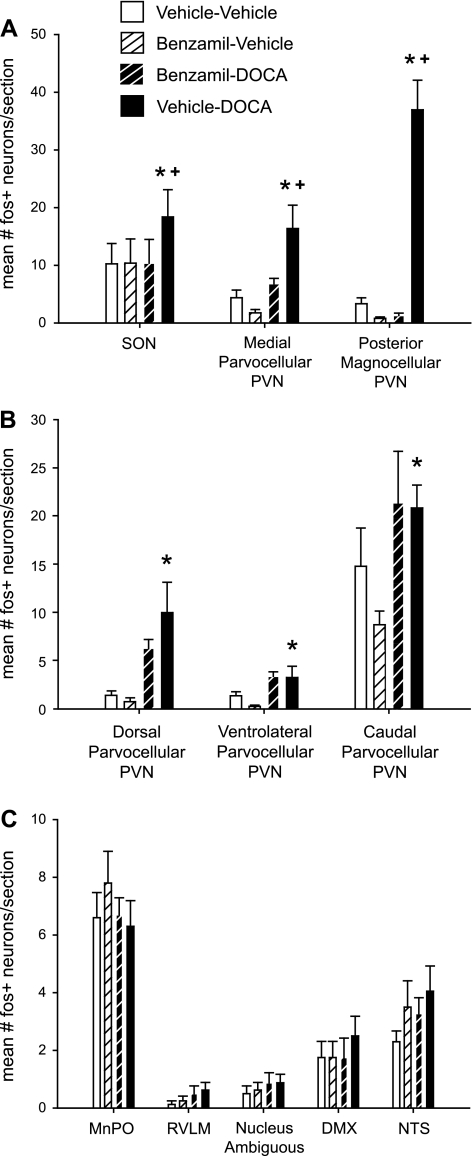
Quantification of c-Fos immunoreactivity across brain regions. A: regions showing a main effect of DOCA-salt treatment, which was significantly moderated by benzamil treatment (P < 0.05, *significant difference from Vehicle-Vehicle, +significant difference from Benzamil-DOCA). In all cases, DOCA-salt treatment increased c-Fos immunoreactivity, while benzamil treatment reduced this effect. This effect was seen most dramatically in the pmPVN neurons, but was also observed in the supraoptic nucleus (SON) and in mpPVN neurons. Note that counts in pmPVN and SON reflect only double-labeled neurons. B: regions showing a main effect of DOCA-salt treatment (P < 0.05), with no response to ICV benzamil (P < 0.05, *significant difference from Vehicle-Vehicle). DOCA-salt treatment increased c-Fos immunoreactivity in the dorsal parvocellular PVN, the ventrolateral parvocellular PVN, and in the more posterior mixed region of caudal parvocellular PVN neurons (containing both medial and lateral parvocellular neurons). C: regions that did not respond to DOCA-salt treatment with increased c-Fos immunoreactivity. We observed no group differences in c-Fos immunoreactivity within the median preoptic nucleus (MnPO), the rostroventrolateral medulla (RVLM), the nucleus ambiguous, the dorsal motor nucleus of the vagus nerve, or the nucleus of the tractus solitarius. DMX, dorsal motor nucleus of the vagus nerve; NTS, nucleus of the tractus solitarius.
Fig. 5.
Fig. 5.
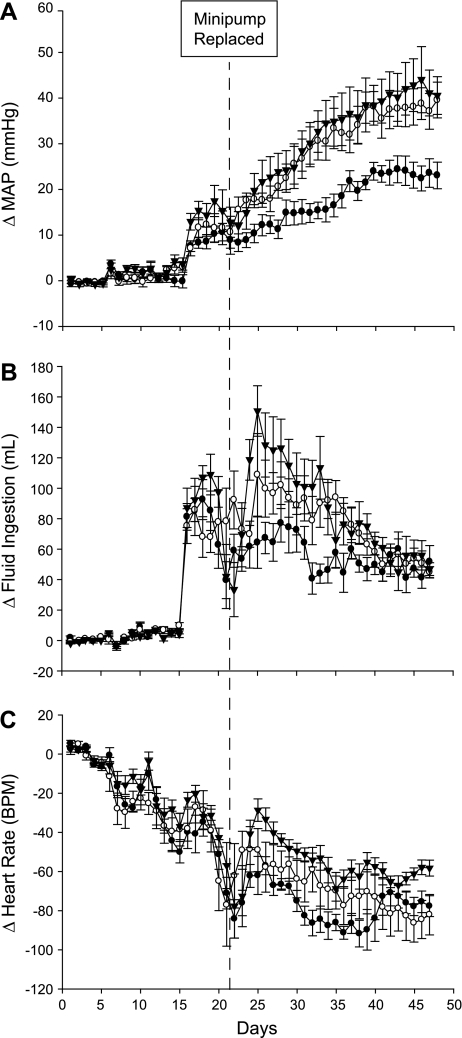
Effect of early cessation of benzamil treatment. Shown are 24-h means for MAP (A), fluid ingestion (B), and HR (C) for Vehicle-DOCA (n = 7, ○, animals from protocol 1), Benzamil-DOCA (n = 7, ●, animals from protocol 1), and Benzamil-Stop (n = 7, ▴, animals from protocol 2) rats. The day of the minipump replacement surgery, when Benzamil-Stop rats ceased benzamil treatment, is noted by a dotted line. P < 0.05 for all effects noted. A: 24-h averages for MAP. Benzamil-Stop rats showed identical pressure profiles to Vehicle-DOCA rats, and were significantly different from Benzamil-DOCA rats. B: while fluid ingestion initially matched between the 2 benzamil groups, when Benzamil-Stop animals stopped receiving benzamil treatment, their fluid ingestion rapidly rose to match that of the Vehicle-DOCA rats, with no significant differences observed between Vehicle-DOCA and Benzamil-Stop rats. C: all treatment groups showed similar HR decreases with no significant between group differences observed. All 3 groups showed a significant decrease in HR over the course of the study.
Fig. 6.
Fig. 6.
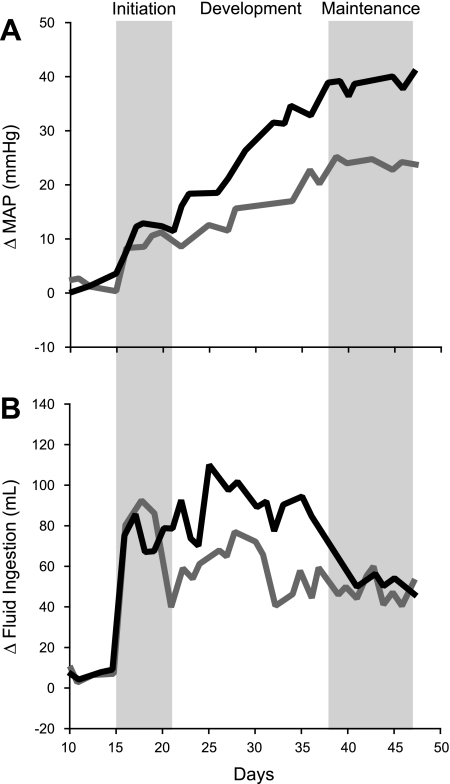
Phases in the development of DOCA-salt hypertension. Data from protocol 1 are replotted to highlight putative phases in the development of DOCA-salt hypertension. Vehicle-DOCA rat are indicated by the black line and Benzamil-DOCA rats are shown by the gray line. During the initiation phase, MAP increased rapidly in DOCA-salt-treated rats, followed by a brief plateau. During this same time, fluid ingestion also showed a marked increase. During the developmental phase, Vehicle-DOCA rats exhibited a second, more gradual increase in arterial pressure and maintained high levels of fluid ingestion. In the Benzamil-DOCA animals, a shift to the developmental phase was noted when fluid ingestion declined, with significantly less saline ingested in Benzamil-DOCA rats than Vehicle-DOCA rats on the transition day. Benzamil-DOCA rats also experienced a second, more gradual increase in MAP, but this was more modest than the rise exhibited by Vehicle-DOCA rats. During the maintenance phase, both groups showed stable levels of MAP, significantly above that of control animals, and both groups showed reduced fluid ingestion.

References

    1. Abrams JM, Osborn JW. A role for benzamil-sensitive proteins of the central nervous system in the pathogenesis of salt-dependent hypertension. Clin Exp Pharmacol Physiol 35: 687–694, 2008 - PMC - PubMed
    1. Amin MS, Wang HW, Reza E, Whitman SC, Tuana BS, Leenen FH. Distribution of epithelial sodium channels and mineralocorticoid receptors in cardiovascular regulatory centers in rat brain. Am J Physiol Regul Integr Comp Physiol 289: R1787–R1797, 2005 - PubMed
    1. Antoni FA. Hypothalamic control of adrenocorticotropin secretion: advances since the discovery of 41-residue corticotropin-releasing factor. Endocr Rev 7: 351–378, 1986 - PubMed
    1. Berecek KH, Barron KW, Webb RL, Brody M. Vasopressin-central nervous system interactions in the development of DOCA hypertension. Hypertension 4: II-131–II-137, 1982 - PubMed
    1. Berecek KH, Bohr DF. Whole body vascular reactivity during the development of deoxycorticosterone acetate hypertension in the pig. Circ Res 42: 764–771, 1978 - PubMed

Publication types

MeSH terms

LinkOut - more resources