doi: 10.1371/journal.pbio.1000501.
How and why chromosome inversions evolve
Affiliations
- PMID: 20927412
- PMCID: PMC2946949
- DOI: 10.1371/journal.pbio.1000501
Item in Clipboard
How and why chromosome inversions evolve
PLoS Biol.
.
Abstract
Chromosome inversions are a major engine of genome evolution. New genomic and ecological data are beginning to reveal the evolutionary forces that drive the evolution of inversions.
Conflict of interest statement
The author has declared that no competing interests exist.
Figures
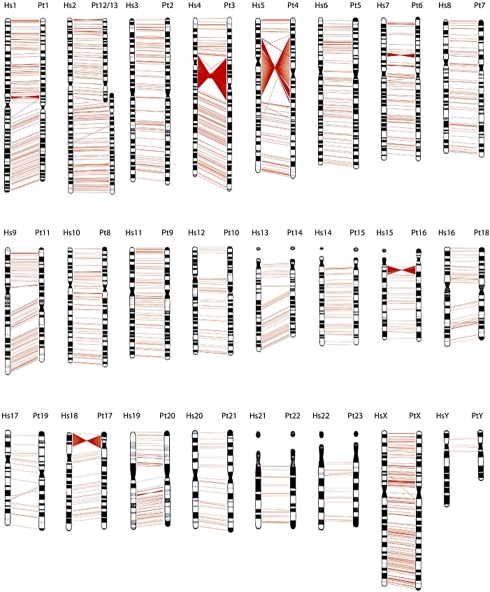
The human chromosome is shown on the left and its chimpanzee homologue on the right for the autosomes and the two sex chromosomes (X and Y). Each red line corresponds to an inversion, with larger inversions (>100 kb) represented by multiple lines.
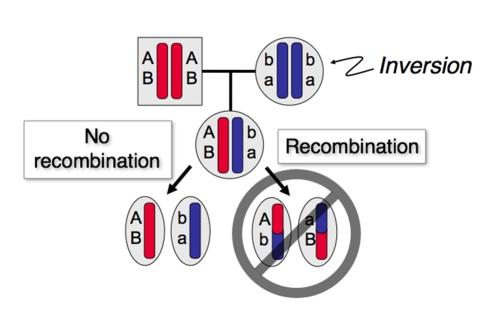
Two loci segregate for the alleles (A, a) and (B, b). An individual that is heterozygous at both loci and for the inversion does not produce the recombinant gametes A/b and a/B.
Comment on
- PLoS Biol. 8:e1000500.
References
-
- Dobzhansky T. G. Genetics of the evolutionary process. New York: Columbia University Press; 1970.
-
- Feuk L, MacDonald J. R, Tang T, Carson A. R, Li M, et al. Discovery of human inversion polymorphisms by comparative analysis of human and chimpanzee DNA sequence assemblies. PLoS Genet. 2005;1:e56. doi: 10.1371/journal.pgen.0010056. - DOI - PMC - PubMed
-
- Ranz J. M, Maurin D, Chan Y. S, von Grotthuss M, Hillier L. W, et al. Principles of genome evolution in the Drosophila melanogaster species group. PLoS Biol. 2007;5:e152. doi: 10.1371/journal.pbio.0050152. - DOI - PMC - PubMed
-
- Andolfatto P, Depaulis F, Navarro A. Inversion polymorphisms and nucleotide variability in Drosophila. Genet Res. 2001;77:1–8. - PubMed
MeSH terms
LinkOut - more resources
Full Text Sources