


Minimally invasive or open transforaminal lumbar interbody fusion as revision surgery for patients previously treated by open discectomy and decompression of the lumbar spine
- PMID: 20927557
- PMCID: PMC3065602
- DOI: 10.1007/s00586-010-1578-4
Minimally invasive or open transforaminal lumbar interbody fusion as revision surgery for patients previously treated by open discectomy and decompression of the lumbar spine
Abstract
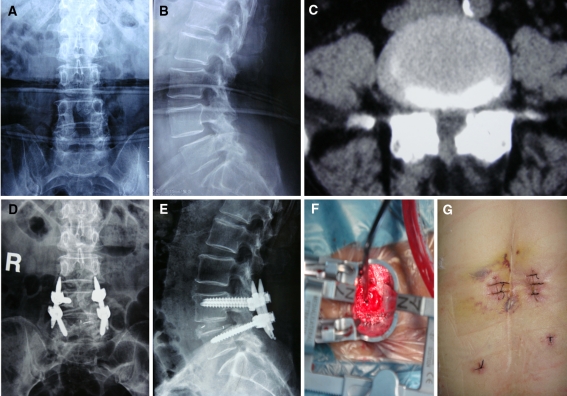
Minimally invasive lumbar fusion techniques have been developed in recent 20 years. The goals of these procedures are to reduce approach-related soft tissue injury, postoperative pain, and disability while allowing the surgery to be conducted in an effective manner. There have been no prospective clinical reports published on the comparison of minimally invasive transforaminal lumbar interbody fusion as revision surgery for patients previously treated by open discectomy and decompression or a traditional open approach. A prospective clinical study was performed by evaluating the clinical and radiographic results of minimally invasive transforaminal lumbar interbody fusion as an alternative new technique in the revision surgery for patients previously treated by open procedure. 52 patients (28 M, 24 F) with an average age of 55.7 (31-76) were prospectively evaluated. All patients who had previous discectomy (n = 13), hemilaminectomy (n = 16), laminectomy (n = 12) and facetectomy (n = 11) underwent monosegmental and bisegmental minimally invasive transforaminal lumbar interbody fusion (MiTLIF) (n = 25) or open transforaminal lumbar interbody fusion (OTLIF) (n = 27) by two experienced surgeons at one hospital, from March 2006 to October 2008 (minimum 12-month follow-up). The following data were compared between the two groups: the clinical and radiographic results, operative time, blood loss, X-ray exposure time, postoperative back pain, and complications. Clinical outcome was assessed using the visual analogue scale and the Oswestry disability index (ODI). The operative time and clinical and radiographic results were basically identical in both groups. Comparing with the OTLIF group, the MiTLIF group had significantly less blood loss and less postoperative back pain at the second day postoperatively. The radiation time was significantly longer in the MiTLIF group. Complications included three cases of small dural tear in the MiTLIF group. There were five cases of dural tear and two cases of superficial wound infection in the OTLIF group. One case of nonunion was observed from each group. Minimally invasive TLIF is a safe and effective procedure for treatment of selected revision patients previously treated by open surgery with some potential advantages. However, this technique needs longer X-ray exposure time.
Figures
References
-
- Cloward RB. History of PLIF: forty years of personal experience. In: Lin PM, editor. Posterior lumbar interbody fusion. Springfield: Charles C Thomas; 1982. pp. 58–71.
-
- Steffee AD, Sitkowski DJ. Posterior lumbar interbody fusion and plates. Clin Orthop. 1988;227:99–102. - PubMed
-
- Harms JG, Jeszenszky D. The unilateral transforaminal approach for posterior lumbar interbody fusion. Orthop Traumatol. 1998;6:88–89.
MeSH terms
LinkOut - more resources
Full Text Sources
Medical
