


Trial Protocol: randomised controlled trial of the effects of very low calorie diet, modest dietary restriction, and sequential behavioural programme on hunger, urges to smoke, abstinence and weight gain in overweight smokers stopping smoking
- PMID: 20929584
- PMCID: PMC2959046
- DOI: 10.1186/1745-6215-11-94
Trial Protocol: randomised controlled trial of the effects of very low calorie diet, modest dietary restriction, and sequential behavioural programme on hunger, urges to smoke, abstinence and weight gain in overweight smokers stopping smoking
Abstract
Background: Weight gain accompanies smoking cessation, but dieting during quitting is controversial as hunger may increase urges to smoke. This is a feasibility trial for the investigation of a very low calorie diet (VLCD), individual modest energy restriction, and usual advice on hunger, ketosis, urges to smoke, abstinence and weight gain in overweight smokers trying to quit.
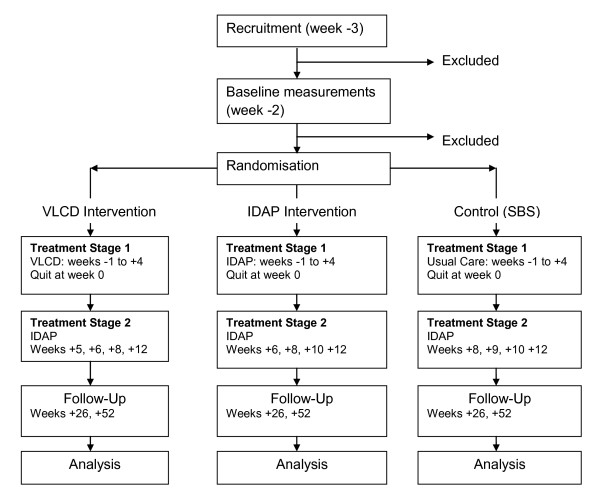
Methods: This is a 3 armed, unblinded, randomized controlled trial in overweight (BMI > 25 kg/m2), daily smokers (CO > 10 ppm); with at least 30 participants in each group. Each group receives identical behavioural support and NRT patches (25 mg(8 weeks),15 mg(2 weeks),10 mg(2 weeks)). The VLCD group receive a 429-559 kcal/day liquid formula beginning 1 week before quitting and continuing for 4 weeks afterwards. The modest energy restricted group (termed individual dietary and activity planning(IDAP)) engage in goal-setting and receive an energy prescription based on individual basal metabolic rate(BMR) aiming for daily reduction of 600 kcal. The control group receive usual dietary advice that accompanies smoking cessation i.e. avoiding feeling hungry but eating healthy snacks. After this, the VLCD participants receive IDAP to provide support for changing eating habits in the longer term; the IDAP group continues receiving this support. The control group receive IDAP 8 weeks after quitting. This allows us to compare IDAP following a successful quit attempt with dieting concurrently during quitting. It also aims to prevent attrition in the unblinded, control group by meeting their need for weight management. Follow-up occurs at 6 and 12 months.Outcome measures include participant acceptability, measured qualitatively by semi-structured interviewing and quantitatively by recruitment and attrition rates. Feasibility of running the trial within primary care is measured by interview and questionnaire of the treatment providers. Adherence to the VLCD is verified by the presence of urinary ketones measured weekly. Daily urges to smoke, hunger and withdrawal are measured using the Mood and Physical Symptoms Scale-Combined (MPSS-C) and a Hunger Craving Score (HCS). 24 hour, 7 day point prevalence and 4-week prolonged abstinence (Russell Standard) is confirmed by CO < 10 ppm. Weight, waist and hip circumference and percentage body fat are measured at each visit.
Trial registration: Current controlled trials ISRCTN83865809.
References
-
- Klesges RC, Winders SE, Meyers AW. et al. How much weight gain occurs following smoking cessation? A comparison of weight gain using both continuous and point prevalence abstinence. Journal of Consulting & Clinical Psychology. 1997;65(2):286–291. - PubMed
-
- Davey-Smith G, Bracha Y, Svendsen KH. et al. Incidence of type 2 diabetes in the randomized multiple risk factor intervention trial.[see comment][summary for patients in Ann Intern Med. 2005 Mar 1, 142(5):I17; PMID: 15738445] Annals of Internal Medicine. 2005;142(5):313–322. - PubMed
Publication types
MeSH terms
Substances
Associated data
LinkOut - more resources
Full Text Sources
Medical
