Review
doi: 10.1242/jcs.063727.
Post-translational modifications of microtubules
Affiliations
- PMID: 20930140
- PMCID: PMC2951466
- DOI: 10.1242/jcs.063727
Item in Clipboard
Review
Post-translational modifications of microtubules
J Cell Sci.
.
Erratum in
- J Cell Sci. 2011 Jan 1;124(Pt 1):154
Abstract
Microtubules--polymers of tubulin--perform essential functions, including regulation of cell shape, intracellular transport and cell motility. How microtubules are adapted to perform multiple diverse functions is not well understood. Post-translational modifications of tubulin subunits diversify the outer and luminal surfaces of microtubules and provide a potential mechanism for their functional specialization. Recent identification of a number of tubulin-modifying and -demodifying enzymes has revealed key roles of tubulin modifications in the regulation of motors and factors that affect the organization and dynamics of microtubules.
Figures
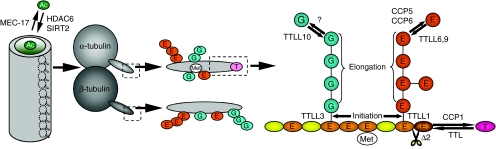
Tubulin PTM types and sites. Shown are the well-characterized post-translational modifications that act on tubulin and the enzymes that are responsible for these modifications. Most of the modifications occur at the C-terminal tail (CTT) domains of α- and β-tubulin. Ac, acetylated lysine; E, glutamic acid; G. glycine; Met, methylated glutamic acid; Δ2, proteolytic removal of the penultimate C-terminal amino acid.
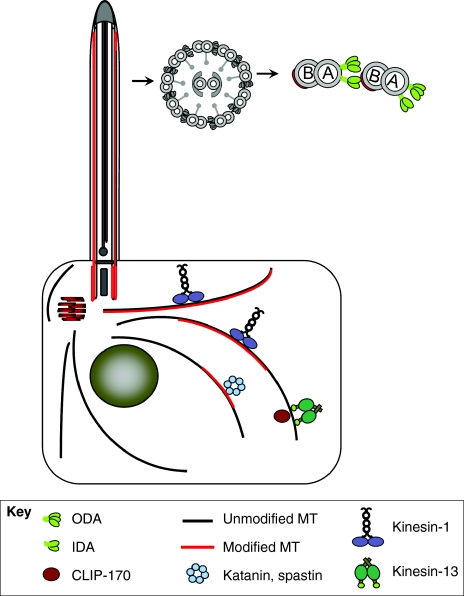
Tubulin PTMs regulate diverse activities by increasing the activity of microtubule effectors. Tubulin modifications regulate diverse activities including motor protein movement, microtubule severing, microtubule-end polymerization and activity of +TIPs. See text for further details.
References
-
- Argarana C. E., Barra H. S., Caputto R. (1978). Release of [14C]tyrosine from tubulinyl-[14C]tyrosine by brain extract. Separation of a carboxypeptidase from tubulin-tyrosine ligase. Mol. Cell. Biochem 19, 17-21 - PubMed
-
- Argarana C. E., Barra H. S., Caputto R. (1980). Tubulinyl-tyrosine carboxypeptidase from chicken brain: properties and partial purification. J. Neurochem. 34, 114-118 - PubMed
-
- Barra H. S., Rodriguez J. A., Arce C. A., Caputto R. (1973). A soluble preparation from rat brain that incorporates into its own proteins (14 C)arginine by a ribonuclease-sensitive system and (14 C)tyrosine by a ribonuclease-insensitive system. J. Neurochem. 20, 97-108 - PubMed
Publication types
MeSH terms
Substances
Grants and funding
LinkOut - more resources
Full Text Sources