


Effects of instructed focus and task difficulty on concurrent walking and cognitive task performance in healthy young adults
- PMID: 20931180
- PMCID: PMC3058115
- DOI: 10.1007/s00221-010-2429-6
Effects of instructed focus and task difficulty on concurrent walking and cognitive task performance in healthy young adults
Abstract
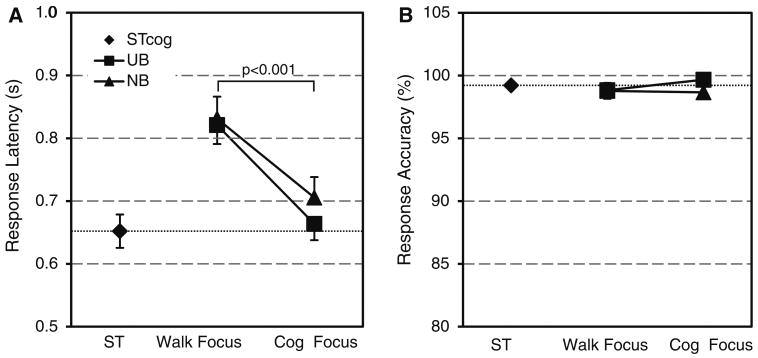
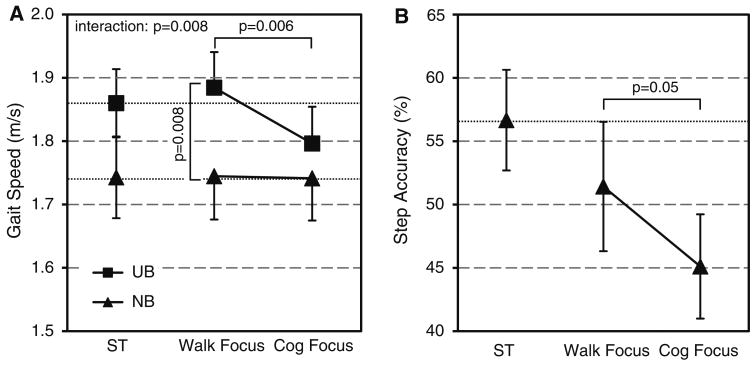
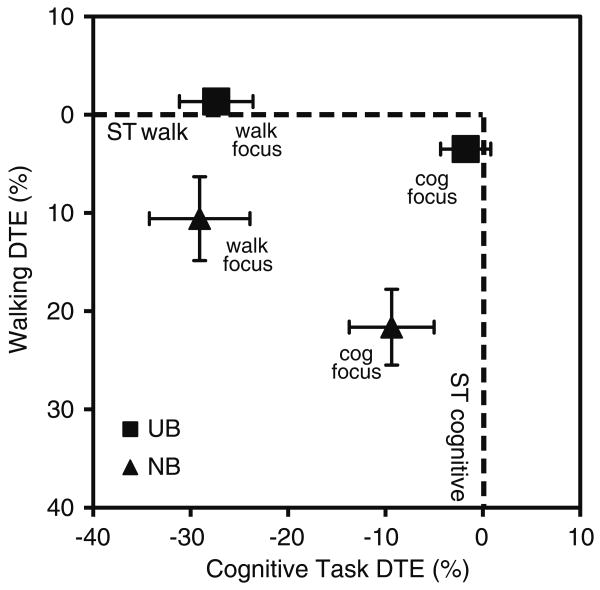
Dual task paradigms can be used to examine the interactions between cognition and the control of posture and gait. Measuring and interpreting changes in dual task performance is challenging, however, because many factors can influence performance. This study examined the effects of instructed focus and walking task difficulty, and the interaction between these factors, on dual task performance in healthy young adults. Fifteen participants performed a cognitive task while walking with either a usual base or a narrow base of support. Participants were instructed to focus on either the cognitive task or walking. Trade-offs both within and between tasks were assessed using the modified attention allocation index and the performance operating characteristic. Instructed focus influenced both the cognitive task and walking. Performance on the cognitive task was faster with instructions to focus on the cognitive task, and walking was faster (and more accurate in the narrow-base condition) with instructions to focus on walking. Walking task difficulty did not affect cognitive performance but did affect walking, with faster walking in the usual-base versus narrow-base condition. There was evidence of an interaction, with greater effects of instructed focus on the cognitive task during usual versus narrow-base walking. These results support the idea that the ability to flexibly shift attention allocation and task performance in response to instructions depends on the difficulty of the postural control task. The modified attention allocation index and the performance operating characteristic were instrumental in fully characterizing trade-offs between and within tasks in order to understand dual task performance changes. A clearer understanding of the factors that affect dual task walking and the interactions between these factors has important implications for the assessment of dual task performance in both clinical and research settings.
Conflict of interest statement
Figures

References
-
- Brown LA, Shumway-Cook A, Woollacott MH. Attentional demands and postural recovery: the effects of aging. J Gerontol A Biol Sci Med Sci. 1999;54:M165–M171. - PubMed
-
- Brown LA, McKenzie NC, Doan JB. Age-dependent differences in the attentional demands of obstacle negotiation. J Gerontol A Biol Sci Med Sci. 2005;60:924–927. - PubMed
-
- Fraizer EV, Mitra S. Methodological and interpretive issues in posture-cognition dual-tasking in upright stance. Gait Posture. 2008;27:271–279. - PubMed
-
- Gage WH, Sleik RJ, Polych MA, McKenzie NC, Brown LA. The allocation of attention during locomotion is altered by anxiety. Exp Brain Res. 2003;150:385–394. - PubMed
Publication types
MeSH terms
Grants and funding
LinkOut - more resources
Full Text Sources
