


Inhibitory C-type lectin receptors in myeloid cells
- PMID: 20934454
- PMCID: PMC3061320
- DOI: 10.1016/j.imlet.2010.10.005
Inhibitory C-type lectin receptors in myeloid cells
Abstract
C-type lectin receptors encoded by the natural killer gene complex play critical roles in enabling NK cell discrimination between self and non-self. In recent years, additional genes at this locus have been identified with patterns of expression that extend to cells of the myeloid lineage where many of the encoded inhibitory receptors have equally important functions as regulators of immune homeostasis. In the present review we highlight the roles of some of these receptors including recent insights gained with regard to the identification of exogenous and endogenous ligands, mechanisms of cellular inhibition and activation, regulated expression within different cellular and immune contexts, as well as functions that include the regulation of bone homeostasis and involvement in autoimmunity.
Copyright © 2010 Elsevier B.V. All rights reserved.
Figures
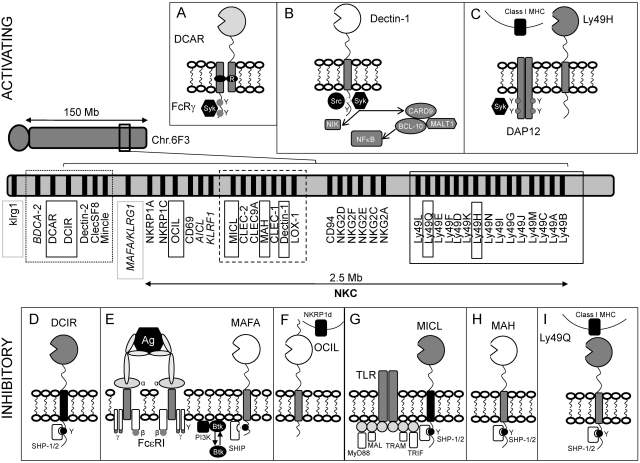
 ; ITIM: ●; ITAM-like: ○. Activating receptor substrates such as Src and Syk kinases and inhibitory receptor substrates such as protein tyrosine phosphatases SHP-1,-2 and SHIP are also shown. (E) Rat MAFA inhibits the secretory response induced by IgE-mediated FcɛRI aggregation, (G) human MICL ligation suppresses TLR-induced responses within specific immune and cellular contexts.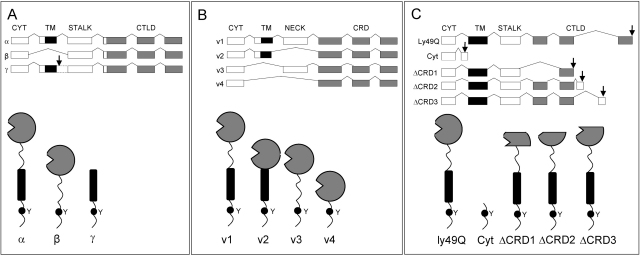
References
-
- Drickamer K. C-type lectin-like domains. Curr Opin Struct Biol. 1999;9:585–590. - PubMed
-
- Drickamer K. Engineering galactose-binding activity into a C-type mannose-binding protein. Nature. 1992;360:183–186. - PubMed
-
- Zelensky A.N., Gready J.E. The C-type lectin-like domain superfamily. FEBS J. 2005;272:6179–6217. - PubMed
-
- Yokoyama W.M., Plougastel B.F. Immune functions encoded by the natural killer gene complex. Nat Rev Immunol. 2003;3:304–316. - PubMed
Publication types
MeSH terms
Substances
Grants and funding
LinkOut - more resources
Full Text Sources
Other Literature Sources
