


Review
doi: 10.1016/j.semcancer.2010.10.003.
Epub 2010 Oct 8.
Mutator phenotypes due to DNA replication infidelity
Affiliations
- PMID: 20934516
- PMCID: PMC3087159
- DOI: 10.1016/j.semcancer.2010.10.003
Item in Clipboard
Review
Mutator phenotypes due to DNA replication infidelity
Semin Cancer Biol.
2010 Oct.
Abstract
This article considers the fidelity of DNA replication performed by eukaryotic DNA polymerases involved in replicating the nuclear genome. DNA replication fidelity can vary widely depending on the DNA polymerase, the composition of the error, the flanking sequence, the presence of DNA damage and the ability to correct errors. As a consequence, defects in processes that determine DNA replication fidelity can confer strong mutator phenotypes whose specificity can help determine the molecular nature of the defect.
Published by Elsevier Ltd.
Conflict of interest statement
The authors declare that there is no conflict of interest.
Figures
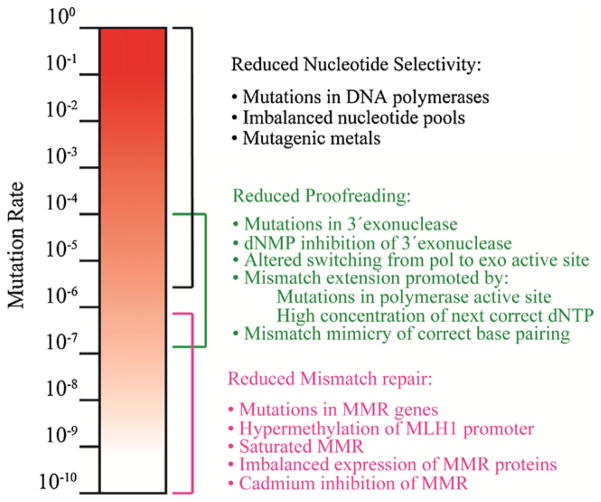
Contribution of nucleotide selectivity, proofreading and DNA mismatch repair to DNA replication fidelity. The figure depicts the wide-ranging contributions of three major processes that act in series to determine DNA replication fidelity. The colored brackets illustrate the investment each process makes to the overall fidelity. Conditions that comprise each process are shown on the right.
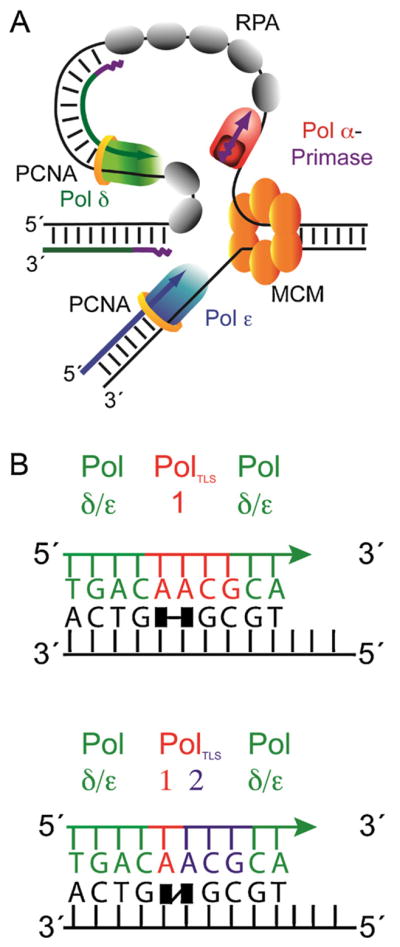
Models for the replication fork and for translesion synthesis. (A) Simplified schematic depicting one current model for the roles of the three major replicative DNA polymerases at the eukaryotic DNA replication fork. (B) The 1-TLS polymerase model (left) is illustrated for bypass of a thymine–thymine dimer (black squares with horizontal line). This model shows that one polymerase is responsible for bypass of the dimer, including insertion opposite the lesion and extension of the primer terminus (red bases) followed by synthesis by a replicative DNA polymerase (green). The 2-TLS polymerase model (right) is illustrated for bypass of thymine–thymine 6–4 photoproduct (black squares with diagonal line). In this example, one polymerase inserts a nucleotide opposite the 3′ T and a second polymerase extends the primer-terminus by three nucleotides, to then allow continuation of synthesis by a major replicative polymerase (green).
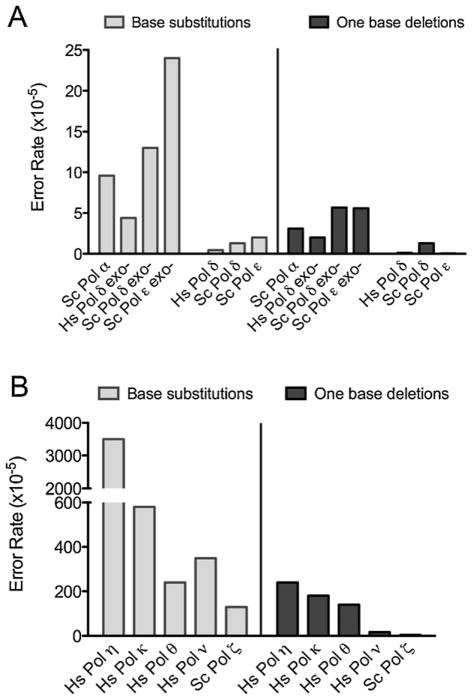
Eukaryotic DNA polymerase error rates for single base mutations. (A) Error rates for Homo sapiens Pol δ and S. cerevisiae polymerases α, δ and ε, for single base substitutions (BS; light grey bars) and one base deletions (dark grey). (B) Error rates for Homo sapiens polymerases η, κ, θ and ν and cerevisiae Pol ζ. Note the difference in scales between panels A and B. Error rates for each polymerase were obtained with the lacZ-α forward mutation assay. The assay measures error made when copying a template in a gapped DNA substrate in vitro that contains the wildtype lacZ-α complementation sequence. The assay [89] scores all 12 single base–base mismatches and different single-base deletion mismatches in numerous different sequence contexts. [85,87,90,91].
References
-
- Bebenek K, Kunkel TA. Functions of DNA polymerases. Adv Protein Chem. 2004;69:137–65. - PubMed
-
- Friedberg EC, Walker GC, Siede W, Wood RD, Schultz RA, Ellenberger T. DNA repair and mutagenesis. 2. ASM Press; 2006.
Publication types
MeSH terms
Substances
Grants and funding
LinkOut - more resources
Full Text Sources
Research Materials
