. 2010 Dec;16(12):2349-59.
doi: 10.1261/rna.2302810. Epub 2010 Oct 8.

Assembly and activation of a kinase ribozyme

Affiliations

Assembly and activation of a kinase ribozyme

Donald H Burke et al. RNA. 2010 Dec.

Abstract

RNA activities can be regulated by modulating the relative energies of all conformations in a folding landscape; however, it is often unknown precisely how peripheral elements perturb the overall landscape in the absence of discrete alternative folds (inactive ensemble). This work explores the effects of sequence and secondary structure in governing kinase ribozyme activity. Kin.46 catalyzes thiophosphoryl transfer from ATPγS onto the 5' hydroxyl of polynucleotide substrates, and is regulated 10,000-fold by annealing an effector oligonucleotide to form activator helix P4. Transfer kinetics for an extensive series of ribozyme variants identified several dispensable internal single-stranded segments, in addition to a potential pseudoknot at the active site between segments J1/4 and J3/2 that is partially supported by compensatory rescue. Standard allosteric mechanisms were ruled out, such as formation of discrete repressive structures or docking P4 into the rest of the ribozyme via backbone 2' hydroxyls. Instead, P4 serves both to complete an important structural element (100-fold contribution to the reaction relative to a P4-deleted variant) and to mitigate nonspecific, inhibitory effects of the single-stranded tail (an additional 100-fold contribution to the apparent rate constant, k(obs)). Thermodynamic activation parameters ΔH(‡) and ΔS(‡), calculated from the temperature dependence of k(obs), varied with tail length and sequence. Inhibitory effects of the unpaired tail are largely enthalpic for short tails and are both enthalpic and entropic for longer tails. These results refine the structural view of this kinase ribozyme and highlight the importance of nonspecific ensemble effects in conformational regulation by peripheral elements.


Figures
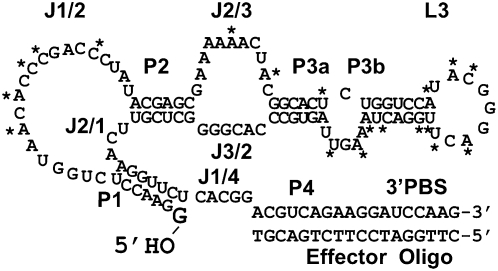
FIGURE 1.
FIGURE 1.
Secondary structural features of ribozyme Kin.46, labeled as described in the text. The 5′ hydroxyl that is phosphorylated by the ribozyme is shown in large text. Asterisks indicate positions where polymorphisms were observed in the original selection (Lorsch and Szostak 1994). All other positions were invariant.
FIGURE 2.
FIGURE 2.
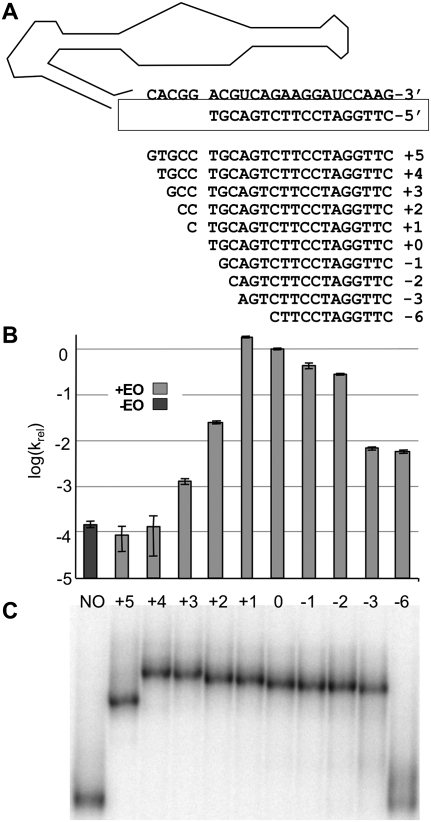
Effect on Kin.46 ribozyme activity of extending or shortening the effector oligonucleotide. For Figures 2, 3, 4, and 6, light gray bars indicate data obtained in the presence of effector oligonucleotides, and dark gray bars indicate data obtained when EO was omitted from the reaction. (A) Sequences for EO+5 through EO-6 are shown 3′-to-5′ below the sequence of Kin.46 J1/4 and PBS strands (structural elements are as detailed in Fig. 1). (B) Log(kobs) values are plotted relative to the values obtained in the presence of EO0 or without EO (sample “NO”). (C) Comparison of electrophoretic mobilities of Kin.46 with EOs of varying lengths in a 10% nondenaturing polyacrylamide gel. Labels above the lanes align with bar graphs in B. Identical patterns of relative migration were also seen for all 10 samples run on 8% and 6% native polyacrylamide gels (data not shown).
FIGURE 3.
FIGURE 3.
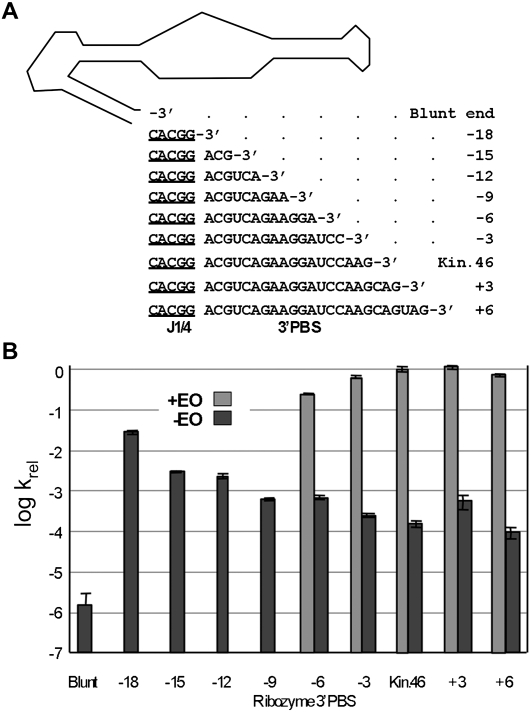
Effect of 3′ tail length on activity and allostery. (A) “Blunt end” indicates a ribozyme terminating at the 3′ end of P1. Numbering indicates the lengths of the 3′ tail relative to the original 3′PBS. (B) Activities for “+EO” were only measured for ribozymes “-6” through “+6.”
FIGURE 4.
FIGURE 4.
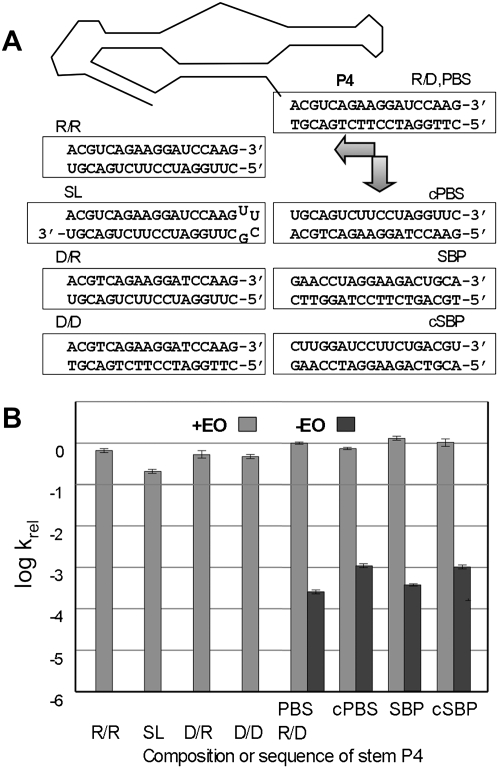
Effect of P4 helix composition on ribozyme activity. (A) P4 variants are shown below a schematic of Kin.46. “SL” is a stem–loop construct in which the ribozyme 3′ end folds back on itself to form the activating helix. Essentially identical data were obtained for an SL construct in which the UUCG loop was replaced with a slightly less stable GAAA tetraloop (Supplemental Table S1; data not shown). (B) Relative apparent initial rate constants for P4 variants shown in A. Apparent binding affinity for donor substrates is not adversely affected by altering the sequence of the 3′ tail. Km values for all four tail variants are within experimental error of each other, both in the presence or absence of EO (0.5–1.6 ± 0.4 μM) (Supplemental Table S1), and all are well below the substrate concentration used in the Eyring analysis (10 μM).
FIGURE 5.
FIGURE 5.
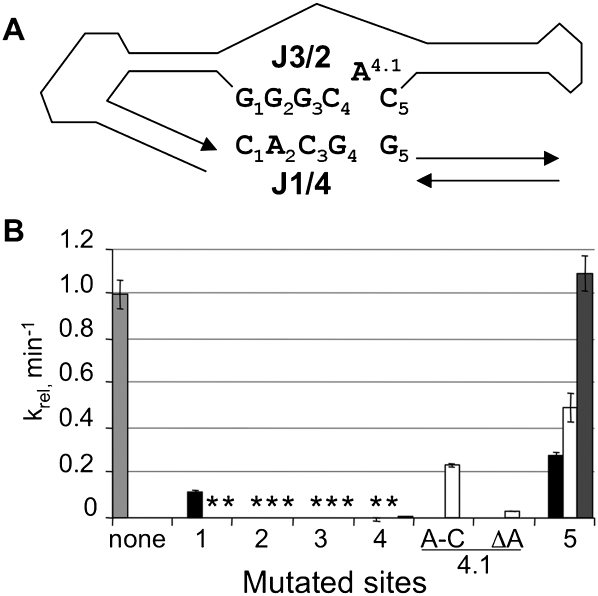
Potential tertiary interactions in Kin.46. (A) Base numbering of nucleotides in J3/2 and J1/4. The rest of the ribozyme is shown schematically. (B) Activities of mutated ribozymes carrying mutations at the positions indicated, normalized to the activity of the original Kin.46, in the presence of EO0. For each mutant, the indicated position was changed to its Watson-Crick complement (A changed to U; G changed to C, etc.). The light gray bar, representing the original Kin.46 ribozyme, indicates no changes; the black bars, mutations within J1/4 only; white bars, mutations within J3/2 only; the dark gray bar, compensatory mutations within both strands, as detailed in the text. A-C is an A-to-C mutation at position 4.1; ΔA is a deletion of this same nucleotide. Where no bars are visible (*), measured activity was >1000-fold reduced relative to activated Kin.46.
FIGURE 6.
FIGURE 6.
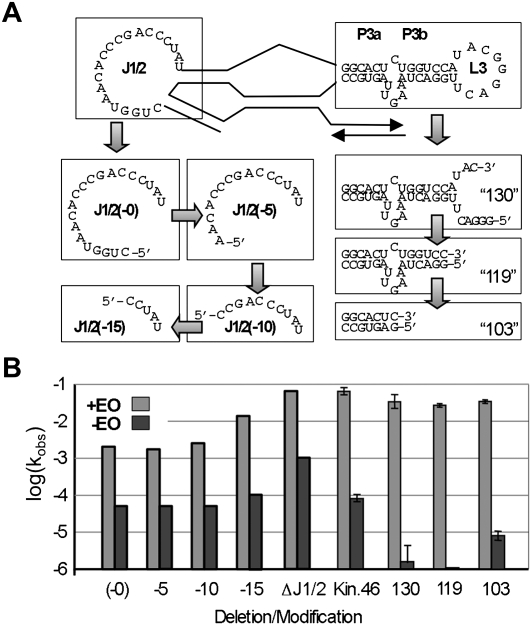
Effect of internal deletions on split kinase ribozyme activity and allosteric activation. (A) The J1/2 loop was disconnected from the 7 nt substrate strand using hammerhead-kinase tandem ribozyme transcripts to remove 0, 5, 10, or 15 nucleotides, as indicated, or all 20 nucleotides (ΔJ1/2, structure not shown explicitly). The L3 loop was similarly interrupted and deletions were made as indicated. Numbers in the corners of each box indicate the sum of the lengths of the 5′ and 3′ segments of the annealed ribozyme. (B) Activities and allosteric activation of “split” ribozyme constructs compared to wild-type. The light gray bars indicate observed rates in the presence of EO; dark gray bars indicate rates in the absence of EO.
FIGURE 7.
FIGURE 7.
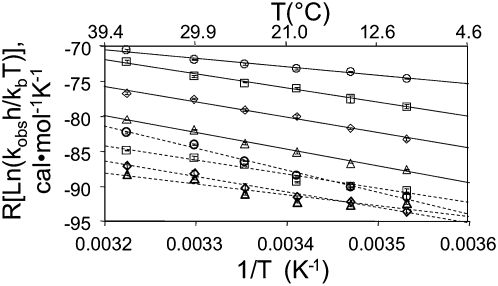
Eyring plots of autokinase activity by Kin.46 mutants with alterations in 3′ tail length. Circles with solid lines, represent original Kin.46 in the presence of EO0. All other reactions are in the absence of EO. Squares with solid lines indicate ribozyme “-18” (18 nucleotides removed from the 3′ end of the original Kin.46); diamonds with solid lines indicate “-15”; triangles with solid lines indicate “-12”; circles with dashed lines indicate “-9”; squares with dashed lines indicate “-6”; diamonds with dashed lines indicate “-3”; triangles with dashed lines represent original Kin.46 without EO. Error bars reflect standard deviations of three or more measurements at each temperature.
FIGURE 8.
FIGURE 8.
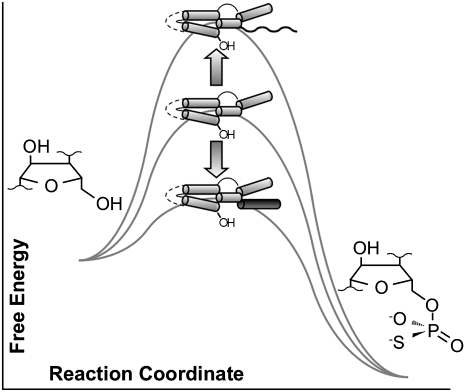
Effect of activator helix P4 and 3′ tail on transition state stabilization by Kin.46. Relative to the tail-less “-18” ribozyme (center), adding an unpaired 3′ tail increases the barrier to RNA-catalyzed thiophosphorylation (top), while adding both strands of P4 decreases the free energy barrier (bottom).

References

    1. Achenbach J, Jeffries G, McManus S, Billen L, Li Y 2005. Secondary-structure characterization of two proficient kinase deoxyribozymes. Biochemistry 44: 3765–3774 - PubMed
    1. Admiraal S, Herschlag D 1995. Mapping the transition state for ATP hydrolysis: implications for enzymatic catalysis. Chem Biol 2: 729–739 - PubMed
    1. Admiraal S, Schneider B, Meyer P, Janin J, Véron M, Deville-Bonne D, Herschlag D 1999. Nucleophilic activation by positioning in phosphoryl transfer catalyzed by nucleoside diphosphate kinase. Biochemistry 38: 4701–4711 - PubMed
    1. Admiraal S, Meyer P, Schneider B, Deville-Bonne D, Janin J, Herschlag D 2001. Chemical rescue of phosphoryl transfer in a cavity mutant: A cautionary tale for site-directed mutagenesis. Biochemistry 40: 403–413 - PubMed
    1. Beisel C, Smolke C 2009. Design principles for riboswitch function. PLoS Comput Biol 5: e1000363 doi: 10.1371/journal.pcbi.1000363 - PMC - PubMed

Publication types

LinkOut - more resources