. 2010 Dec;192(23):6191-9.
doi: 10.1128/JB.01651-09. Epub 2010 Oct 8.

Emergence of Pseudomonas aeruginosa strains producing high levels of persister cells in patients with cystic fibrosis

Affiliations

Emergence of Pseudomonas aeruginosa strains producing high levels of persister cells in patients with cystic fibrosis

Lawrence R Mulcahy et al. J Bacteriol. 2010 Dec.

Abstract

The majority of cystic fibrosis (CF) patients succumb to a chronic infection of the airway with Pseudomonas aeruginosa. Paradoxically, pathogenic strains are often susceptible to antibiotics, but the infection cannot be eradicated with antimicrobial therapy. We find that in a majority of patients with airway infections, late isolates of P. aeruginosa produce increased levels of drug-tolerant persister cells. The genomes of a clonal pair of early/late isolates from a single patient have been previously sequenced, and the late isolate (obtained at age 96 months) showed a 100-fold increase in persister levels. The 96-month isolate carries a large number of mutations, including a mutation in mutS that confers a hypermutator phenotype. There is also a mutation in the mexZ repressor controlling the expression of the MexXY-OprM multidrug pump, which results in a moderate increase in the ofloxacin, carbenicillin, and tobramycin MICs. Knocking out the mexXY locus restored the resistance to that of the parent strain but did not affect the high levels of persisters formed by the 96-month isolate. This suggests that the late isolate is a high-persister (hip) mutant. Increased persister formation was observed in exponential phase, stationary phase, and biofilm populations of the 96-month isolate. Analysis of late isolates from 14 additional patients indicated that 10 of them are hip mutants. Most of these hip mutants did not have higher drug resistance. Increased persister formation appears to be their sole mechanism for surviving chemotherapy. Taken together, these findings suggest a link between persisters and recalcitrance of CF infection and identify an overlooked culprit-high-persister mutants producing elevated levels of drug-tolerant cells. Persisters may play a similarly critical role in the recalcitrance of other chronic infections.


Figures
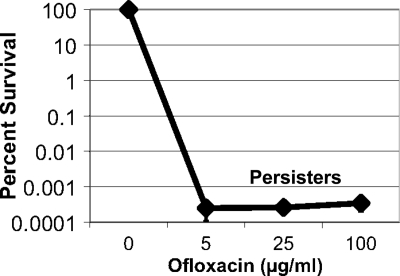
FIG. 1.
FIG. 1.
Dose-dependent killing of a clinical isolate of P. aeruginosa. Strain AMT0023-30 was isolated from an 8-month-old patient. Antibiotic was added at time zero at the indicated concentration to a stationary-phase culture, and after an 8-h incubation, surviving persister cells were plated for colony count (percent survival ± standard error of the mean [SEM]; n = 3).
FIG. 2.
FIG. 2.
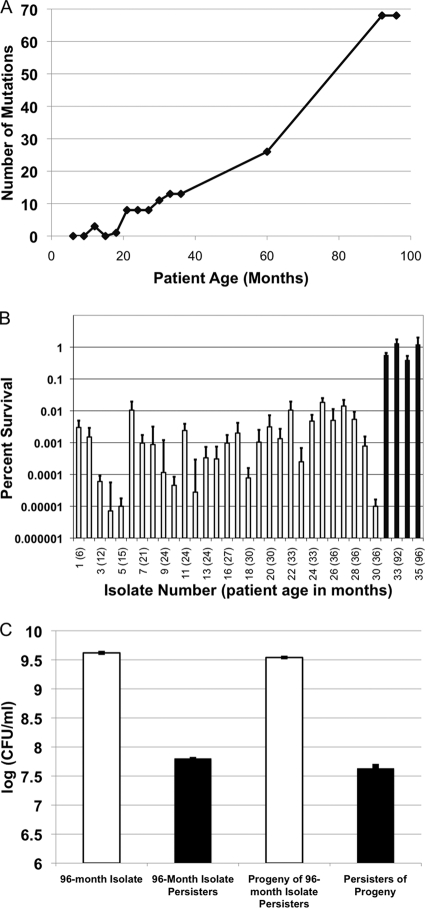
Persister levels in longitudinal clonal isolates of P. aeruginosa from a CF patient. (A) The number of mutations at the time a given strain was isolated (47); (B) persister levels (percent survival ± SEM; n = 3) of 35 longitudinal isolates of P. aeruginosa. Stationary-phase cultures were exposed to 100 μg/ml of ofloxacin for 8 h, and surviving cells were determined by colony count. hip mutants are indicated with black bars. (C) Persister progeny from the 96-month hip mutant form the same levels of persisters. The 96-month isolate was grown to the stationary phase and treated with 100× the MIC of ofloxacin for 8 h, and persister levels were determined (96-month isolate persisters). Persisters were regrown to the stationary phase (progeny of 96-month isolate persisters) and then treated with 100× the MIC of ofloxacin for 8 h, after which persister levels were determined were determined by colony count (persisters of progeny) (log [CFU/ml] ± SEM; n = 3).
FIG. 3.
FIG. 3.
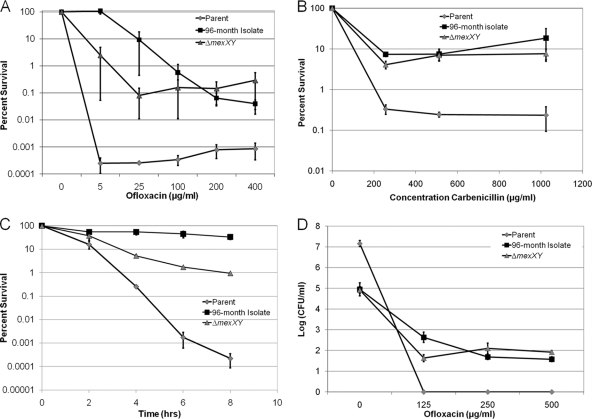
Separating resistance from tolerance in a 96-month isolate of P. aeruginosa. In each experiment, the same set of strains was examined: the parent (AMT0023-30), 96-month isolate (AMT0023-34), and the ΔmexXY (KLE2000) derivative of the 96-month isolate. (A) Stationary-phase cultures were incubated for 8 h with ofloxacin, and surviving cells were enumerated by colony count (percent survival ± SEM; n = 3). (B) Exponential-phase cultures were treated for 8 h with carbenicillin. Surviving cells were enumerated by colony count (percent survival ± SEM; n = 3). (C) Stationary-phase cells were treated with tobramycin (20× MIC), and the surviving cells were enumerated by colony count (percent survival ± SEM; n = 4). (D) Twenty-four-hour biofilms were treated with ofloxacin for 8 h, and surviving cells were determined by colony count (log [CFU/ml] ± SEM; n = 4).
FIG. 4.
FIG. 4.
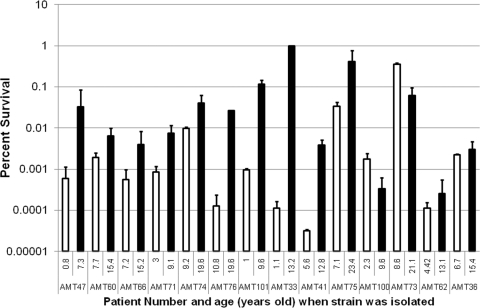
A screen of P. aeruginosa clinical isolates for hip mutants. Stationary-phase cultures of clonal early/late isolate pairs from 14 patients were exposed to ofloxacin (50× MIC) for 8 h, and the surviving cells were determined by colony count (percent survival ± SEM; n = 4). Early isolates are indicated with white bars, while late isolates are indicated with black bars. The patient number and age at which the tested isolates were obtained are displayed on the x axis. A hip mutant emerged in 10 of the 14 patients. A hip mutant did not emerge in the isolates from the last four patients displayed on the right side of the graph.
FIG. 5.
FIG. 5.
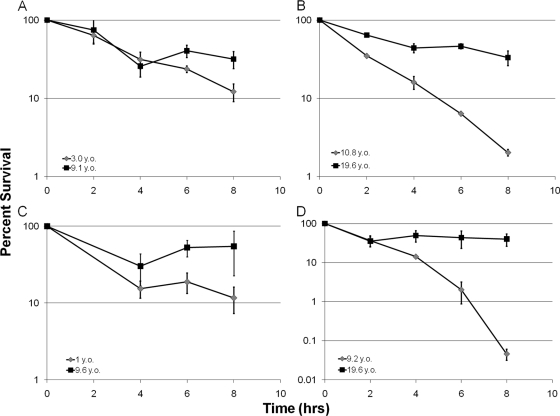
(A to D) Time-dependent killing of paired early/late isolates from different patients by tobramycin. Strains were grown to the stationary phase, treated with tobramycin (20× MIC), and the surviving cells were enumerated by colony count (percent survival ± SEM; n = 3). The age of the patient at the time the isolate was obtained (years old [y.o.]) is indicated.

References

    1. Alhede, M., T. Bjarnsholt, P. O. Jensen, R. K. Phipps, C. Moser, L. Christophersen, L. D. Christensen, M. van Gennip, M. Parsek, N. Hoiby, T. B. Rasmussen, and M. Givskov. 2009. Pseudomonas aeruginosa recognizes and responds aggressively to the presence of polymorphonuclear leukocytes. Microbiology 155:3500-3508. - PubMed
    1. Bjarnsholt, T., P. Ø. Jensen, M. J. Fiandaca, J. Pedersen, C. R. Hansen, C. B. Andersen, T. Pressler, M. Givskov, and N. Høiby. 2009. Pseudomonas aeruginosa biofilms in the respiratory tract of cystic fibrosis patients. Pediatr. Pulmonol. 44:547-558. - PubMed
    1. Bjarnsholt, T., K. Kirketerp-Moller, P. O. Jensen, K. G. Madsen, R. Phipps, K. Krogfelt, N. Hoiby, and M. Givskov. 2008. Why chronic wounds will not heal: a novel hypothesis. Wound Repair Regen. 16:2-10. - PubMed
    1. Burns, J. L., J. M. Van Dalfsen, R. M. Shawar, K. L. Otto, R. L. Garber, J. M. Quan, A. B. Montgomery, G. M. Albers, B. W. Ramsey, and A. L. Smith. 1999. Effect of chronic intermittent administration of inhaled tobramycin on respiratory microbial flora in patients with cystic fibrosis. J. Infect. Dis. 179:1190-1196. - PubMed
    1. Ceri, H., M. E. Olson, C. Stremick, R. R. Read, D. Morck, and A. Buret. 1999. The Calgary biofilm device: new technology for rapid determination of antibiotic susceptibilities of bacterial biofilms. J. Clin. Microbiol. 37:1771-1776. - PMC - PubMed

Publication types

MeSH terms

Substances