. 2010 Nov 1;185(9):5619-27.
doi: 10.4049/jimmunol.1001879. Epub 2010 Oct 8.

IL-17A is proatherogenic in high-fat diet-induced and Chlamydia pneumoniae infection-accelerated atherosclerosis in mice

Affiliations

IL-17A is proatherogenic in high-fat diet-induced and Chlamydia pneumoniae infection-accelerated atherosclerosis in mice

Shuang Chen et al. J Immunol. .

Abstract

The role of IL-17 in atherogenesis remains controversial. We previously reported that the TLR/MyD88 signaling pathway plays an important role in high-fat diet as well as Chlamydophila pneumoniae infection-mediated acceleration of atherosclerosis in apolipoprotein E-deficient mice. In this study, we investigated the role of the IL-17A in high-fat diet (HFD)- and C. pneumoniae-induced acceleration of atherosclerosis. The aortic sinus plaque and aortic lesion size and lipid composition as well as macrophage accumulation in the lesions were significantly diminished in IL-17A(-/-) mice fed an HFD compared with wild-type (WT) C57BL/6 control mice. As expected, C. pneumoniae infection led to a significant increase in size and lipid content of the atherosclerotic lesions in WT mice. However, IL-17A(-/-) mice developed significantly less acceleration of lesion size following C. pneumoniae infection compared with WT control despite similar levels of blood cholesterol levels. Furthermore, C. pneumoniae infection in WT but not in IL-17A(-/-) mice was associated with significant increases in serum concentrations of IL-12p40, CCL2, IFN-γ, and numbers of macrophages in their plaques. Additionally, in vitro studies suggest that IL-17A activates vascular endothelial cells, which secrete cytokines that in turn enhance foam cell formation in macrophages. Taken together, our data suggest that IL-17A is proatherogenic and that it plays an important role in both diet-induced atherosclerotic lesion development, and C. pneumoniae infection-mediated acceleration of atherosclerotic lesions in the presence of HFD.


Figures
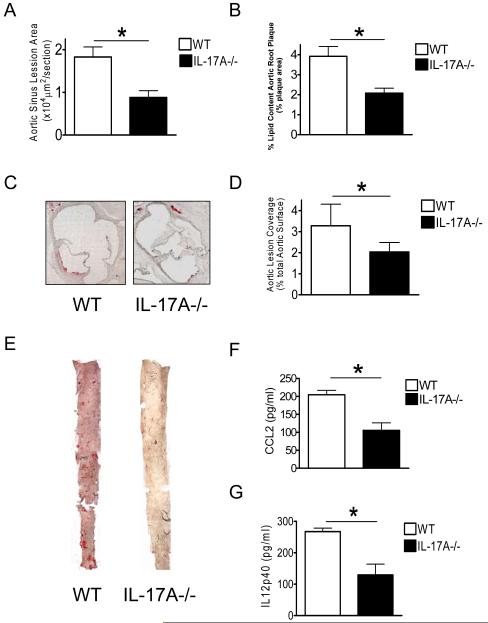
Figure 1
Figure 1. Lack of IL-17A reduced High cholesterol diet-induced acceleration of atherosclerosis
A, B, D, Quantification of lipid content in the aortic sinus and aorta lesions en face from WT and IL17A−/− mice. C, E, Representative oil red O staining of aortic sinus plaque and aorta en face from WT and IL-17A−/− mice are shown. Data are presented as mean value ± SEM. N=12 for WT, N=15 for IL-17A−/− group. F, G, Serum concentration of CCL2 and IL-12p40 are reduced in IL-17A−/− mice compared with C57BL/6 mice after fed with a high-cholesterol diet for 12 weeks. (n = 10 in each group). Means and SD are shown (*p < 0.05).
Figure 2
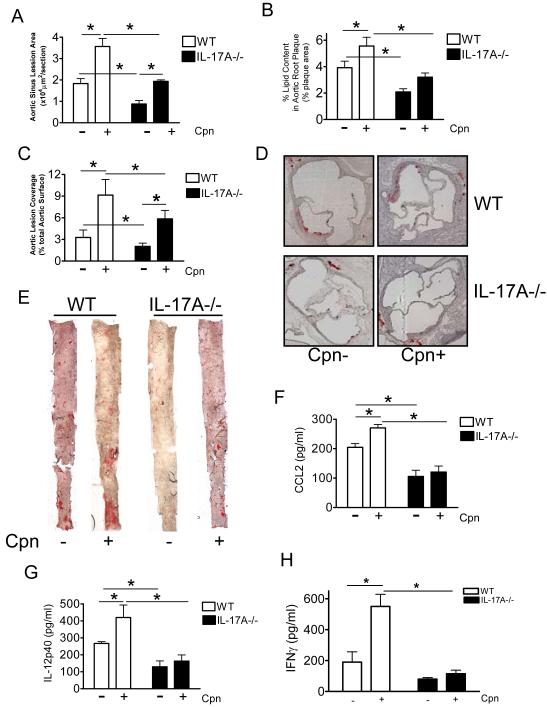
Figure 2. Lack of IL-17A reduced Chlamydia pneumoniae infection-induced acceleration of atherosclerosis in C57BL/6 mice
A, B, C, Quantification of lipid content in the aortic sinus, and aorta en face from WT and IL-17A−/− mice with and without infection. D, E, Representative Oil red O staining of aortic sinus and aorta en face lesions from infected and uninfected WT and IL-17A−/− mice are shown. Data are shown as mean values ± SEM, n=12-15 for the aortic sinus experiments, and n=12-15 for the en face aorta experiments. F, G, H, CCL2, IL-12p40 and IFN-γ serum concentrations of C57BL/6 mice and IL-17A−/− mice fed with a high-cholesterol diet for 12 weeks with and without C. pneumoniae infection (n = 10 in each group). Means and SD are shown (*p < 0.05).
Figure 3
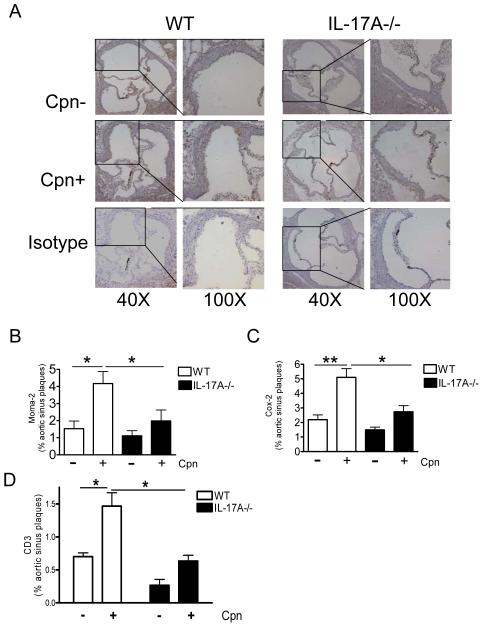
Figure 3. C. pneumoniae infection leads to increasing of macrophage infiltration, Cox-2 expression, and CD3 T cell infiltration in the aortic sinus of C57BL/6 mice compared with IL-17A−/− mice
A, Representative MOMA-2-positive staining in uninfected and infected IL-17A−/− and WT mice. Infection with C. pneumoniae (5 × 10⁴ IFU/mouse) led to greater accumulation of MOMA-2 -positive and (brown nuclear) in the aortic sinus from C57BL/6 mice, but not in IL-17A−/− mice (only blue nuclears). B, Quantitative analysis of macrophage immunoreactivity in aortic sinus plaques of WT and IL-17A−/− mice, expressed as a proportion of the total plaque areas (n=7 in each group). Means and SD are shown (*p < 0.05). C, Quantitative analysis of COX-2 immunofluorescent staining in sclerotic plaques of WT and IL-17A−/− mice (n = 6 in each group). Means and SD are shown (*p < 0.05). D, Quantification of CD3+ cells and quantitative analysis of CD3 immunoreactivity in the aortic sinus plaques of WT and IL-17A−/− mice (n = 5 in each group). Means and SD are shown (*p < 0.05).
Figure 4
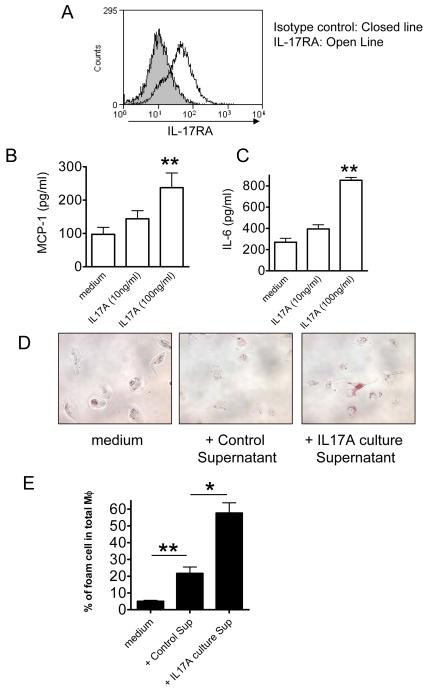
Figure 4. IL-17A increases macrophage foam cell formation via murine aortic endothelial cells
A, Flow cytometry analysis on MAECs derived from aortas of WT mice to determine the presence of IL-17RA. Shaded histogram: Isotype control. Open histogram: Anti-IL-17RA. B, MAECs derived from aortas of WT mice were stimulated with recombinant IL-17A (100 ng/ml) for 24 h. The supernatants were collected and IL-6 and levels were measured by ELISA. C, MAECs derived from aortas of WT mice were stimulated with recombinant IL-17A (100 ng/ml) for 24 hr. CCL2 levels were measured by ELISA. Data shown are derived from one representative experiment out of three independent experiments. Stimulations were performed in quadruplicates. Means ± SD are shown. D, Micrographs of Oil Red O- stained wild type peritoneal macrophages treated with culture supernatants of MAEC with and without IL-17A stimulation. E, The percentages of foam cells in total macrophages were quantified. Means and SD are shown (*p < 0.05, **<p<0.01). Control Sup: culture supernatants of MAEC without IL-17A stimulation.

References

    1. Hansson GK, Libby P, Schonbeck U, Yan ZQ. Innate and adaptive immunity in the pathogenesis of atherosclerosis. Circ Res. 2002;91:281–291. - PubMed
    1. Coffman RL. Origins of the T(H)1-T(H)2 model: a personal perspective. Nat Immunol. 2006;7:539–541. - PubMed
    1. Moseley TA, Haudenschild DR, Rose L, Reddi AH. Interleukin-17 family and IL-17 receptors. Cytokine Growth Factor Rev. 2003;14:155–174. - PubMed
    1. Weaver CT, Hatton RD, Mangan PR, Harrington LE. IL-17 family cytokines and the expanding diversity of effector T cell lineages. Annu Rev Immunol. 2007;25:821–852. - PubMed
    1. Kolls JK, Linden A. Interleukin-17 family members and inflammation. Immunity. 2004;21:467–476. - PubMed

Publication types

MeSH terms