


Spatial patterns of pulmonary tuberculosis incidence and their relationship to socio-economic status in Vitoria, Brazil
- PMID: 20937178
- PMCID: PMC3713790
Spatial patterns of pulmonary tuberculosis incidence and their relationship to socio-economic status in Vitoria, Brazil
Abstract
Objective: To investigate spatial patterns of the incidence of pulmonary tuberculosis (TB) and its relationship with socio-economic status in Vitoria, Espirito Santo, Brazil.
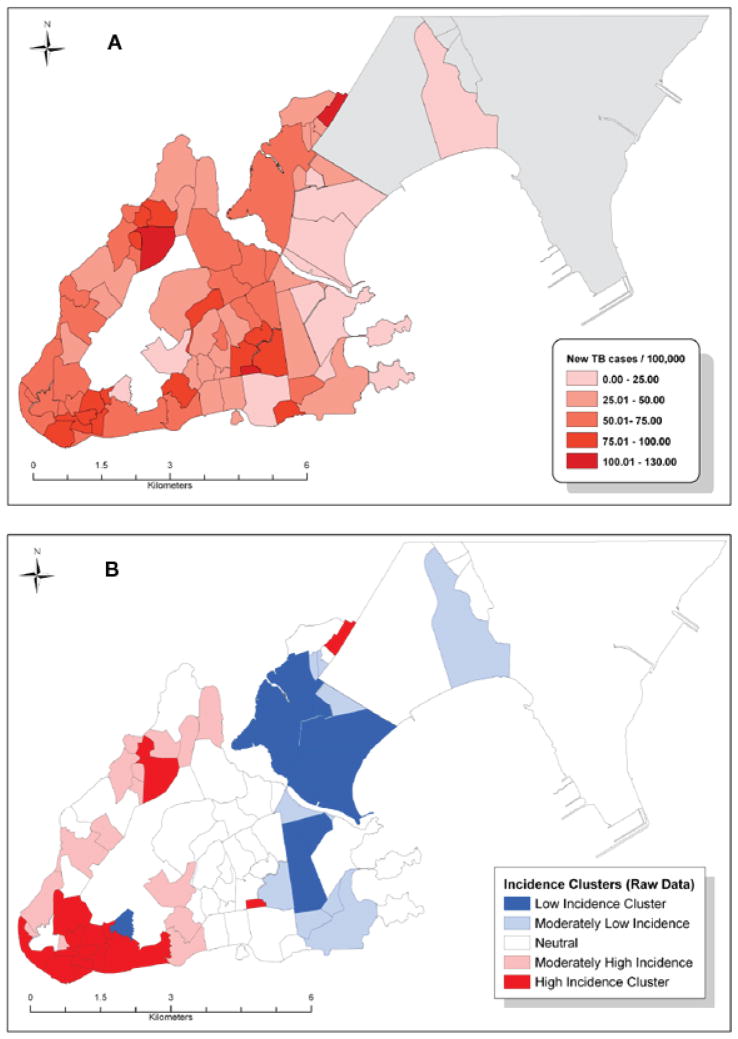
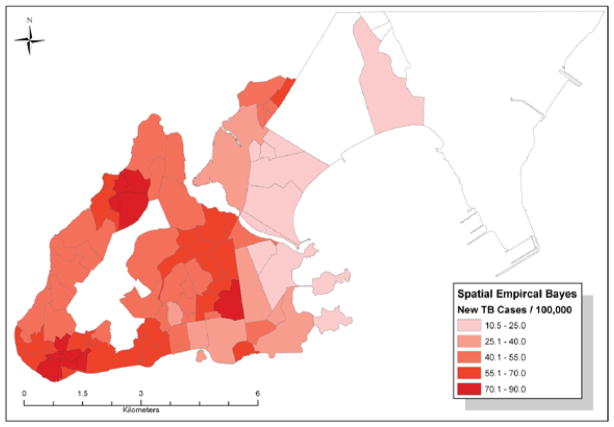
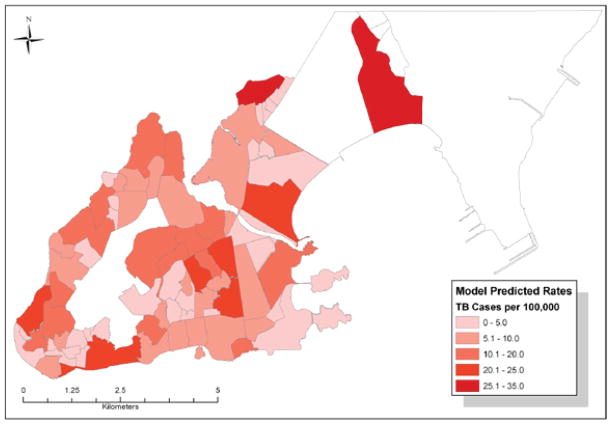
Design: In a 4-year, retrospective, territory-based surveillance study of all new pulmonary TB cases conducted in Vitoria between 2002 and 2006, spatial patterns of disease incidence were compared using spatial clustering statistics (Anselin's local indicators of spatial association [LISA] and Getis-Ord Gi* statistics), smoothed empirical Bayes estimates and model-predicted incidence rates. Spatial Poisson models were fit to examine the relationship between socio-economic status and TB incidence.
Results: A total of 651 TB cases were reported across 78 neighborhoods, with rates ranging from 0 to 129 cases per 100,000 population. Moran's I indicated strong spatial autocorrelation among incidence rates (0.399, P < 0.0001), and four areas of high incidence were identified by LISA and Gi* statistics. Smoothed spatial empirical Bayes estimates demonstrate that two of these areas range from 70 to 90 cases/100,000, while the other two range from 40 to 70 cases/100,000. TB incidence and socio-economic status had a significant curvilinear relationship (P = 0.02).
Conclusions: Data derived from these spatial statistical tools will help TB control programs to allocate TB resources to those populations most at risk of increasing TB rates and to target areas where TB control efforts need to be concentrated.
Figures

References
-
- Ministério da Saúde. Guia para tratamento da tuberculose para o Programa de Saúde da Família. Brasília, Brazil: Ministério da Saúde; 2002. [Portuguese]
-
- Ministério da Saúde. Sistema de informações sobre mortalidade. Brasília, Brazil: Ministério da Saúde; [Accessed September 2006]. http://www.datasus.gov.br. [Portuguese]
-
- Ministério da Saúde. Série histórica de doenças de notificação compulsória por UF, 1980–2001. Brasília, Brazil: Ministério da Saúde; [Accessed September 2006]. http://www.funasa.gov.br/epi/epi00.htm. [Portuguese]
-
- Advisory Council for the Elimination of Tuberculosis. Essential components of a tuberculosis prevention and control program recommendations of the Advisory Council for the Elimination of Tuberculosis. MMWR. 1995;44 (RR-11):1–16. - PubMed
-
- Conde MB, de Melo FA, Marques AM, et al. BTA Committee on Tuberculosis; BTA guidelines on Tuberculosis Work Group. III Brazilian Thoracic Association guidelines on tuberculosis. J Bras Pneumol. 2009;35:1018–1048. - PubMed
Publication types
MeSH terms
Grants and funding
LinkOut - more resources
Full Text Sources
