. 2011 Jan 11;279(1-3):130-8.
doi: 10.1016/j.tox.2010.10.001. Epub 2010 Oct 17.

Development of an in vitro alternative assay method for vaginal irritation

Affiliations

Development of an in vitro alternative assay method for vaginal irritation

Seyoum Ayehunie et al. Toxicology. .

Abstract

The vaginal mucosa is commonly exposed to chemicals and therapeutic agents that may result in irritation and/or inflammation. In addition to acute effects, vaginal irritation and inflammation can make women more susceptible to infections such as HIV-1 and herpes simplex virus 2 (HSV-2). Hence, the vaginal irritation potential of feminine care formulations and vaginally administered therapeutic agents is a significant public health concern. Traditionally, testing of such materials has been performed using the rabbit vaginal irritation (RVI) assay. In the current study, we investigated whether the organotypic, highly differentiated EpiVaginal™ tissue could be used as a non-animal alternative to the RVI test. The EpiVaginal tissue was exposed to a single application of ingredients commonly found in feminine hygiene products and the effects on tissue viability (MTT assay), barrier disruption (measured by transepithelial electrical resistance, TEER and sodium fluorescein (NaFl) leakage), and inflammatory cytokine release (interleukin (IL)-1α, IL-1β, IL-6, and IL-8) patterns were examined. When compared to untreated controls, two irritating ingredients, nonoxynol 9 and benzalkonium chloride, reduced tissue viability to <40% and TEER to <60% while increasing NaFl leakage by 11-24% and IL-1α and IL-1β release by >100%. Four other non-irritating materials had minimal effects on these parameters. Assay reproducibility was confirmed by testing the chemicals using three different tissue production lots and by using tissues reconstructed from cells obtained from three different donors. Coefficients of variation between tissue lots reconstructed with cells obtained from the same donor or lots reconstructed with cells obtained from different donors were less than 10% and 12%, respectively. In conclusion, decreases in tissue viability and barrier function and increases in IL-1α and IL-1β release appear to be useful endpoints for preclinical screening of topically applied chemicals and formulations for their vaginal irritation potential.


Figures

Figure 1
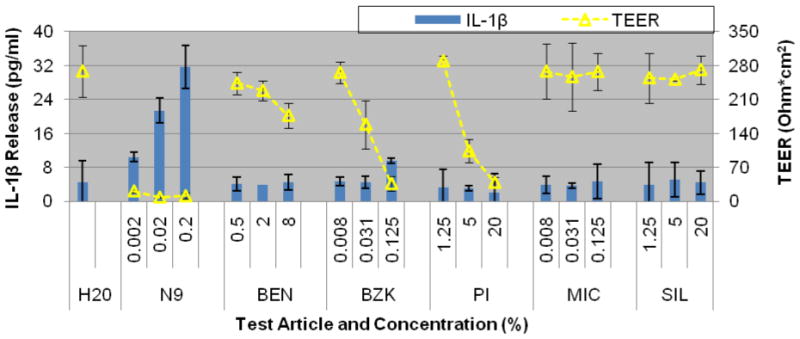
Figure 1
H & E stained cross-sections of: A) Partial thickness, epithelial VEC-100 tissue, B) Full-thickness VEC-100-FT tissue with epithelial and lamina propria layers, and C) Native human explant vaginal tissue. The epithelium in all tissues contains nucleated basal and suprabasal cell layers. As the apical surface is approached, the cells lose their nuclei and become filled with glycogen. In the full thickness and explant tissues, a lamina propria layer consisting of collagen gel matrix containing vaginal fibroblasts is observed. Conclusion: Good morphological correspondence between the EpiVaginal and native explant tissues was observed.
Figure 2
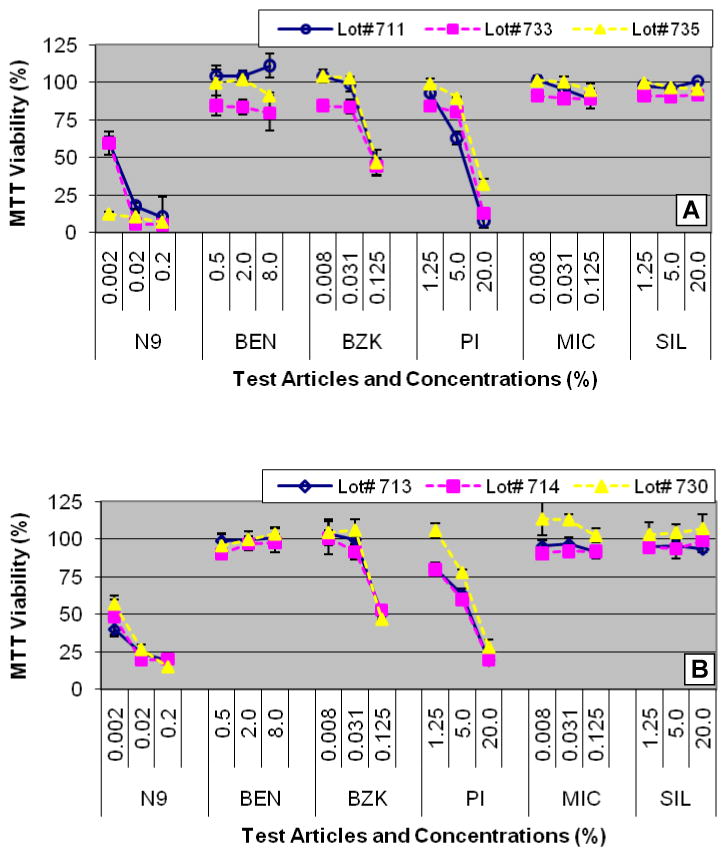
Figure 2
Tissue viability results for: A) Partial-thickness VEC-100 tissues cultured with cells from 3 different donors (lots # 711, 733, and 735) and B) 3 independent lots (lots # 713, 714, and 730) of full-thickness VEC-100-FT tissues obtained from cells from a single donor. Tissues were topically dosed with the test articles (Table 2) for 24 hr.
Figure 3
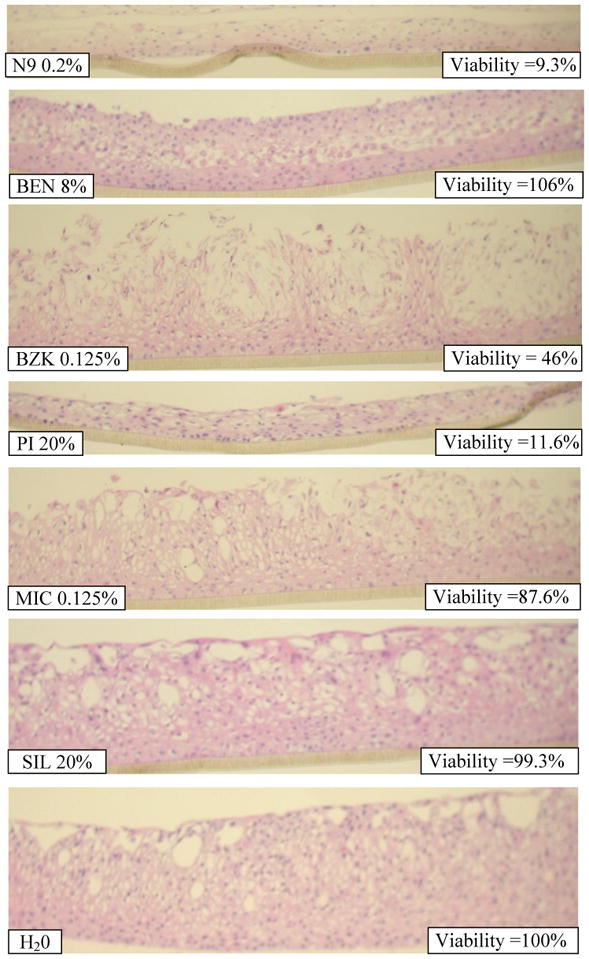
Figure 3
H&E stained cross-sections of EpiVaginal tissues following 24 hour exposure to the highest concentration of the test articles (Table 2).
Figure 4
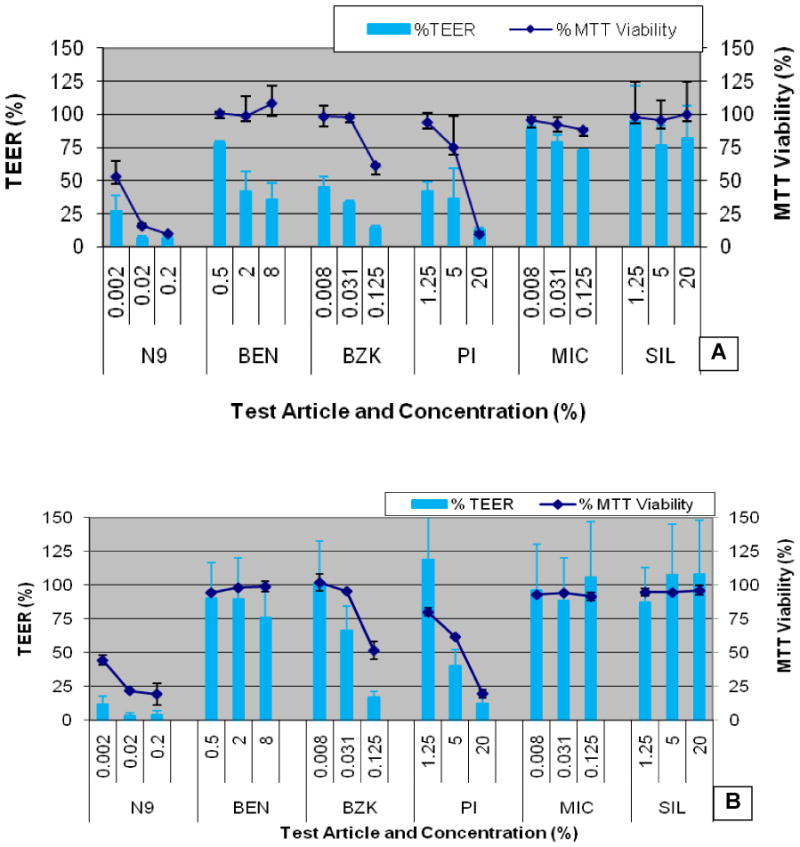
Figure 4
Transepithelial electrical resistance (TEER) and tissue viability (MTT) measurements for EpiVaginal tissues following 24 hr exposure to the test articles (Table 2). Averages (n=2 lots) are presented for: A) Partial-thickness VEC-100 and B) Full-thickness VEC-100-FT tissues. Exposure to ultrapure H2O was used the negative control. Conclusion: TEER values are parallel to, or are slightly more sensitive than, the tissue viability measurements.
Figure 5
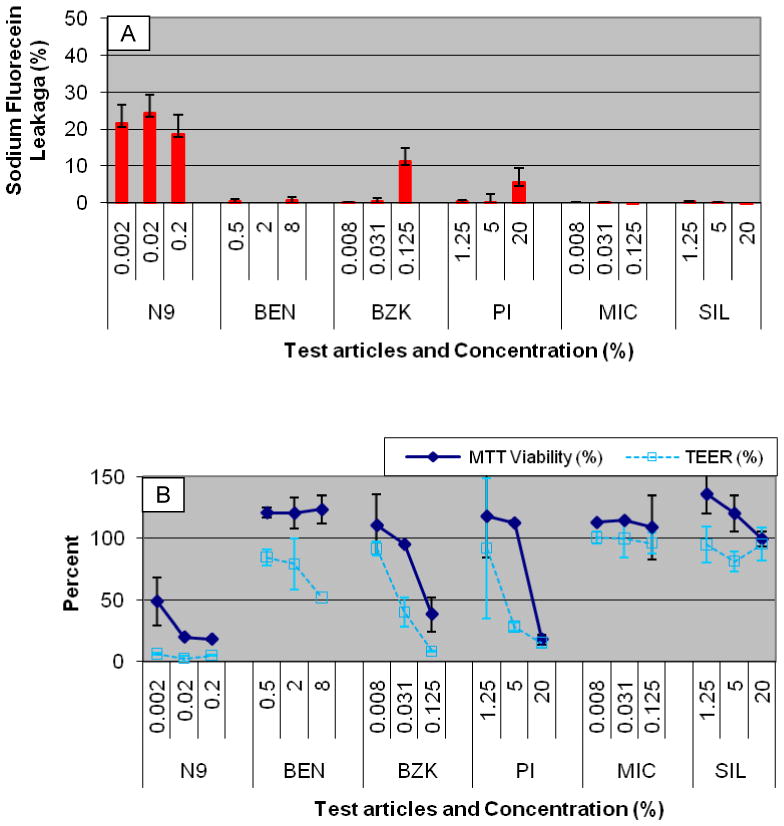
Figure 5
Results for the full thickness VEC-100-FT tissue following 24 hour exposure to the test articles (Table 2). A) Sodium fluorescein (NaFl) leakage and B) Tissue viability (MTT) and TEER assays. Conclusion: NaFl leakage increases when tissue viability and TEER decrease.
Figure 6
Figure 6
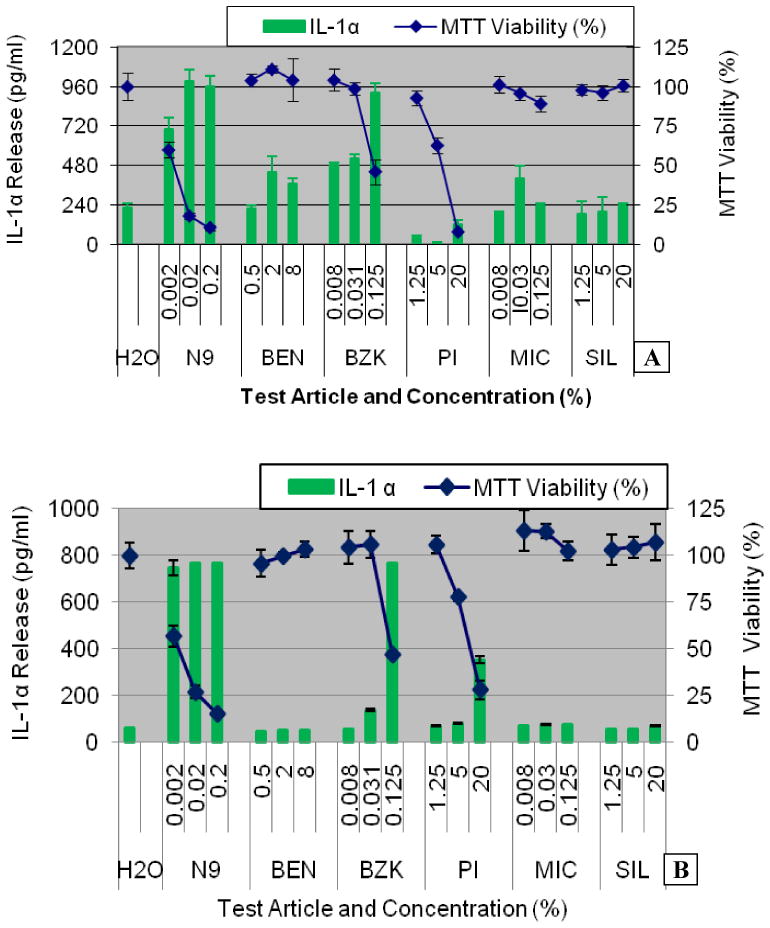
IL-1α release into culture supernatants of: A) Partial thickness VEC-100 and B) Full-thickness VEC-100-FT EpiVaginal tissues following topical exposure to the test articles (Table 2) for 24 hours. Conclusion: IL-1α release increases when tissue viability decreases.
Figure 7
Figure 7
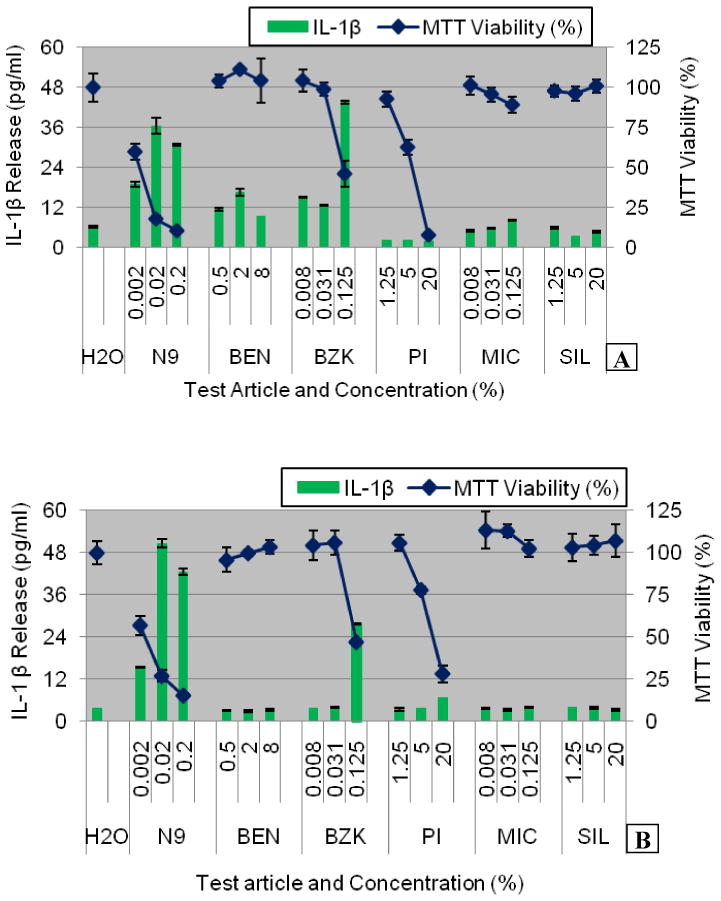
IL-1β release into culture supernatants of: A) Partial thickness VEC-100 and B) Full-thickness VEC-100-FT EpiVaginal tissues following topical exposure to the test articles (Table 2) for 24 hours. Conclusion: IL-1β release increases when tissue viability decreases except for test article PI.
Figure 8
Figure 8
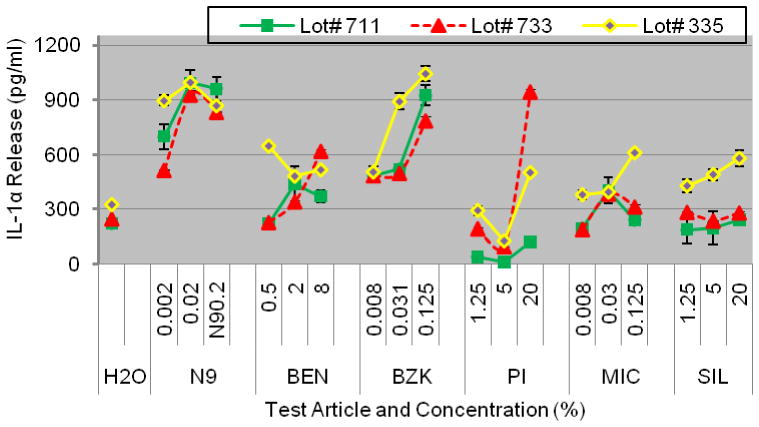
Reproducibility of IL-1α release into culture supernatants of partial thickness VEC-100 EpiVaginal tissue cultured with cells obtained from 3 different donors (Lots # 711, 733, and 735). Conclusion: IL-1α release was highly reproducible for all 3 cell donors.
Figure 9
Figure 9
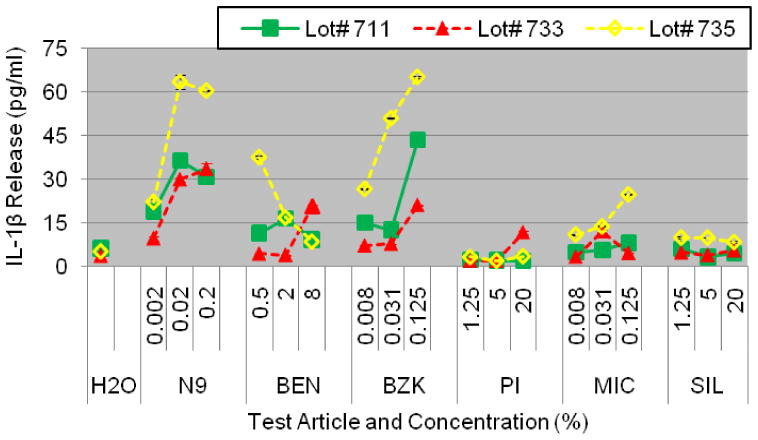
Reproducibility of IL-1β release into culture supernatants of partial thickness VEC-100 EpiVaignal tissue cultured with cells obtained from 3 different donors (Lots # 711, 733, and 735). Conclusion: IL-1β release was highly reproducible for all 3 cell donors.
Figure 10
Figure 10
Reproducibility of transepithelial electrical resistance (TEER) measurements and IL-1β release by the full-thickness EpiVaginal tissue model following 24 hour exposure to the test articles (Table 2). Averages for N=2 independent tissue lots are shown. Exposure to ultrapure H2O was used the negative control. Conclusions: a) IL-1β release appears independent of changes in TEER values and b) IL-1β and TEER values show high levels of reproducibility.

References

    1. Achilles SL, et al. Microbicide efficacy and toxicity tests in a mouse model for vaginal transmission of Chlamydia trachomatis. Sex Transm Dis. 2002;29:655–664. - PubMed
    1. Ayehunie S, et al. Organotypic human vaginal-ectocervical tissue model for irritation studies of spermicides, microbicides, and feminine-care products. Toxicology in Vitro. 2006;20:689–698. - PubMed
    1. Bamforth SD, et al. Ultrastructural analysis of interleukin-1beta-induced leukocyte recruitment to the rat retina. Invest Ophthalmol & Visual Science. 1997;38:25–35. - PubMed
    1. Belec L, et al. Proinflammatory cytokine expression in cervicovaginal secretions of normal and HIV-infected women. Cytokine. 1995;7:568–74. - PubMed
    1. Catalone BJ, et al. Comparative safety evaluation of candidate vaginal microbicide C31G. Antimicrobial Agents and Chemothrapy. 2005;49:1509–1520. - PMC - PubMed

Publication types

MeSH terms