


Prevalence, metabolic features, and prognosis of metabolically healthy obese Italian individuals: the Cremona Study
- PMID: 20937689
- PMCID: PMC3005463
- DOI: 10.2337/dc10-0665
Prevalence, metabolic features, and prognosis of metabolically healthy obese Italian individuals: the Cremona Study
Abstract
Objective: Some obese individuals have normal insulin sensitivity. It is controversial whether this phenotype is associated with increased all-cause mortality risk.
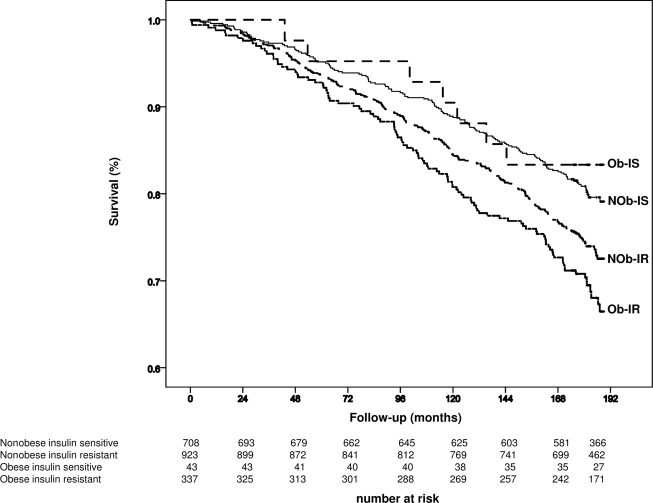
Research design and methods: Fifteen-year all-cause mortality data were obtained through the Regional Health Registry for 2,011 of 2,074 Caucasian middle-aged individuals of the Cremona Study, a population study on the prevalence of diabetes in Italy. Individuals were divided in four categories according to BMI (nonobese: <30 kg/m²; obese: ≥30 kg/m²) and estimated insulin resistance (insulin sensitive: homeostasis model assessment of insulin resistance <2.5; insulin resistant ≥2.5).
Results: Obese insulin-sensitive subjects represented 11% (95% CI 8.1-14.5) of the obese population. This phenotype had similar BMI but lower waist circumference, blood pressure, fasting glucose, triglycerides, and fibrinogen and higher HDL cholesterol than obese insulin-resistant subjects. In the 15-year follow-up, 495 deaths (cardiovascular disease [CVD]: n = 221; cancer: n = 180) occurred. All-cause mortality adjusted for age and sex was higher in the obese insulin-resistant subjects (hazard ratio 1.40 [95% CI 1.08-1.81], P = 0.01) but not in the obese insulin-sensitive subjects (0.99 [0.46-2.11], P = 0.97) when compared with nonobese insulin-sensitive subjects. Also, mortality for CVD and cancer was higher in the obese insulin-resistant subjects but not in the obese insulin-sensitive subjects when compared with nonobese insulin-sensitive subjects.
Conclusions: In contrast to obese insulin-resistant subjects, metabolically healthy obese individuals are less common than previously thought and do not show increased all-cause, cancer, and CVD mortality risks in a 15-year follow-up study.
Figures
References
-
- Brochu M, Tchernof A, Dionne IJ, Sites CK, Eltabbakh GH, Sims EA, Poehlman ET: What are the physical characteristics associated with a normal metabolic profile despite a high level of obesity in postmenopausal women? J Clin Endocrinol Metab 2001;86:1020–1025 - PubMed
-
- Karelis AD, Faraj M, Bastard J-P, St-Pierre DH, Brochu M, Prud'homme D, Rabasa-Lhoret R: The metabolically healthy but obese individual presents a favourable inflammation profile. J Clin Endocrinol Metab 2005;90:4145–4150 - PubMed
-
- Iacobellis G, Ribaudo MC, Zappaterreno A, Iannucci CV, Leonetti F: Prevalence of uncomplicated obesity in an Italian obese population. Obes Res 2005;13:116–1122 - PubMed
-
- Perseghin G: Is a nutritional therapeutic approach unsuitable for metabolically healthy but obese women? Diabetologia 2008;51:1567–1569 - PubMed
-
- Karelis AD: Metabolically healthy but obese individuals. Lancet 2008;372:1281–1283 - PubMed
Publication types
MeSH terms
LinkOut - more resources
Full Text Sources
Medical
