. 2011 Jan;55(1):255-63.
doi: 10.1128/AAC.00709-10. Epub 2010 Oct 11.

Novel compounds containing multiple guanide groups that bind the HIV coreceptor CXCR4

Affiliations

Novel compounds containing multiple guanide groups that bind the HIV coreceptor CXCR4

Royce A Wilkinson et al. Antimicrob Agents Chemother. 2011 Jan.

Abstract

The G-protein-coupled receptor CXCR4 acts as a coreceptor for human immunodeficiency virus type 1 (HIV-1) infection, as well as being involved in signaling cell migration and proliferation. Compounds that block CXCR4 interactions have potential uses as HIV entry inhibitors to complement drugs such as maraviroc that block the alternate coreceptor CCR5 or in cancer therapy. The peptide T140, which contains five arginine residues, is the most potent antagonist of CXCR4 developed to date. In a search for nonpeptide CXCR4 ligands that could inhibit HIV entry, three series of compounds were synthesized from 12 linear and branched polyamines with 2, 3, 4, 6, or 8 amino groups, which were substituted to produce the corresponding guanidines, biguanides, or phenylguanides. The resulting compounds were tested for their ability to compete with T140 for binding to the human CXCR4 receptor expressed on mammalian cells. The most effective compounds bound CXCR4 with a 50% inhibitory concentration of 200 nM, and all of the compounds had very low cytotoxicity. Two series of compounds were then tested for their ability to inhibit the infection of TZM-bl cells with X4 and R5 strains of HIV-1. Spermine phenylguanide and spermidine phenylguanide inhibited infection by X4 strains, but not by R5 strains, at low micromolar concentrations. These results support further investigation and development of these compounds as HIV entry inhibitors.


Figures
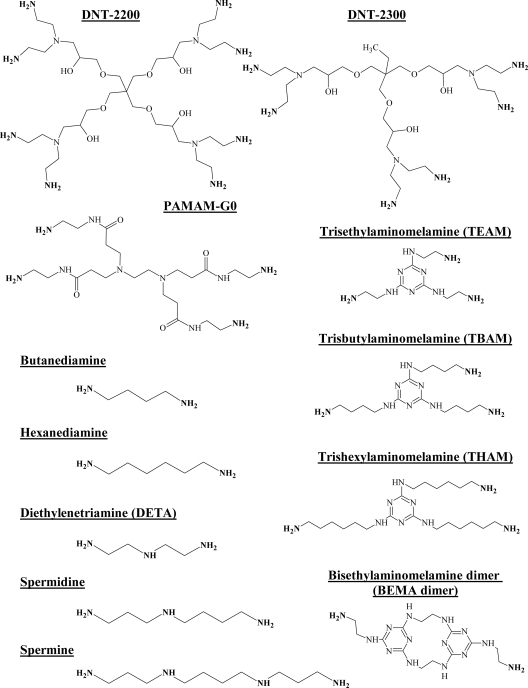
FIG. 1.
FIG. 1.
Synthetic starting materials. The structures of the starting material polyamines used to synthesize guanide, biguanide, and phenylguanide derivatives are shown. Reactive amines are noted in boldface.
FIG. 2.
FIG. 2.
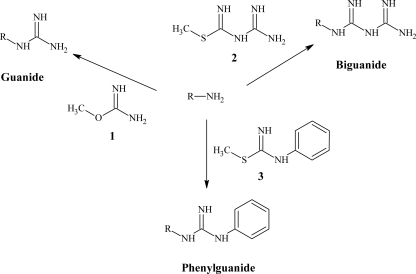
Generic synthetic reaction scheme. Primary and secondary amines treated with the reactive compounds O-methylisourea (compound 1), S-methyl-N-guanylisothiourea (compound 2), or S-methyl-N-phenylisothiourea (compound 3) give the desired guanide, biguanide, or phenylguanide derivatives.
FIG. 3.
FIG. 3.
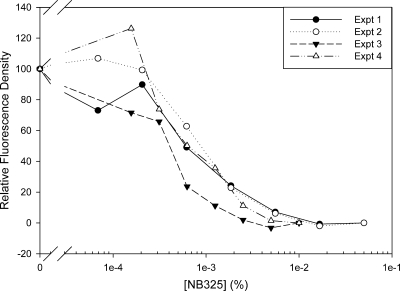
Inhibition of T140-fluorescein cross-linking to CXCR4. CXCR4-expressing cells were incubated with serial dilutions of the polybiguanide NB325 and then allowed to bind the fluorescent, photoactive T140 derivative. After irradiation at 365 nm, the samples were dissolved in SDS, run on an SDS-PAGE gel, and imaged with a fluorescent gel imager. Inhibition curves for four separate experiments with one reading per data point are shown.
FIG. 4.
FIG. 4.
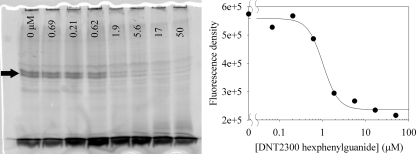
Representative inhibition experiment gel and graphical analysis. Serial dilutions of the inhibitor (DNT2300 hexaphenylguanide) were incubated with CXCR4-expressing cells. The fluorescent, photoactive derivative of T140 was added, followed by irradiation at 365 nm to induce cross-linking between the peptide and receptor. Samples were dissolved in SDS, run on an SDS-PAGE gel, and imaged with a fluorescent gel reader. The concentration of inhibitor is marked at the top of each lane. The intensities of the fluorescent CXCR4 bands (doublet indicated by arrow) were quantified and plotted with Sigma Plot to determine an approximate IC50 (∼1 μM). A Western blot of the gel incubated with monoclonal antibody 1D4 was used to confirm the identity of the CXCR4 bands and their uniformity across the gel (not shown).
FIG. 5.
FIG. 5.
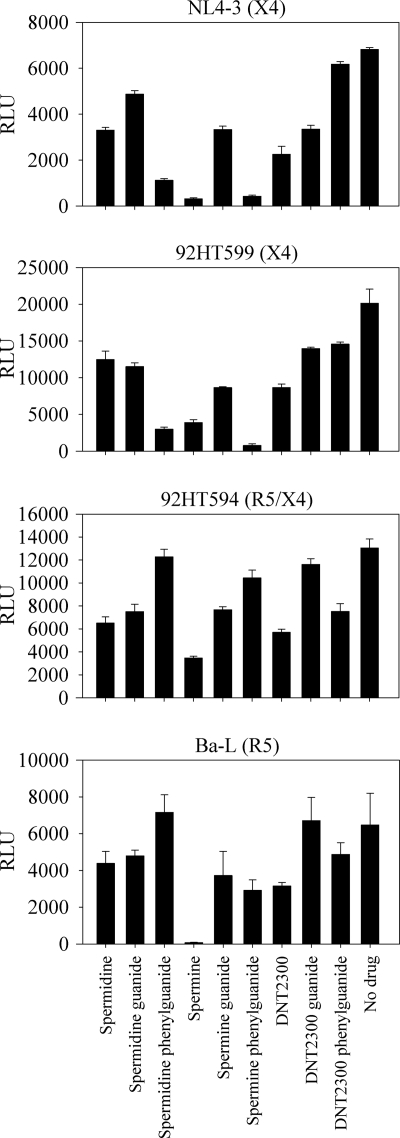
Initial anti-HIV activity screen. The series (amine, guanide, and phenylguanide) of the most active derivatives (spermidine, spermine, and DNT2300) in the T140 cross-link inhibition assay were screened for anti-HIV activity. TZM-bl cells were plated and preincubated with the inhibitors at a final concentration of 10 μM. Previously titered viral supernatants were added, and the cells were incubated for 3 days. Cells were lysed, and the TAT-driven reporter luciferase activity was measured using a Bright-Glo luciferase assay. Experiments were performed in triplicate with errors shown as means ± the standard error of the mean (SEM). RLU, relative luminescence units.
FIG. 6.
FIG. 6.
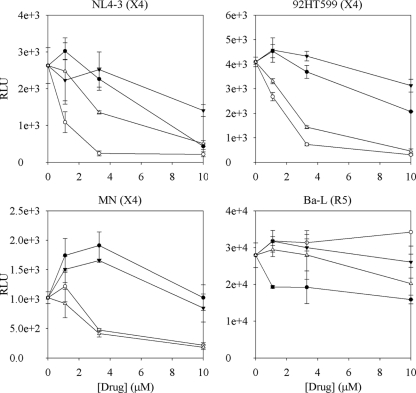
HIV inhibition dose-response trials. Spermine (•), spermine phenylguanide (○), spermidine (▾), and spermidine phenylguanide (▵) were tested for dose-response activity in the TZM-bl luciferase anti-HIV assay. Increased activity against CXCR4-using viral strains were observed with the phenylguanides compared to the underivatized parent amines. Experiments were performed in triplicate with errors shown as means ± the SEM. RLU, relative luminescence units.
FIG. 7.
FIG. 7.
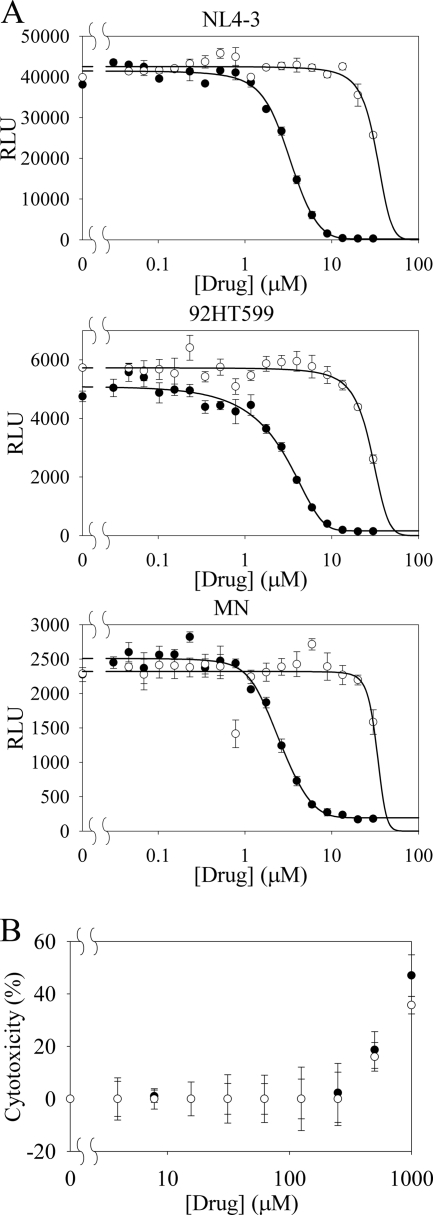
Spermidine phenylguanide activity and cytotoxicity. (A) HIV inhibition activity of spermidine phenylguanide (•) and spermidine (○) against three CXCR4 specific HIV clones (NL4-3, 92HT599, and MN) using the TZM-bl assay. Experiments were performed in triplicate with errors shown as means ± the SEM. RLU, relative luminescence units. (B) An MTS assay was used to measure the cytotoxicity (% of control TZM-bl cells) for spermidine phenylguanide (•) and spermidine (○) against the TZM-bl cells. Experiments were performed in duplicate with errors shown as means ± the SEM.

References

    1. Babcock, G. J., T. Mirzabekov, W. Wojtowicz, and J. Sodroski. 2001. Ligand binding characteristics of CXCR4 incorporated into paramagnetic proteoliposomes. J. Biol. Chem. 276:38433-38440. - PubMed
    1. Billick, E., C. Seibert, P. Pugach, T. Ketas, A. Trkola, M. J. Endres, N. J. Murgolo, E. Coates, G. R. Reyes, B. M. Baroudy, T. P. Sakmar, J. P. Moore, and S. E. Kuhmann. 2004. The differential sensitivity of human and rhesus macaque CCR5 to small-molecule inhibitors of human immunodeficiency virus type 1 entry is explained by a single amino acid difference and suggests a mechanism of action for these inhibitors. J. Virol. 78:4134-4144. - PMC - PubMed
    1. Catalone, B. J., T. M. Kish-Catalone, L. R. Budgeon, E. B. Neely, M. Ferguson, F. C. Krebs, M. K. Howett, M. Labib, R. Rando, and B. Wigdahl. 2004. Mouse model of cervicovaginal toxicity and inflammation for preclinical evaluation of topical vaginal microbicides. Antimicrob. Agents Chemother. 48:1837-1847. - PMC - PubMed
    1. Connor, R. I., K. E. Sheridan, D. Ceradini, S. Choe, and N. R. Landau. 1997. Change in coreceptor use correlates with disease progression in HIV-1-infected individuals. J. Exp. Med. 185:621-628. - PMC - PubMed
    1. De Clercq, E. 2009. The AMD3100 story: the path to the discovery of a stem cell mobilizer (Mozobil). Biochem. Pharmacol. 77:1655-1664. - PubMed

Publication types