


Effects of Heating Season on Residential Indoor and Outdoor Polycyclic Aromatic Hydrocarbons, Black Carbon, and Particulate Matter in an Urban Birth Cohort
- PMID: 20938487
- PMCID: PMC2951607
- DOI: 10.1016/j.atmosenv.2010.08.024
Effects of Heating Season on Residential Indoor and Outdoor Polycyclic Aromatic Hydrocarbons, Black Carbon, and Particulate Matter in an Urban Birth Cohort
Abstract
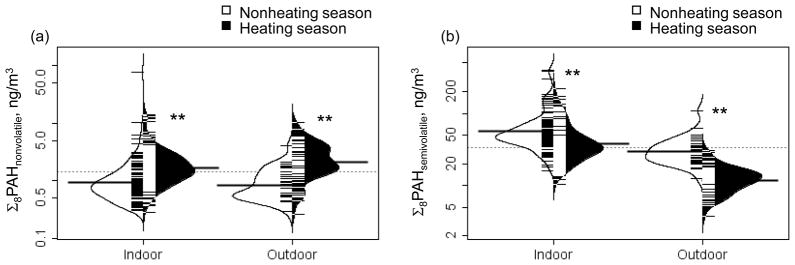
Exposure to air pollutants has been associated with adverse health effects. However, analyses of the effects of season and ambient parameters such as ozone have not been fully conducted. Residential indoor and outdoor air levels of polycyclic aromatic hydrocarbons (PAH), black carbon (measured as absorption coefficient [Abs]), and fine particulate matter <2.5 μm (PM)(2.5) were measured over two-weeks in a cohort of 5-6 year old children (n=334) living in New York City's Northern Manhattan and the Bronx between October 2005 and April 2010. The objectives were to: 1) characterize seasonal changes in indoor and outdoor levels and indoor/outdoor (I/O) ratios of PAH (gas + particulate phase; dichotomized into Σ(8)PAH(semivolatile) (MW 178-206), and Σ(8)PAH(nonvolatile) (MW 228-278)), Abs, and PM(2.5); and 2) assess the relationship between PAH and ozone. Results showed that heating compared to nonheating season was associated with greater Σ(8)PAH(nonvolatile) (p<0.001) and Abs (p<0.05), and lower levels of Σ(8)PAH(semivolatile) (p<0.001). In addition, the heating season was associated with lower I/O ratios of Σ(8)PAH(nonvolatile) and higher I/O ratios of Σ(8)PAH(semivolatile) (p<0.001) compared to the nonheating season. In outdoor air, Σ(8)PAH(nonvolatile) was correlated negatively with community-wide ozone concentration (p<0.001). Seasonal changes in emission sources, air exchanges, meteorological conditions and photochemical/chemical degradation reactions are discussed in relationship to the observed seasonal trends.
Conflict of interest statement
Figures


References
-
- Albinet A, Leoz-Garziandia E, Budzinski H, Villenave E, Jaffrezo J. Nitrated and oxygenated derivatives of polycyclic aromatic hydrocarbons in the ambient air of two French alpine valleys Part 2: Particle size distribution. Atmospheric Environment. 2008;42:55–64.
-
- Baek S, Goldstone M, Kirk P, Lester J, Perry R. Phase distribution and particle size dependency of polycyclic aromatic hydrocarbons in the urban atmosphere. Chemosphere. 1991;22:503–520.
-
- Bjorseth A, Ramdahl T. Handbook of polycyclic aromatic hydrocarbons: Emission sources and recent progress in analytical chemistry. Marcel Dekker 1985
-
- Boffetta P. Cancer risk from occupational and environmental exposure to polycylic aromatic hydrocarbons. Cancer causes and control. 1997;8:442–472. - PubMed
Grants and funding
LinkOut - more resources
Full Text Sources
Miscellaneous