Review
. 2010 Dec;12(6):465-70.
doi: 10.1007/s11894-010-0147-7.

Mechanisms of intragastric pH sensing

Affiliations
Review

Mechanisms of intragastric pH sensing

Tyralee Goo et al. Curr Gastroenterol Rep. 2010 Dec.

Abstract

Luminal amino acids and lack of luminal acidity as a result of acid neutralization by intragastric foodstuffs are powerful signals for acid secretion. Although the hormonal and neural pathways underlying this regulatory mechanism are well understood, the nature of the gastric luminal pH sensor has been enigmatic. In clinical studies, high pH, tryptic peptides, and luminal divalent metals (Ca(2+) and Mg(2+)) increase gastrin release and acid production. The calcium-sensing receptor (CaSR), first described in the parathyroid gland but expressed on gastric G cells, is a logical candidate for the gastric acid sensor. Because CaSR ligands include amino acids and divalent metals, and because extracellular pH affects ligand binding in the pH range of the gastric content, its pH, metal, and nutrient-sensing functions are consistent with physiologic observations. The CaSR is thus an attractive candidate for the gastric luminal sensor that is part of the neuroendocrine negative regulatory loop for acid secretion.


Figures
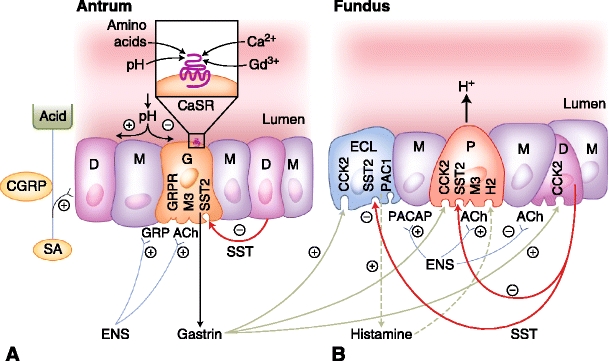
Fig. 1
Fig. 1
Hormonal and paracrine signaling regulating gastric acid with respective receptors. Antral gastric glands (A) contain G cells (G), mucous cells (M), and open type D cells (D). Fundic oxyntic glands (B) contain enterochromaffin-like cells (ECL), mucous cells (M), parietal cells (P), and closed-type D cells. The neuronal circuits from the enteric nervous system (ENS) with acetylcholine (Ach) release and selected neuropeptide output are also shown. Feedback control of acid secretion by extrinsic sensory afferent nerves (SA) of nodose and dorsal root ganglion origin includes calcitonin gene-related peptide (CGRP)–related somatostatin release, which indirectly decreases gastrin release (shown in A). The SA nerves monitor luminal acidity, decreasing acid output as pH decreases below 2.5 with reciprocal effects as pH increases. The calcium-sensing receptor (CaSR) depicted on the luminal surface of a G cell is in the family C of G-protein coupled 7 transmembrane receptors (A inset). Agonists include calcium and polyvalent cations such as gadolinium with activity modulated allosterically by L-amino acids and luminal pH. CCK2 cholecystokinin receptor 2; GRP gastrin-releasing peptide; GRPR GRP receptor; H 2 histamine receptor type 2; M3 muscarinic receptor type 3; PACAP pituitary adenylate cyclase-activating polypeptide; PAC1 PACAP receptor type 1; SST somatostatin; SST2 SST receptor type 2; (+) stimulating action; (−) inhibitory action. (Adapted from Wank [10].)

References

    1. Andersson S, Olbe L. Inhibition of gastric acid response to sham feeding in pavlov pouch dogs by acidification of antrum. Acta Physiol Scand. 1964;61:55–64. doi: 10.1111/j.1748-1716.1964.tb02942.x. - DOI - PubMed
    1. Barreras RF. Calcium and gastric secretion. Gastroenterology. 1973;64:1168–1184. - PubMed
    1. Behar J, Hitchings M, Smyth RD. Calcium stimulation of gastrin and gastric acid secretion: effect of small doses of calcium carbonate. Gut. 1977;18:442–448. doi: 10.1136/gut.18.6.442. - DOI - PMC - PubMed
    1. Feurle GE. Effect of rising intragastric pH induced by several antacids on serum gastrin concentrations in duodenal ulcer patients and in a control group. Gastroenterology. 1975;68:1–7. - PubMed
    1. Mazzacca G, Cascione F, Budillon G, et al. Parietal cell hyperplasia induced by long-term administration of antacids to rats. Gut. 1978;19:798–801. doi: 10.1136/gut.19.9.798. - DOI - PMC - PubMed

Publication types
